10.6. THE HOMECOMING OF AMERICA’S DIVA-ADELINA PATTI

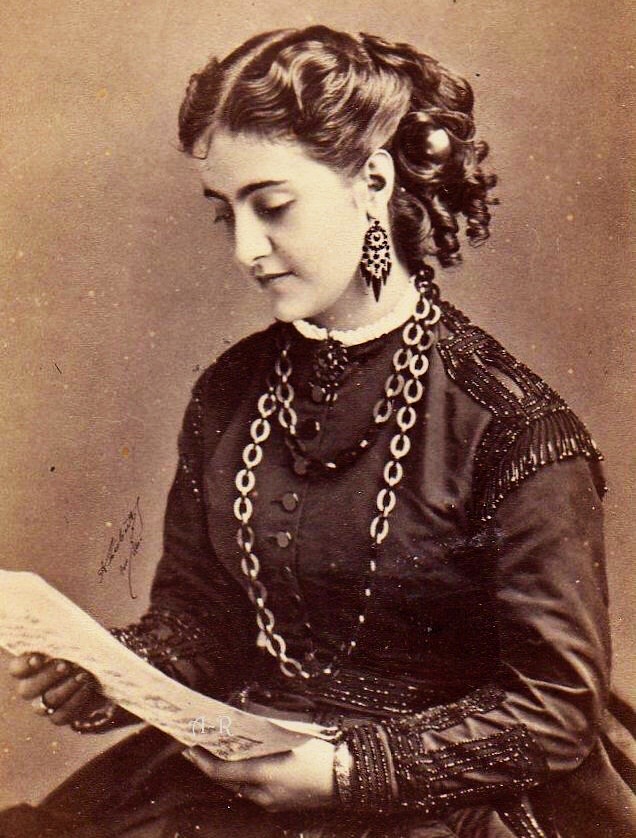
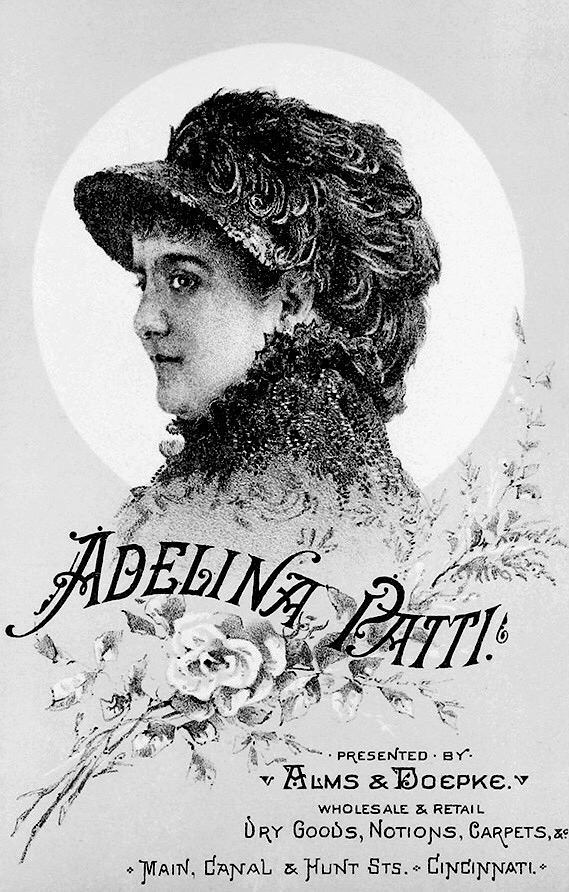
While Theodore Thomas had resigned from Cincinnati’s College of Music, he remained committed to the Cincinnati May Festivals throughout his life.  The overwhelming success of this biennial event had led Cincinnati’s cultural elite to expand into Grand Opera, seemingly in response to New York’s inception of the Metropolitan Opera.  Cincinnati had a head start in this competition, however, for while New York still had to construct a major music hall for Grand Opera, Cincinnati already had its majestic Music Hall.  Mapleson was named the impresario of the Cincinnati Grand Opera Festival and convinced to bring his star, world-famous soprano Adelina Patti, along with his Covent Garden troupe in February 1881 to Music Hall. Although born to Italian parents who at the time lived in Spain, the family had moved to New York where she learned to sing, making her operatic debut at the Academy of Music in 1859.  At the age of 16 she had been brought to London by Mapleson to make her European debut, where she remained for the next twenty years. Finally, in February 1881 Mapleson brought her back to the U.S. for a homecoming tour.  I cannot ascertain whether she played first in New York, which is what I expected happened, or she debuted in Cincinnati.  Either way, her appearance assured Cincinnati’s huge auditorium would be packed to the rafters, shaming Chicago’s music community to react as best it could. (It was reported that some Chicago opera buffs had taken the train to Cincinnati to hear the diva.)
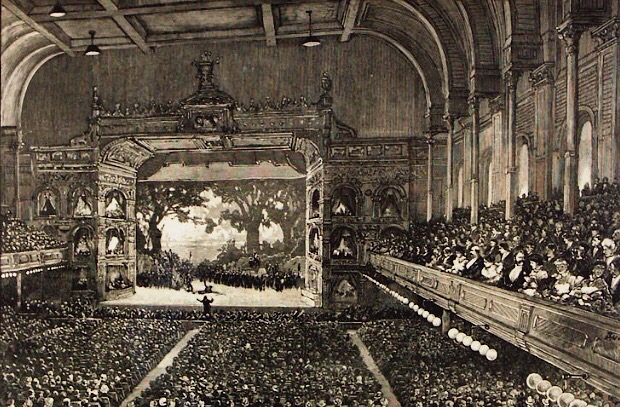
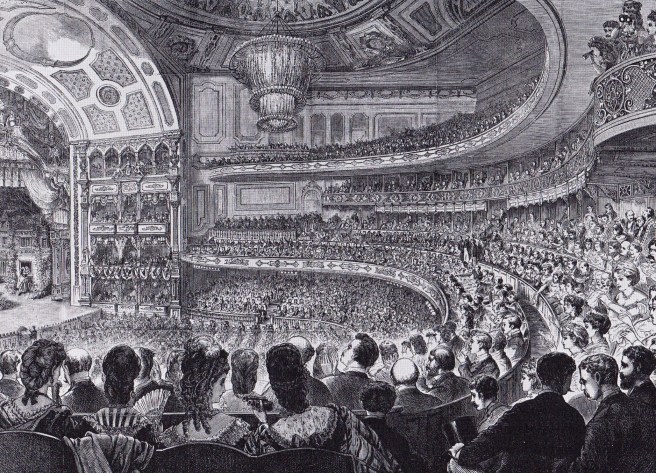
Opening Night of the First Cincinnati Opera Festival, Feb. 21, 1881. Drawing by H. F. Farny. (Online)
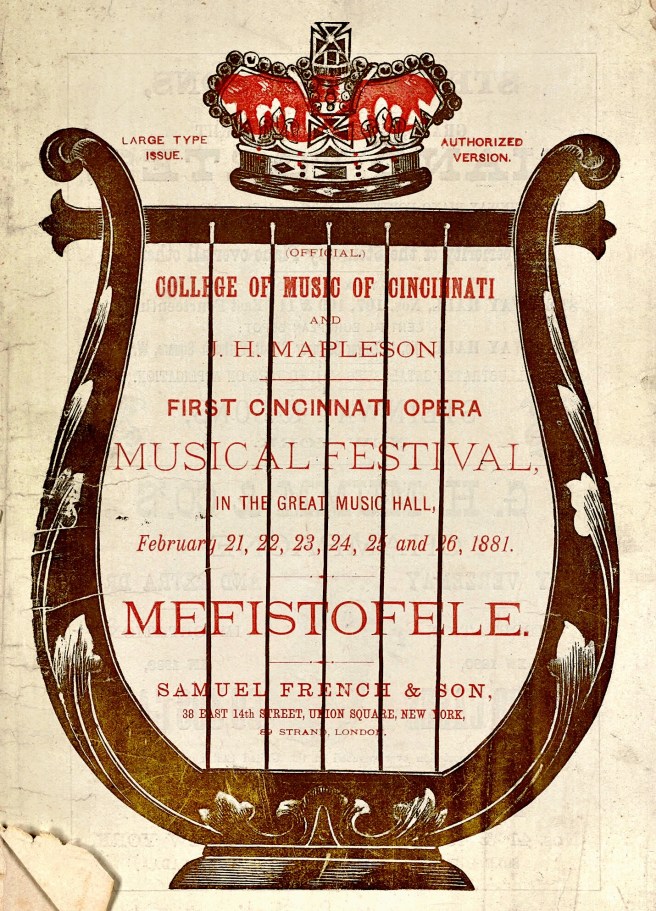
First Cincinnati Opera Festival, Libretto for Mefistofele. Feb. 21, 1881. (Online)

Meanwhile, Mapleson would continue to bring his Covent Garden troupe, sans Patti, each January to Chicago to play in Haverly’s Theater (note that the new Central Music Hall was not used by Mapleson) to smaller and smaller crowds each year. N. K. Fairbank once again reacted to the events in Cincinnati by organizing the Chicago May Festival Association that same February of 1881, while Cincinnati’s first Grand Opera Festival was in full force, to plan a music festival for the following year similar to Cincinnati’s eight-year-old May Festival, including inviting its disillusioned director Theodore Thomas to lead it.  As local choral groups rehearsed, the Tribune mused “whether Chicago in the future will have a chorus distinctively its own, and as intimately identified with the city as the Cincinnati chorus is with that city.” Mapleson returned to Cincinnati with Patti in February 1882 for the second Cincinnati Grand Opera Festival, where she once again enchanted all who heard her sing the role of Aida on Valentine’s Day and closed the Festival on Saturday, Feb. 18, in the role of Leonora in Verdi’s Il Trovatore.  So Patti had played Cincinnati twice before Chicago could stage its first May Festival. 

10.7. THE CHICAGO 1882 MAY FESTIVAL

The following month, meanwhile, saw Chicago’s Socialists commemorate the eleventh anniversary of the Paris Commune with another “monster rally” in the Interstate Industrial Exposition Building in March 1882, only two months before Fairbank’s May Festival Organization was scheduled to use the same building to house the first Chicago May Music Festival during May 23-6, 1882.  In essence, the struggle over the Expo Building in 1882 summarized the battle being waged in Chicago between its business elites and the city’s growing Socialist movement.  Fairbank once again turned to his trusted friend, Dankmar Adler to design a temporary hall in the antiquated Expo Building for the 1882 May Festival.  Adler was given the south end of the building for his installation that comprised of a sounding board similar in design to the one Thomas had designed back in 1877, and seating for 6500 built in sections on raised platforms.  Access tunnels to the seats were painted in a variety of colors that matched the tickets so that the audience could easily locate their seats.  Adler’s valiant attempt notwithstanding, however, the vast Expo Building had not been designed for musical performance and the music simply disappeared into the air:

“The people were there; but did not hear the music… It may be reasonably doubted that more than ten percent of those who were present heard any soloist as they should all have been heard, or felt the chorus and orchestra [carry] to their ears the complement of harmony necessary for genuine pleasure… The readiness with which business men advanced the cost of the festival, and the actual popularity of the concerts, even in severe weather, indicated that Chicago people are eager to enjoy music of the highest character.  They have not yet had an opportunity to do so… The opportunity cannot arrive until a suitable structure, like that of which Cincinnati justly boasts, shall be erected.”

The final kiss of death for the concerts that May was provided by the Illinois Central locomotives as they whistled and chugged by during the performances less than 100’ to the east of the glass-enclosed structure…

10.8. FAIRBANK FAILS ONCE MORE TO GARNER PRIVATE MONEY TO BUILD A MUSIC HALL IN CHICAGO

Nonetheless, encouraged by the over the 45,000 who had attended the festival during the four days in May, Mapleson finally brought Patti to Chicago for her debut the following January 1883.  The successive reduction in ticket sales that he had been forced to swallow over the past two of his annual Chicago appearances in Haverly’s Theater, however, led him to lease the smaller McVicker’s Theater (1800 seats vs. 2500 seats) to insure a sold house at the higher price that a Patti performance would command.  The $20 price for all six nights, in which Patti made but only one appearance, precluded all but the very rich from attending what many had thought should have been uplifting entertainment for those in the middle and lower classes, some of which had attended the preceding May Festival.  If these people were ever to enjoy such entertainment, Chicago would eventually have to erect a structure similar in size and acoustic quality to that of Cincinnati’s Music Hall:

“The Academy of Music needed [in Chicago] must be erected by public spirit alone [as was Cincinnati’s], for no one pretends to think or say that it will be a good financial investment.  It must be large, with excellent acoustics, central in location, with exits on three sides possible – nothing else can give satisfaction or benefit the community.  Such a building devoted to art and music would make it possible for the middle class to hear opera and not become paupers.”

Indeed, N.K. Fairbank as early as 1880 had pledged to give $100,000 towards a permanent music hall if nine other similarly-minded businessmen would each match his pledge.  None had come forward. (Remember that five years earlier Cincinnatian Reuben Springer had personally donated over $250,000 toward the cost of the Music Hall in 1877 during the lowpoint of the Depression.)  Following Patti’s Chicago debut, Fairbank, with the support of one or two other like-minded individuals, had again made this offer, but again Chicago’s leading businessmen were still simply too tightfisted to give this kind of money for a civic institution. 

10.9. THE FOUNDING OF THE METROPOLITAN OPERA

Josiah Cleveland Cady, Metropolitan Opera House, 1881. (Siry, Auditorium)

The contrast with New York at precisely this moment couldn’t have been starker.  While Chicago’s business leaders would not entertain Fairbank’s proposal, this was precisely what New York’s elites were doing in order to erect a new building for the new Metropolitan Opera.  Following the incorporation of the Met’s stock company in April 1880, seventy families had donated $17,500 each through the purchase of shares in the company to raise $1.2 million.  A loan of $600,000 completed the amount needed to construct the design of architect J. Cleveland Cady on the west side of Broadway, between 39th and 40th. It was completed in October 1883 with a capacity of 3,045 seats, many of which were located in private boxes that lined the first three galleries.  As opposed to Cincinnati’s Music Hall that was designed on the exterior to look like a music auditorium in its park-like setting, however, Cady had to design the Met’s exterior as a downtown business building, similar to Adler’s exterior of the Central Music Hall.  Its four-story central entry was flanked by seven-story pavilions on each corner whose upper five floors contained bachelors apartments, an inclusion to generate income towards the building upkeep.  
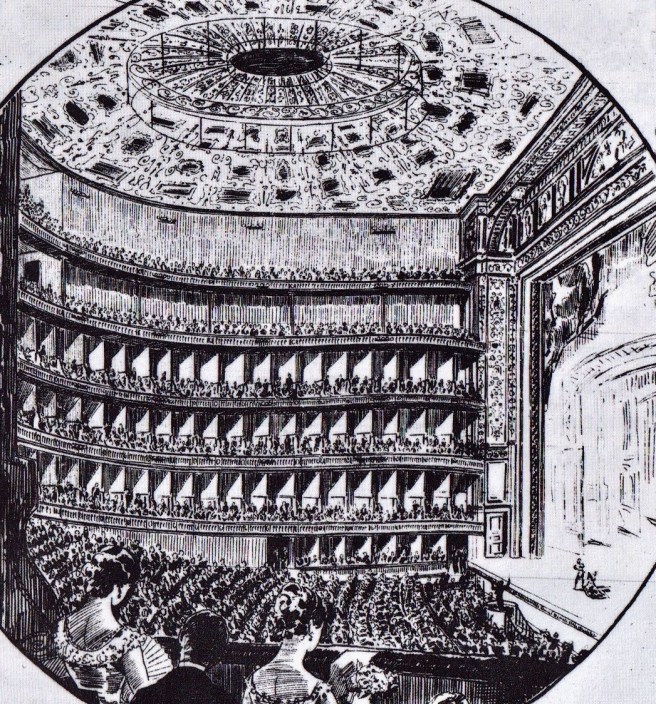
Josiah Cleveland Cady, Metropolitan Opera House, 1881. Note that private boxes line the first three galleries. (Siry, Auditorium)

As the Metropolitan Opera was established to be a rival for New York’s Academy of Music, where Mapleson’s Covent Garden troupe performed each November, an entire new opera company had to be formed in time for the opening of the new Metropolitan Opera building in October 1883.  This responsibility was given to Henry Abbey, the former manager of Edwin Booth’s theater, who arranged to have the premiere of the new troupe on October 22 with Gounod’s Faust, starring Patti’s rival, the Swedish soprano Christina Nilsson.  
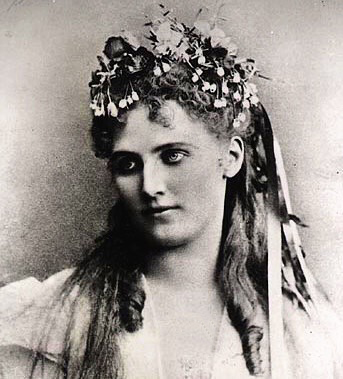
Christina Nilsson, (Online)

FURTHER READING:

Siry, Joseph M. The Chicago Auditorium Building. Chicago: University of Chicago Press, 2002.

(If you have any questions or suggestions, please feel free to eMail me at: thearchitectureprofessor@gmail.com)

10.4. MRS. ASTOR, MEET MRS. VANDERBILT

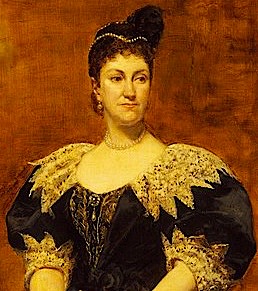
Alva Smith Vanderbilt (Mrs. William K. Vanderbilt) as she appeared at her 1883 costumed ball. (Online)

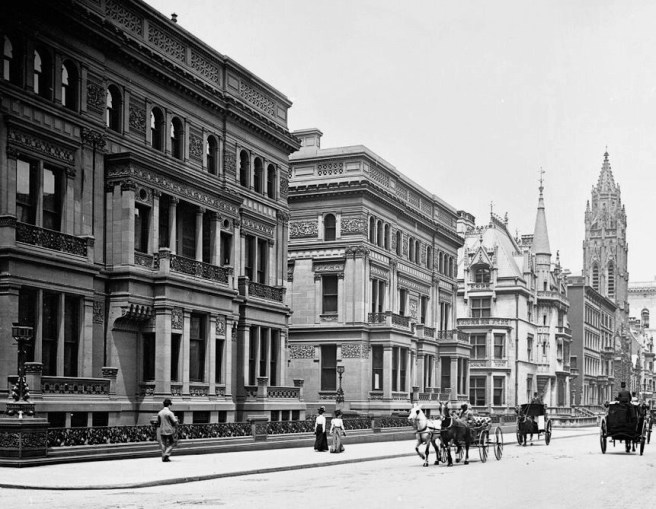
The leader of this next generation of New York’s elites was Alva Vanderbilt, wife of William Kissam Vanderbilt, the second son of the Commodore’s eldest son, William H.  William K. had married Alva Erskine Smith in 1875, the ambitious daughter of a New York commissions merchant who had business contacts in Europe.  While living in England during the Civil War, Mr. Smith had his daughter educated in a private school in Neuilly-sur-Seine, a northwestern suburb of Paris.  The new Mrs. Vanderbilt was not a person to cross swords with, as we shall she, and had set her sights on achieving the social status for the Vanderbilt clan among New York’s old money, knickerbocker social circles that she felt her family’s money and influence merited. The Commodore had died on January 4, 1877, leaving his son, William H., a rail empire that controlled virtually all of the traffic between Chicago and the Northeast.  The Commodore’s estate had finally been settled in April 1879, after which the Commodore’s son and his two eldest grandsons, Cornelius II and William K., took little time in spending a portion of their inheritances in erecting for each of themselves a spectacular mansion along Fifth Avenue just south of Central Park, eventually creating what was known as “Vanderbilt Row.”  (See Vol. 2, Sec. 5.17)

Vanderbilt Row: Fifth Avenue and 51st, looking north. At the far left is the dual mansion of William H. Vanderbilt (son of Cornelius), designed by John Snook. Across 52nd street stands Hunt’s chateau for Alva and William K. Vanderbilt. (Online)

Once her husband’s share of the Commodore’s estate had been finalized, Mrs. Vanderbilt hired New York’s leading architect, Richard Morris Hunt, who also had very strong ties to France and was already engaged in the construction of her family’s new home on Long Island, Idle Hour, to design for her family the most luxurious of all New York mansions to sit directly across 52nd from the house that her father-in-law was building for his two daughters, in order to make sure the Vanderbilts could no longer be ignored by the city’s Knickerbocker social elite.  Mrs. Vanderbilt had not only chosen Hunt to design it, but also worked very closely with him during the design and construction of the mansion.  Mrs. Vanderbilt, as I noted earlier, had been educated in France, and, therefore, it is quite apparent that she had no interest in building an “American”-styled house, but wanted to emulate the taste of the French Aristocracy (pre-1789 of course). First announced in December 1879 and completed in late 1882 with a final price tag of $3 million (Potter Palmer had spent $3.2 million only eight years earlier building the entire Palmer House. One wonders what influence Alva’s new house had had on Bertha Palmer’s decision to build a new house?), it was renown as being the most expensive house ever built in the U.S. up to this time.

Richard Morris Hunt, William K. and Alva Vanderbilt House, New York, NW corner of Fifth Avenue and 52nd, 1879. (Online)

Hunt used this blank check to produce an academically rigorous version of a French chateau whose style would soon be referred to as Francois I, that was not the typical nouveau riche overuse of decoration (a lá the Palmer House-hotel), but was still ostentatious while also being so historically accurate and well-designed that it immediately became the epitome of “good taste.” Francois I was Hunt’s favorite style, and the turret or tourelle with a conical roof, that he placed on Fifth Avenue, near the corner of the building, was his favorite detail:

“Hunt’s motive for using the corner tower was not practical; he did not seek to provide extra daylight.  His impetus was aesthetic.  A towerlike corner treatment tied his often disparate elevations together, emphasized the three-dimensional quality of the house, and served to “detach” the building from all-too-close neighboring buildings.  Not incidentally, it also served to draw attention to the building.”

Critics Montgomery Schuyler praised Hunt’s design as “brilliantly successful,” and Royal Cortissoz  pronounced it to be “an isolated triumph of lightness and vivacious beauty… It stands alone in all America.”  Overnight it became the model for countless other buildings during the decade.

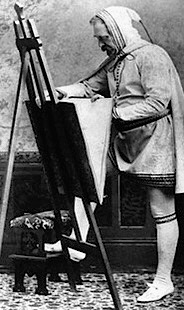
To introduce New York society to its new self-appointed fashion-setter, Mrs. Vanderbilt held a costume ball in her just-completed mansion on March 26, 1883.  An apocryphal story relates that she consciously did not invite Caroline Astor, the youngest daughter of Mrs. William Astor, Jr., (Caroline Schermerhorn Astor) the recognized queen of New York’s old social elite, “The 400,” who had snubbed the Vanderbilts up to this point as mere nouveau riche in the past, in order to force Mrs. Astor to first call upon her at her new house in order to secure an invite and not be left out of THE social event of the year. Whether true or not, Mrs. Astor had called on Mrs. Vanderbilt before the ball, and did attend, with her daughter, the ball that the New York Herald described the following morning as “probably never rivaled in republican America and never outdone by the gayest court of Europe.”  Continuing the parallel with France, it was as if the Empress Eugénie, Napoléon III’s wife and consort, had simply transplanted herself in the New World following the fall of the Second Empire.  New York City’s new fashion leader had only just begun her long career and influence.

Richard Morris Hunt as costumed to be “Cimabue” for the Vanderbilt costume party, 1883. (Baker, Hunt)

10.5. NEW YORK CONSOLIDATES ITS CENTRALITY IN AMERICAN MUSIC: THE METROPOLITAN OPERA AND THE PHILHARMONIC

Josiah Cleveland Cady, Metropolitan Opera House, 1881. (Siry, Auditorium)

Mapleson’s second New York Opera Festival was scheduled for November/December 1879.  Alva Vanderbilt’s husband had just received his share of his grandfather’s estate back in April and she was about to announce Hunt’s design for their new house, planned to be the most expensive house in the country.  Yet she could not buy her way into one of those eighteen private boxes in the Academy of Music for the Opera Festival so that she could also show off her new wealth among New York’s elite.  So be it!  Together with similarly stymied nouveau riche families, they banded together to establish an entirely new opera organization and to build an appropriate building to house it.  Thus, New York’s famous Metropolitan Opera was born in April 1880.  This spat among New York’s upper society had paralleled a similar power struggle in Cincinnati, (1880) where Theodore Thomas had taken his charge to develop the Cincinnati College of Music very seriously, but had run into a brick wall as his vision of an elite school on the European model funded by an endowment, conflicted with that of the College’s Board of Directors, led by Maria Longworth Nichols’ husband, George Ward Nichols, who planned to run it on the American model of charging tuition to all that could afford it.  After a year and a half of building the best music program in the country, Thomas was disillusioned by the CCM Board’s lack of vision, resigned in March 1880, one month before the organization of the Metropolitan Opera, and returned to New York to pick up the baton of the New York Philharmonic once again.  Thus ended Cincinnati’s chance to become the music capital of the United States, and just maybe, the world as well (to Chicago’s good fortune as we will soon see):

“[The college] was nevertheless rapidly being developed on university lines, and it is reasonable to suppose that the man who could achieve such important results in the short period of eighteen months, would eventually have carried it to its logical conclusion, had time, money, and authority been given him.  Unfortunately, none of these essentials were at this command in the Cincinnati College of Music.  But, in spite of the handicap under which he worked, the close of the first season of the College, found it a thoroughly organized school, possessing, in addition to the customary departments of such institutions, a chorus of three hundred thoroughly trained voices, a fine string quartette for chamber music, and a symphony orchestra [not to mention the largest Music Hall in the country].  In short, with these advantages, and the biennial May Festivals already established, Cincinnati had only to go on as it had begun and it would soon have become, in very truth, the leading musical center of America and one of the foremost in the world.”

Thus, by April 1880, New York had taken the needed steps to establish both the Metropolitan Opera and the New York Philharmonic that would become the premiere American musical organizations that they are today.

FURTHER READING:

Siry, Joseph M. The Chicago Auditorium Building. Chicago: University of Chicago Press, 2002.

(If you have any questions or suggestions, please feel free to eMail me at: thearchitectureprofessor@gmail.com)
CHAPTER 10. CULTURE VS. SOCIALISM: THE THEATERS OF ADLER (AND SULLIVAN)

10.1. THE CHICAGO OPERA HOUSE OPENS TO LESS THAN RAVE REVIEWS

Cobb & Frost, Chicago Opera House Block. Plans of Main Floor and Balcony of the House. (Siry, Auditorium)

In August 1885, the Chicago Opera House opened to less than stunning reviews.   The first auditorium designed by Cobb & Frost was to house the “spectacular extravaganzas” staged by impresario David Henderson, staged to awe middle-class audiences with glitz and over-the-top special effects.  Apparently, Cobb & Frost could not resist competing with Henderson’s “lack of good taste.”  One critic excoriated its gaudy interior decoration: “every advantage has been taken of the color scale, so as to obtain the greatest amount of glitter and glare.  There is a want of repose – some cool spot to rest the eye upon.  An endeavor has been made to gild refined gold and paint the lily, and the feeling aroused is more one of astonishment than admiration.”

While the negative response to their aesthetics could have been waived off as being subjective, Cobb & Frost’s lack of experience in the actual physical design of an auditorium was suffered by all who were crammed into its 2300 seats, as related by two critics: “By the way the people on the sides of the balcony stand up and crane their necks to look at the stage it is evident that the construction of the many seats in that quarter will have to be revised” for it “impresses one as less open and airy than most of the other city theaters, more compact, something of agreeable appearance having been sacrificed to the purpose of getting as many people as possible as close to the stage.”  The theater’s owners had to admit their error in hiring a firm without any prior auditorium experience to design the theater and once the theater’s premiere season ended in June 1886, and hired Adler & Sullivan, who by this time had established themselves as the city’s leading theater designers, to completely remodel the auditorium’s interior.

10.2. THE FAILURE OF THE CENTRAL MUSIC HALL 

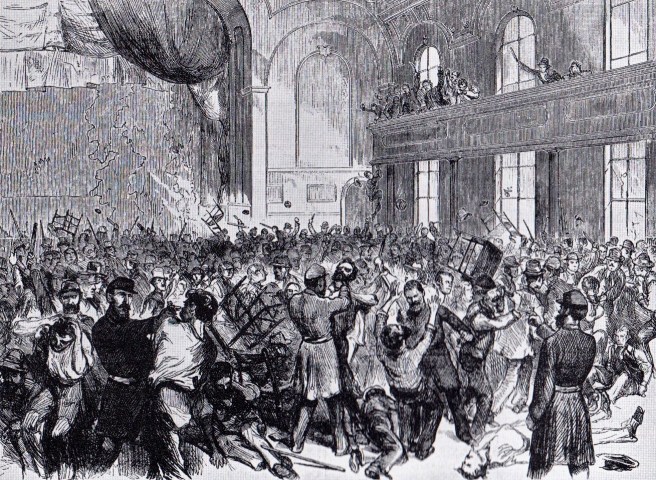
Police Break-up Meeting in Vörwarts Hall, Chicago, July 26, 1877. (Siry, Auditorium)

The one fact I did not discuss about the Opera House Block when I reviewed it in Sec. 8. 9 was the reason why the owners felt the need to build another large theater in Chicago in the spring of 1884? The time to do this has now come, and to do so we must first return to July 1877 when Maestro Theodore Thomas was in the midst of his concerts of the Chicago Summer Nights series held in the Exposition Center.  Joseph Siry has documented in his book on Chicago’s Auditorium building the interrelationship between the rise of Chicago’s Socialists in the post-fire city and the efforts of the ruling business elites to counter this with an agenda of European artistic culture, i.e. theaters and museums.  Charles Gregersen has cataloged the theaters designed by Dankmar Adler, along with the young Louis Sullivan, that were erected as part of this program in his monograph, Dankmar Adler: His Theatres and Auditoriums. I will combine the research of these two historians with my studies of the history of Cincinnati’s music and artistic scene to present the intense competition between New York, Cincinnati, and Chicago that occurred between 1877, when Cincinnati first embarked on the construction of its Music Hall, and when Chicago finally opened its Auditorium Theater some twelve years later on December 9, 1889.

Hannaford and Proctor, Cincinnati Music Hall. The Auditorium. Note the new organ, also the largest in the country at the time, including Boston’s then famous organ. (Painter, Music Hall)

Thomas’ concert series in 1877 was brought to an immediate halt and the remaining series cancelled by the Railroad Strike of 1877 and the protest/riots that ensued, especially those that broke out in Chicago between Friday, July 20 and Thursday, July 26.  The series promoters, George B. Carpenter and Nathaniel K. Fairbank attempted to make amends to Thomas for the interruption by having him perform a benefit concert on August 1, the proceeds of which were given to Thomas, but the damage had been done to Chicago’s campaign to entice him to move to the city.  Thomas would take up residence in Cincinnati in its brand new 4400-seat Music Hall the following year.

Adler, Central Music Hall. Interior. (Lowe, Chicago Interiors)

The police had brutally quashed these protest/riots that had resulted in the Socialists’ success in the November 1878 municipal elections that had upset the balance of power in City Council and had led to the Council’s forcing the Exposition Center’s owners to allow the Socialists to hold their massive rally in the building on March 28, 1879, to mark the eighth anniversary of the Paris Commune.  This threat to the business community’s control of the city had been met with the construction of the Central Music Hall as an attempt to not only respond to the success of Cincinnati’s Music Hall and to provide an alternative venue to the Socialist lectures around town, but also to provide an auditorium for the Rev. David Swing and his influential followers who had moved from the Fourth Presbyterian Church on the Near North side to McVicker’s Theater.  Dankmar Adler was commissioned to design the building in which he succeeded in providing a venue with excellent acoustics that had launched his career as Chicago’s premiere theater designer.  The first church service had consecrated the building on January 5, 1880.   The requirement that Adler had to design the interior primarily for Swing’s church services, however, resulted in the exclusion of a stage and provisions for scenery, in favor of a pulpit framed by the church’s large organ; there were no provisions or space for performances or scenery, and therefore, failed to provide an adequate venue to compete with Cincinnati.

10.3. JAMES MAPLESON BRINGS ITALIAN OPERA TO THE U.S.

Alexander Sältzer, New York Academy of Music, remodeled in 1866. Note there are only nine private boxes at each side of the stage. (Siry, Auditorium)

As Theodore Thomas was to orchestral music in the U.S., British opera impresario James H. Mapleson was the central name in Italian opera in the U.S.  In the mid-19th Century, there was no art form more important or influential than opera, a fact of which many 21st Century people are simply oblivious. It was the equivalent of today’s movies. In fact, it was the closest thing to a movie before the invention of electricity. Opera had drama, stage sets, special effects and lighting, sometimes dancing, and music, such great music. Richard Wagner understood this when he employed the term “gesamtkunstwerk“( total work of art) in his 1849 essay, “The Artwork of the Future,” in theorizing the ultimate union of drama, opera, art, and life. Paris had just opened its new Opera House in 1875. Wagner had completed his new house in Bayreuth the following year, with Cincinnati opening its Music Hall in 1878. Civic and national prestige were, quite simply, measured by one’s opera house.

Mapleson managed a number of London’s leading opera houses and companies, including Her Majesty’s and Covent Garden’s. As America’s economy had begun to improve towards the latter part of 1878, Mapleson had brought his London opera company first to New York, staging what he planned to be an annual opera festival in New York’s Academy of Music during the months of November and December, that he would then follow up with a national tour along a route similar to that taken by Theodore Thomas and his orchestra during the previous decade, making major appearances in both Chicago and Cincinnati. 

Oscar Cobb, Haverly’s Theater, Chicago, 57 W. Monroe. 1881. (Chicagology)

Mapleson chose the largest venue (2500 seats) in Chicago, the recently completed (opened on Aug. 4, 1878) Haverly’s Theater, designed by Oscar Cobb and located on the south side of Monroe between Dearborn and Clark, to initiate his annual national tour of his opera troupe in January 1879, establishing it as the site for Italian Grand Opera in Chicago. Following the city’s mediocre response in Chicago, Cincinnati’s Music Hall, with its 4400 seats had provided Mapleson with large profits, even though he had to lower the price of the tickets.  New York’s Academy of Music, the bastion of Manhattan’s old-monied elite society, however, was much smaller than Cincinnati, so Mapleson had charged exorbitant prices for tickets and still filled the house. The combination of the small number of seats and the high prices of those seats had only increased the frustration among those who enjoyed opera in New York.   But the Academy of Music had posed an even more significant obstacle for the city’s newly-emerging elites: there were only eighteen private boxes in the entire theater, and they were all owned by the old-monied knickerbockers.  There was no room for the newcomers to show off their wealth and good taste.

FURTHER READING:

Gregersen, Charles E.  Dankmar Adler: His Theaters and Auditoriums. Athens, Ohio University, 1990.

Siry, Joseph M. The Chicago Auditorium Building. Chicago: University of Chicago Press, 2002.

(If you have any questions or suggestions, please feel free to eMail me at: thearchitectureprofessor@gmail.com)

9.6. THE FORMATION OF THE ILLINOIS STATE ASSOCIATION OF ARCHITECTS

Two months after the W.A.A. convention, the Illinois State Association of Architects (I.S.A.A.) was formed as the W.A.A. chapter to parallel the Chicago Chapter of the A.I.A.  Burnham seemed (or wanted) to be in complete control, as he was the first to nominate candidates to each of the Executive positions.  He first nominated Adler to be president, who quickly deferred to the candidacy of W.W. Boyington as president, dutifully recognizing him as Chicago’s leading architect, as the Board of Trade neared completion:

“I do not know that there is a member of the profession here, whose services to the profession at large have been so eminent as those of Mr. Boyington.  There is no one among us who has handled such large buildings, whose professional practice has extended over so great an extent of country, and who has been so uniformly successful in professional practice, and I think we, perhaps, owe it to one who has been the most successful among us that we recognize that success by calling him to the head of this association.”

Even Burnham had to admit the truth of Adler’s sentiments, and so seconded Boyington’s nomination.  Burnham then nominated Adler for vice-president, to which position he was elected, after which Burnham was elected second vice-president.  Burnham kept the power all in the family by successfully nominating Root to be chairman of the Association’s Executive Committee.  The I.S.A.A.’s monthly meetings provided the venue for the city’s leading architects to express and debate their viewpoints on a variety of theoretical and professional issues. Therefore, with Burnham as chairman of the W.A.A. Board of Directors, and Root as chairman of the I.S.A.A. Executive Committee, the dynamic duo was ready to dictate their agenda of the West’s direct challenge to the prestige and power of the eastern establishment.

9.7. THE CHICAGO ARCHITECTURAL SKETCH CLUB

C.A.S.C. Membership Card. (Hasbrouck, Architectural Club)

McLean appears to have been a ball of energy.  No sooner had he succeeded in getting the WAA off the ground then he turned his efforts to assisting the city’s “draughtsmen” in creating a similar professional organization.  At this time the term applied to almost everyone working in an office who was not an “architect:” from the mature, head of the drafting room to the newest hire.  In the longstanding tradition of the apprentice system, such an association would allow its members to continue working during the day while they improved their knowledge and skills during the evenings.  This was especially important at this time as the area’s universities (University of Illinois-started in 1873 with Nathan Ricker; University of Michigan-had fitfully started in 1876 with Jenney) were slowly developing their own architecture programs, but it would take a while before these programs would deliver the prerequisite new talent needed by Chicago’s burgeoning building campaign.

Other cities, noteworthy among them being New York and Boston, already had such organizations for draughtsmen and McLean published a letter from 42-year old James H. Carpenter, a local draftsman, published under the name “T-Square” in the Feb. 1885 issue of Inland Architect, inviting individuals interested in forming such a group in Chicago:

“Will you please consider the proposition to invite the draughtsmen who desire to form a sketching club, to send their names directed, if you please, to yourselves, or to “T-Square,” in care of your office?  The intention is to commence at once.”

McLean editorially followed up with: “The idea is a good one, and if properly organized and conducted by the right parties, cannot but result in a permanent and increasing good.”  He then offered his office for the group to meet that occurred on Feb. 26, with McLean acting as the temporary chairman.  Eighteen men attended and all had the same idea: this was not to be a trade union, for they considered themselves as professionals.  Two weeks later this group met again in McLean’s office to hammer out a constitution under his direction.  Henry Lord Gay once again stepped up to the plate by offering the free use of the meeting room in his Builders’ Exchange (the same spot where the first W.A.A. convention had taken place only five months earlier) and the first official meeting of the Chicago Architectural Sketch Club took place on April 13, 1885.  

So that by May 1, 1885, when the new Board of Trade, as did many of the new skyscrapers opened in Chicago, the city’s architectural community had put into place a complete system of professional education and development for its entire population: from the lowliest draftsman to its established leaders.  Jenney would give history lectures at the University of Chicago and Root, among others, would present papers on theory and practice at the I.S.A.A.  All of these talks would be reprinted for all to read in the Inland Architect.  The last ties to the East had been severed.  This, by no means, meant that Chicago would develop its architectural ideas on its isolated own, as some historians have argued.  It only meant that Chicago architects no longer had to rely on information filtered by East Coast prejudices, especially as printed in Boston’s American Architect.  

Chicago would be well versed on the latest ideas from Europe, as I have mentioned earlier: Jenney, the graduate from Paris’ École Centrale des Arts et Manufacturers, could speak firsthand of Viollet-le-Duc’s ideas. Root, having studied in Great Britain and then graduated from NYU’s Civil Engineering program, would be joined by Peter B. Wight in promoting the ideas of Owen Jones and the British Design Reform Movement. Frederick Baumann and Dankmar Adler would present Gottfried Semper’s and other German writers’ ideas on architecture. And a few years later, Louis Sullivan, who had spent just enough time at both William Ware’s MIT program and at Paris’ École des beaux-arts to develop his own ideas about each program’s plus and minuses, would eventually join this august brew of modern architectural thought.

9.8. THE AIA RESPONDS

The A.I.A.’s response to the success of the W.A.A. convention was one of accommodation, rather than confrontation, although in truth, there was no alternative.  The Board of Trustees forwarded their congratulations: “[We] trust that the Western Association of Architects will be the means of accomplishing much good, and that the A.I.A. and the W.A.A. will long continue to work together in harmony in the development of our national architecture.” American Architect was more direct in its report of the convention:

“We take sincere pleasure in learning of the complete success of the movement for establishing a western association of architects… the feeling of the gentlemen present seems to have been unanimously in favor of the establishment of an association working in concord with the American Institute of Architects, but representing the interests of the profession in the West.  Although the American Institute has had no more valued or useful members than many of the Western architects, its influence has been unquestionably too remote to give that moral support which professional men need.  Even Eastern architects find the authority of the Institute less substantial, so far as regards its effect upon their individual business, than that of their local societies, and to their brethren in Chicago and St. Louis the quarterly meetings of the Trustees in New York are of still less practical service, so that the formation of a professional body in the West, which should unite the direct influence exerted by home associations with the authority conferred by a large membership, was, if not yet absolutely necessary, at least most fortunate;”

In response to the charge that the A.I.A. had become solely East Coast-oriented, the A.I.A. decided to hold its 1885 convention in Nashville, only the second time in the past twelve years that it had been held west of the Allegheny Mountains.    The choice of a southern city was wise in that it was not a direct challenge to the W.A.A.’s territory in the West yet tried to show that the A.I.A. could operate further west than its recent history indicated.  Nonetheless, the Institute was in such a sorry state that only 30 members attended the convention in October.  Even worse, the annual reports of the “Chicago and Cincinnati chapters” (if they could still be considered as such) indicated how low the Institute had fallen:

“Chicago Chapter reported meetings once a year for the election of officers.

Cincinnati Chapter reported few meetings, except when a member died though all were not dead yet.”

Two architects from Chicago were actually made Fellows at this convention.  Jenney was finally rewarded for his long-time faithfulness to the cause by being “promoted” to fellowship, while F.M. Whitehouse was elected as a new fellow. The writing was on the wall with regards to the emerging power of the western architects, and to the credit of the A.I.A. Trustees, they recognized as much in their annual report to the convention:

“It would seem desirable that some effort be made to bring about a closer relationship between the architectural associations of this country, The American Institute of Architects and the Western Association.  To this end it seems but proper that some advance be made by the American Institute of Architects as the oldest organization of architects on the continent.  As a means to that end, it would seem desirable that this convention take some action looking to a representation, through a regularly appointed delegate, at all conventions of architectural societies throughout the Union, and that such be requested to send each a delegate to all conventions of the American Institute of Architects.”

The A.I.A. convention so acted, directing the Trustees to appoint a delegate to the W.A.A. convention the following month. More than likely, this action was in response to the presence of McLean at the A.I.A. convention.  Although feigning neutrality in his official capacity as the editor of Inland Architect, he acted as an unofficial liaison between the W.A.A. and the A.I.A.  His specific interest was the A.I.A.’s initiative to reform the federal government’s procedure of erecting buildings through the office of the Supervising Architect in the Treasury Department.  After the convention had approved the A.I.A.’s version of a bill, section by section, McLean requested the privilege of the floor to ask that the convention postpone any further action on the subject until the W.A.A. could review the matter, to avoid a split in the professional community and provide a unified front in Congress.  The A.I.A.’s weakened position was such that although the bill was adopted as the views of the A.I.A., it was voted that the trustees should meet with a committee from the W.A.A. to finalize the bill before sending it to Congress.  The West had won its first battle.

9.9. THE 1885 WAA CONVENTION: COMPETITION REFORMS

A month later, 73 members of the W.A.A. met in St. Louis, in what President Illsley in his opening address claimed to have been “much the largest gathering of architects our country knew.”  Even in the presence of the A.I.A.’s official delegate, A. J. Bloor from New York, Illsley could not contain his pride in boasting that the W.A.A.’s membership of over 250 far surpassed that of the A.I.A.:

“The infant is now a year old, and we think it has grown so well that it may fairly claim its right to wear adult clothing.  Who of the architects now present, or who of the smaller body which met last November… could have dreamed that a year later the newly-born Western Association of Architects would assemble in these commodious quarters in the City of St. Louis, with an active membership greater than that of any similar body in these United States?  Who could have thought that its first birthday party would bring together the largest convention of architects ever seen in this country?”

Burnham and Root were at the forefront of the meeting, with Root giving the W.A.A.’s official response to the St. Louis delegation’s opening welcome.  Burnham took the floor in the afternoon session to lead the floor fight to adopt his committee’s drafted Code for architectural competitions, that he, along with Root and Illsley, had helped to write during the intervening year between the two conventions.  In essence, it required: submissions by all competitors to be uniform; a three-man jury of experts; a custodian to be appointed who would check all submissions before they would be forwarded to the jury; the cost of the winning entry to be verified to be within the allotted budget prior to a final announcement; the winning architect to be guaranteed to be contracted to design the building; and that the drawings of the unsuccessful entries would be immediately returned to the respective architects without any part of these designs being used in the final building, without the consent of the designer.  The Code, as adopted by the convention, would result in reforming some of the more infamous “evils” that architects, especially Burnham and Root, had encountered in past competitions.

The other major business item for the convention to consider was a response to the A.I.A.’s bill to reform the Government’s office of Supervising Architect.  The W.A.A., especially Burnham, differed with the A.I.A. on a few important points in the proposed legislation being drafted for congressional action, as was revealed in McLean’s actions the previous month at the A.I.A. convention.  The chairman of the W.A.A.’s standing committee charged with this issue was Adler, who had apparently bowed to the A.I.A.’s viewpoint in composing the draft that was presented to the convention for its adoption:

“Mr. Bloor is here with us… He has not come with positive power to agree to the several concessions which we have thought it advisable to ask him to make.  We have put the bill as reported in the shape which he believes, with his present knowledge, of the wishes of the directors of the directors of the American Institute will meet with the approval of that body.”

Burnham, however, had in mind other tactics, similar to those of McLean’s at the A.I.A. convention, when he moved:

“that it be referred to a committee appointed by the chair, the committee to have charge of the bill, with power to draft its final form without further reference and as it shall seem best to them… and if it shall become necessary, for a conference with another committee appointed by the A.I.A.”

The convention was swayed to Burnham’s strategy and Illsley appointed Adler, Burnham, and John F. Alexander as a committee of three to meet with the A.I.A.’s corresponding committee.

Apparently, it was Root, however, and not Burnham, who, of the two partners, was the more respected by his peers, for while Adler was nominated to be the second president of the W.A.A., Root was nominated as the secretary.  With another Chicagoan, S. A. Treat, nominated as treasurer, Burnham and Root’s earlier anticipation of resentment among the out-of-town architects proved well-founded, for there were grumblings about the “Chicago clique” in the new organization, which Charles Ramsey, from St. Louis, rose to dispel prior to the election of officers:

“It has been drawn out since this convention assembled-several hints that I have heard around at various places-that this convention was run entirely by Chicago and Chicago men, but I do not think anything of the kind.  I will admit that on the face of it, the convention would appear to be run by Chicago men…[but] while the convention has been handled and managed to a great extent by men who have come to St. Louis from Chicago, they have not managed the convention in the interest of Chicago, nor in the interest of any Chicago clique… I would ask the gentlemen to put aside any personal animosities that might possibly be lurking in their brains.  I don’t know that there any; but I speak of this from the fact that I have heard it said that there was a little disposition by Chicago men to run this, and I wish them to put that entirely aside.”

Burnham thus rose in righteous indignation:

“Gentlemen of the convention, the remarks of Mr. Ramsey are a surprise.  Until he spoke just now I had no idea there was such feeling.  That there be is unjust.  The Board of Directors has taken special pains to avoid anything that should make an impression of this sort… If any one has the slightest notion that there was any such feeling among Chicago men, I beg him to dismiss it… “

Thus said, the convention approved the slate of new officers from Chicago.  While Burnham and Adler marched off to work with the A.I.A. to reform the government’s design process, Root would be coordinating all W.A.A. correspondence, in addition to preparing winning designs under the new competition code.


FURTHER READING:

Hasbrouck, Wilbert R. The Chicago Architectural Club. New York: Monacelli Press, 2005.

(If you have any questions or suggestions, please feel free to eMail me at: thearchitectureprofessor@gmail.com)
9.4. THE CALL FOR A CONVENTION

The call for such a convention was rather single-handedly promoted by McLean, who continued to agitate during the summer of 1884 for the formation of the new organization with monthly articles in Inland Architect.  While continuing to criticize the A.I.A.’s practices, McLean’s view of the new Western organization was not as a national competitor for the A.I.A. (for the A.I.A. had no “national” following at this time), but as a regional sister organization to promote in the West the causes that the A.I.A. championed in the East:

“The American Institute has for many years sought to enlist the interest of the profession in the West, but has failed to do so in any general or active sense.  Seeing this, and realizing the benefits of organization, many Western architects have expressed that an association distinct from, but in harmony with the American Institute, Western in spirit… would have the active support and co-operation of the West… There need be no conflict between an independent Western Association and the American Institute, both having kindred aims, one would aid the other.  With two distinct organizations a lively interest would be awakened and a healthful emulation be engendered, the West striving to outdo the East in the good work of establishing needed reforms.” 

While McLean still encouraged all western architects to attend the 1884 A.I.A. convention in Albany in the upcoming fall, realistically he had to note the reasons for the formation of the new organization:

“This movement is called forth, in a large degree, by the small attendance of Western architects upon the annual meetings of the American Institute; and though for the past few years Western members of that body have been requested to exert themselves in the work of increasing the attendance upon meetings of local chapters, the membership has not enlarged in a degree corresponding with the increase of the profession in the West, while the rolls of the Institute show that a large majority of names of Western members of former years have lapsed.  The Chicago convention is intended to in no way interfere with the existing institution, but to aid it in the work it has so long and creditably performed.  It is therefore apparent to the majority of the profession that the time has come when the architects of the United States should be more united in their action, and this can only be accomplished by the meeting of those who have the future architecture of the country in their charge.”

In August, Henry Lord Gay once again stepped forward to encourage the formation of this new association in Chicago by offering not only the free use of the Permanent Exhibition and Exchange of Building Material’s hall for the convention, but also to pay the entire expense of such a convention.  With the appropriate resources now secured, McLean called for the convention to meet in Chicago on November 12, 1884.  Since the A.I.A. had no authority in the West, its protest would have been counter-productive.  The response of the American Architect to the convention in the West was as cautiously optimistic in its support as had been McLean in his arguments for the convention:

“We trust that the response to the invitation will be general, and are sure that the Western convention will have the best wishes of all architects in the East, and, unless the invitation should be made less general, some of them are not unlikely to make an effort to express in person their fraternal sentiment.”

McLean’s diplomatic request that westerners attend the A.I.A. convention went unheard, for of the twenty-two architects who convened in Albany on October 22, all were from east of Cincinnati.  The comparative strengths of the two organizations were revealed in the relative sizes of their 1884 conventions.  While 22 architects attended the A.I.A. convention in Albany on October 22, 140 architects registered in Chicago three weeks later to form the Western Association of Architects.  None of the 87 who were from Chicago, would be more instrumental and involved with the formation of the W.A.A. than McLean’s close associates, Burnham and Root.

9.5. THE FORMATION OF THE W.A.A.: NOVEMBER 1884

A review of the minutes of the W.A.A. convention, discloses that Burnham, Root, and McLean, in the tradition of Chicago politics, had well-prepared their strategy and goals for the convention.  On the morning of Wednesday, November 12, 1884, McLean stood in front of the gathered throng and called the meeting to order.  He immediately nominated Burnham to be the temporary chairman to open the convention.  Before Burnham called for the election of a permanent chairman, he took the opportunity to deliver a long and inspirational oration on his vision for the new organization, in which he “hoped that the united efforts of us all will leave impressions which shall stamp a pure American spirit on the ages to follow.” Even though he modestly declined many early nominations and begged disinterest in the position, Burnham’s speech had achieved its objective: he sat triumphantly as Chairman in control of the convention at the end of the first day of the three-day meeting.

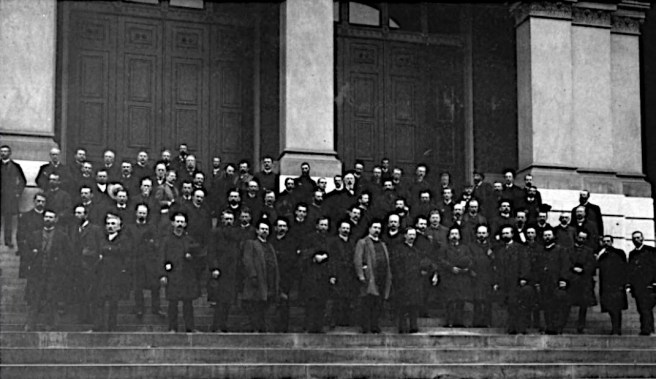
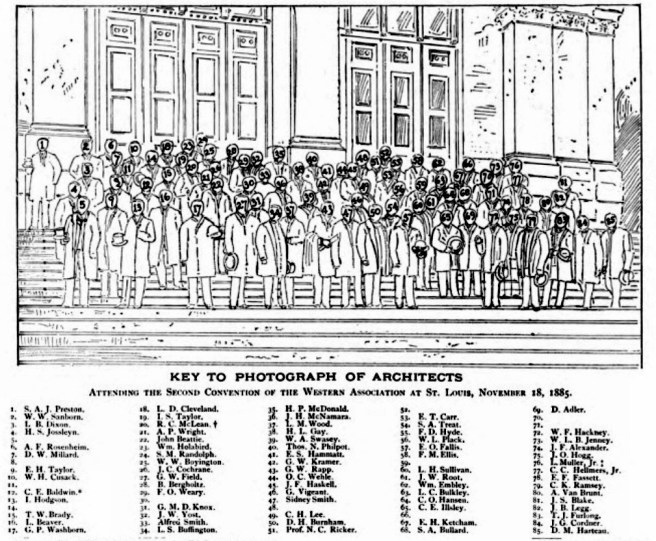
Attendees at the 1885 W.A.A. Convention, St. Louis. (Inland Architect, Feb. 1886)

To ensure the smooth running of the convention along their lines of thought, Burnham, Root, and McLean apparently enlisted, in addition to Gay, the cooperation of Charles K. Ramsey and Charles E. Illsley of St. Louis, and Isaac Hodgson of Minneapolis.  The group’s strategy for controlling the convention was to use motions that asked the chairman to appoint a committee of five to formulate draft resolutions for the variety of issues upon which the convention would vote.  One of the inside group of seven would quickly make such a motion, another would second it, and Burnham would proceed to appoint two of the group to a committee of five, one of them as chairman.  Hence, the size of the group of seven avoided any outward appearance of impropriety, for somebody different always managed to make the initial motion.  Nonetheless, for a convention comprised of 140 people from 14 states, it becomes indeed suspicious to find the Chairman appointing the same four names to sit on the convention’s four committees: Credentials-Hodgson(chair) and Illsley, Constitution-Ramsey(chair) and Hodgson, State Building Laws-Hodgson(chair) and Ramsey, and Competitions-Root(chair-don’t forget the Chicago Board of Trade fiasco: they hadn’t) and Ramsey.

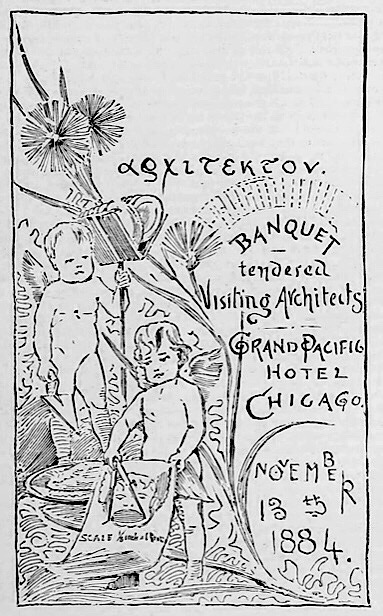
Program for the W.A.A. Banquet, Nov. 13, 1884. (Inland Architect, Nov. 1884)

The approved constitution reflected the differences between the West and the East.  There was to be only one level of professional membership in the W.A.A.: all members were to be known as Fellows (as opposed to the A.I.A.’s two-tiered rankings of Fellow and Associate).  The other major difference was that the organizational structure of the W.A.A. was to be hierarchical, consisting of local, state and the national associations.  This was in stark contrast to the A.I.A.’s recent decision to divest itself of its local chapters and remain a collection of individuals.

The main objectives of Burnham and Root, however, were specifically related to their business interests: competitions, fees and professional registration and ethics.  Obviously still outraged over American competition practices, including their loss in the previous year of the Chicago Board of Trade competition, it was the Committee on Competitions that was their main concern. Burnham had revealed his sense of frustration over competitions in his opening speech: “There are many things undoubtedly to come up for discussion… for instance… that frequent source of trouble, competitions.”  He, therefore, named Root as chairman of the committee with a charge to draft a statement on the subject overnight that could be voted on by the convention the next day.    Root returned the following morning with a sweeping reform of the American competition system, about which Burnham quickly stepped out of the chair to defend.  After much debate, the committee’s resolution: “That no architect should enter a competition for any building or other work, unless the decision of the competition shall be made by recognized experts,” was adopted for the coming year, pending a thorough review of the subject by a standing committee.  It should be no surprise, then, to find Illsley moving that the Chairman appoint a standing committee of five to further pursue the competition reform issue.  Henry Cobb added that Burnham should be one of the five, to which Burnham added Root and Illsley as chair.

In the spirit of true democracy (and shrewd politics), the end of the convention saw Root magnanimously lead a well-coordinated campaign to elect a non-Chicagoan as the first president of the W.A.A., thereby insuring the interest of a broad constituency for the western reform movement.  Not to worry, for Charles Illsley (St. Louis) was duly elected the first President of the W.A.A.  Leaving nothing to chance, however, Burnham then “suggested” that a committee be appointed to nominate the five members of the Board of Directors.  The convention having made and passed such a motion, Burnham appointed Hodgson and McLean to the committee, which quickly came back with the name of Daniel H. Burnham as Chairman of the Board of Directors.

(If you have any questions or suggestions, please feel free to eMail me at: thearchitectureprofessor@gmail.com)


9.3. IRRELEVANCY: THE PUSH TO FORM A NEW ASSOCIATION FOR ARCHITECTS IN THE WEST

Such was the atmosphere of “association fever” in Chicago immediately following the A.I.A.’s final divorce from its local chapters in late 1883.  The Chicago A.I.A. chapter at this time is best described as an ineffective collection of a few old architects who had been long devoted to the cause of the A.I.A.  It held no value for the city’s architects, as witnessed this letter by local architect H. R. Wilson, that was published by McLean in the March 1884 issue of Inland Architect:

“Can I trespass upon a little space in your interesting journal to express a want that I think has been in the minds of most Chicago architects for a long time, but each one, from lack of time or some other cause, is waiting for some one else to take the initiatory step in the direction of supplying that want, – which is an association of architects in this city.  We are far behind many less important cities in this respect, and should organize at once a strong, vigorous society of that character, and enroll as its members all worthy Chicago architects.”

Sidney Smith, an architect from Omaha, quickly expanded upon Wilson’s suggestion with a plan to organize the new local societies into a “Western Association,” that could serve a function not unlike that which the A.I.A. provided in the East:

“While I fully indorse all that Mr. Wilson has urged in support of his suggestion for the establishment of a society or association of architects in Chicago, may I be permitted to offer an additional suggestion – that is, to form it as a Western association, embracing the larger and fast-growing cities of the West, in which many architects of good standing and ability have located, and who from various causes are denied the privilege of attending or offering themselves as members of the American Institute of Architects in New York, would embrace the opportunity of doing so in Chicago, and thus be the means of uniting in future the men who are destined to make this the greatest nation of the earth. It will also infuse new life and energy to members of a profession who, more than any other, need unity of action and comparison or exchange of ideas.”

Such a veiled challenge to the A.I.A. establishment found deep sympathy throughout the ignored West, that, once united by McLean’s efforts, quickly rallied behind the issue and dispensed with diplomatic niceties, no longer being afraid to voice their complaints about the group of eastern architects who called themselves the A.I.A.  This opinion was best reflected later in the opening toast by Chicago architect J. C. Cochrane at the banquet of the W.A.A.’s first convention in November 1884:

“We have had heretofore a chapter of the American Institute of Architects; we have tried to carry that along, but it has been a perfect failure, and I have regarded it as detrimental to the architectural profession in the west, for this reason, that the majority of our architects did not become members.  I attributed this to the fact that the American Institute of Architects really seems to be an Eastern institution.  I feel that we have not been treated fairly in the West by the Institute.  I feel that we Western architects have not been represented.”

Criticism of the A.I.A., was not, however, just limited to those in the West, for in June 1884 even the American Architect ran an article that was critical of the A.I.A. and offered some “possibilities of increasing the practical usefulness of the Institute. Among the magazine’s complaints of the A.I.A. were the following:

“1.  That it is sectional-perhaps “urban” would be a better word- in its composition and operation.

2.  That it is to all intents a trades-union [with respect to its fee schedule].

3.  That to be a member secures an ornamental honor and not a practical benefit; that the member receives no real quid pro quo, and that his fees are simply money wasted.”

Besides being viewed by Westerners as only a regional organization serving the needs of only Eastern architects, the A.I.A. promoted two other practices that were contrary to the Western way of thinking.  The primary philosophic differences between East and West were quite evident in the constitution of the first local association formed in the West, that somewhat surprisingly, was not in Chicago, but in Des Moines that was led by its firebrand secretary Eugene H. Taylor:

“It is indeed time that the profession be thoroughly organized…  The profession should not be divided by sectional lines, since many of its most valuable members have long been connected with the A.I.A., and would be interested, and of great service in perfecting a broader organization than the Institute has proven to be.”

While the A.I.A. promoted a two-tier, hierarchical system of Fellows and Associates, the Des Moines chapter opted for a democratic equality among all of its professional members. Hence, while the aristocratic A.I.A. rated individuals along hierarchical classes, and had just voted to dissolve its relations with any organized structure other than itself, the West viewed each architect as one among equals, and strove to establish an organization based on a hierarchy among local organizations.  Such was the thrust of a letter by Taylor that McLean published in the July 1884 issue of Inland Architect:

“The “Institute” System is a failure.  Witness the present demoralized state of the British Institute itself and the efforts of the ‘American’ one to patch and repair its organization.  An Institute is properly the honor-corps of a nation, containing the highest men of many corps.  It forms the great cap-stone of the pyramid.  Until Architecture in America is sufficiently advanced, and an organized corps of workers need a capping-stone, an ‘Institute’ must be laid aside as ‘the stone the builders reject.’

We cannot build enduring pyramids balanced on one point.  Egypt teaches us better than that.  We want this time to build a broad and good foundation, and to root it well into the soil… Without any delay… let associations begin to form at once.  These are local, rooting into every crevice of the soil…

This winter a convention can be called, that will bring the pyramid above the ground and provide for the necessary ‘batter’…  Let this uncapped pyramid, starting where it belongs, in the great valley of the Mississippi, be… made up, not of individual members, but of local associations.”

(If you have any questions or suggestions, please feel free to eMail me at: thearchitectureprofessor@gmail.com)
9.2. ASSOCIATION FEVER HITS CHICAGO: THE INLAND ARCHITECT

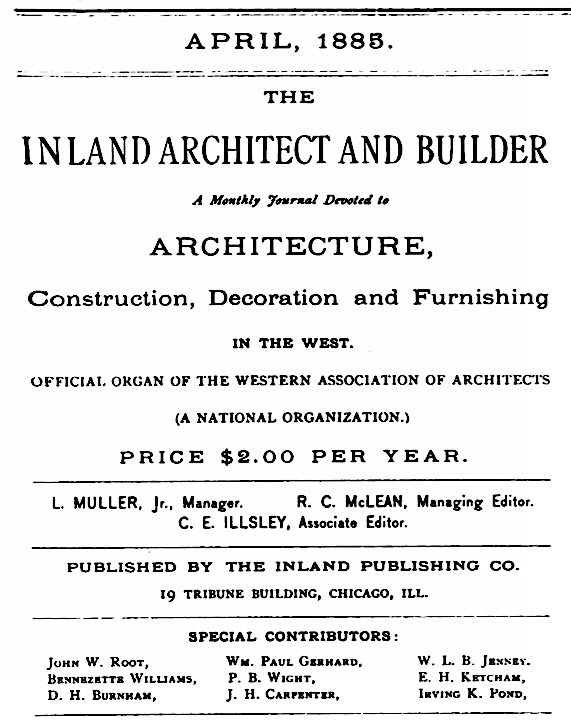
Inland Architect, Titleblock, April (Mid-month) 1885. Note that Root is listed first among the non-alphabetized listing of Special Contributors. (Online)

Due to its youth, Chicago had lagged behind other American cities in the West, as well as the East in the formation of cultural and professional institutions.  Chicago, like most American cities, was primarily focused on survival and growth during its first fifty years of existence.  This was even truer of Chicago in view of the two depressions, the Civil War, and the 1871 fire.  Nonetheless, Chicago still prospered and grew, so that by the time it turned fifty years old in 1883, its leading citizens began to realize that the city was large enough to support, in fact require, the institutions of a major urban center.

The city’s builders and architects were just one of the middle-class groups in Chicago that responded not only to the economic boom in the first half of the 1880s, but also to the increased presence in the late 1870s of labor unions, with the formation of supportive organizations to improve the business and the cultural climate in the city.  The master masons were the first such group to organize, forming the Master Masons’ Association in 1880. Chicago’s architects were aided by two pivotal figures, Robert Craik McLean and Henry Lord Gay, in their campaign to organize locally.  Critical to the effort would be a regular organ to coordinate all communications and promote the local profession.  

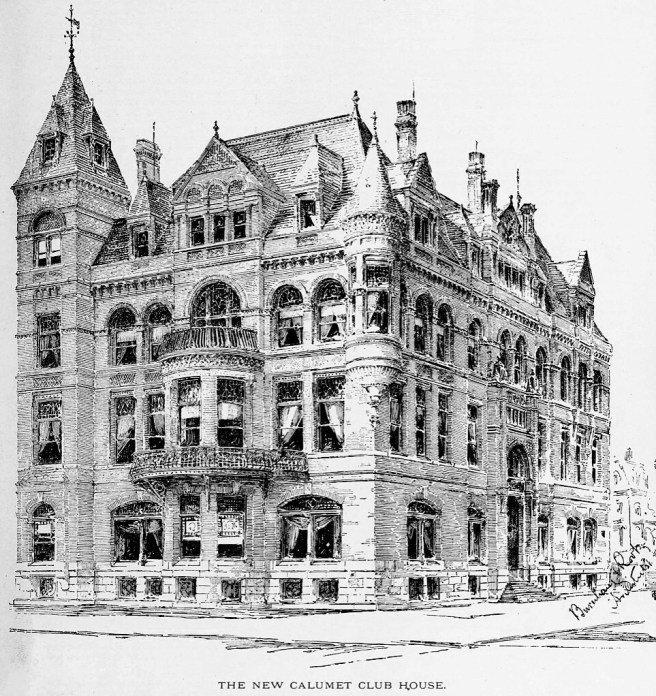
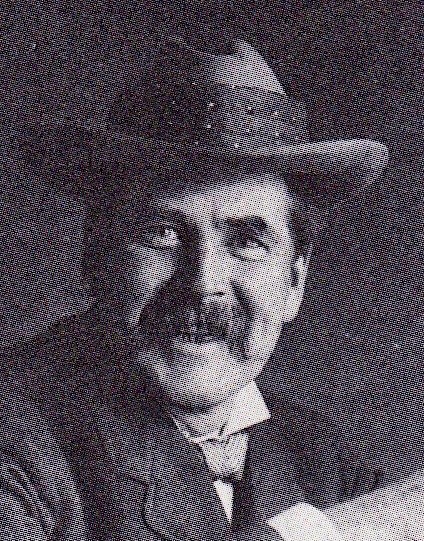
In February 1883, the first issue of Inland Architect, “a monthly journal devoted to architecture, construction, decoration and furnishing in the West,” was published under the editorship of McLean. McLean was born in 1854, four years the junior to Root, in Waukegan, only 40 miles north of Chicago, and his father had hoped that his son would study medicine. The depression of the 1870s put an end to that dream as the young man needed work and had found a job in Evanston working for a religious weekly magazine, where he realized he had a knack for journalism.  During the 1880 Republican convention in Chicago, the 26-year old McLean had scooped all of the city’s major newspapers with the news that James A. Garfield would be the eventual candidate.  The Tribune offered him a position the next day and he moved to the big city.  His passions were music, literature, and the theater… sound like anyone else we know already writing reviews for the local press.  This is informed speculation on my part, but judging from what Root, Burnham, and McLean would accomplish over the next eight years, I believe Root (I list Root because of the two partners, he was more inclined to music and theater) and Burnham not only encouraged McLean to start to magazine, but most likely assisted in securing the necessary funding to do so.  In fact, the first issue contained a rendering of Burnham & Root’s Calumet Club as its first illustration and the following issue featured their Burlington Building.

The organization of the magazines early issues was: editorials and late-breaking news, articles that spanned a breadth of issues (professional, i.e., competitions, technical systems and materials, history, artistic, “art notes” that kept Chicago’s budding Michelangelos current with the fine arts, and architectural theory), an ever-increasing collection of illustrations, and lastly, a monthly round-up of local building news from all large midwestern cities, ending with Chicago.  To assist the region’s architects in self-improvement during the magazine’s inaugural year, McLean included three continuing series: William Le Baron Jenney authored a series on the history of architecture (in which he introduced Viollet-le-Duc and Scottish architectural historian James Fergusson) that really was simply a makeover of his 1869 publication, Principles and Practice of Architecture, John Van Osdel at the age of 72 attempted to reconstruction the history of Chicago’s early architecture, and decorator Louis J. Millet of Healy & Millet submitted a series on the early history of “Decoration in America,” in which he reinforced Jenney’s opinion that Viollet-le-Duc was the leading theoretician of the era. McLean published Root’s first two articles that established his position as the leading theoretician of the emerging Chicago School.  As was typical of the polymath, his first article only tangentially referred to architecture, as its subject was the future use of “pure color.” (I will include his main points in the next chapter.)  By April 1885, when Inland Architect first published its list of contributors, Root was at the head of the (non-alphabetically-listed) group of well-versed practitioners.

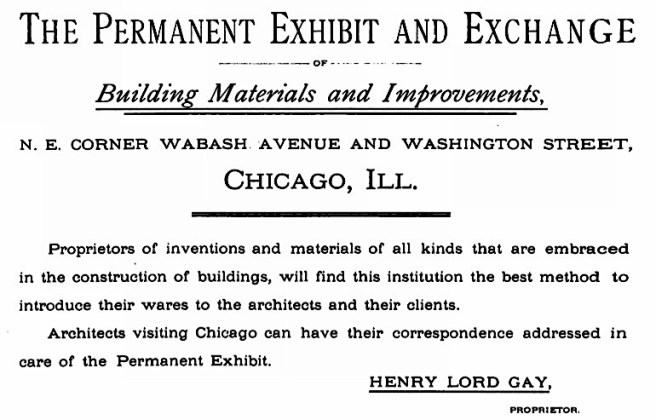
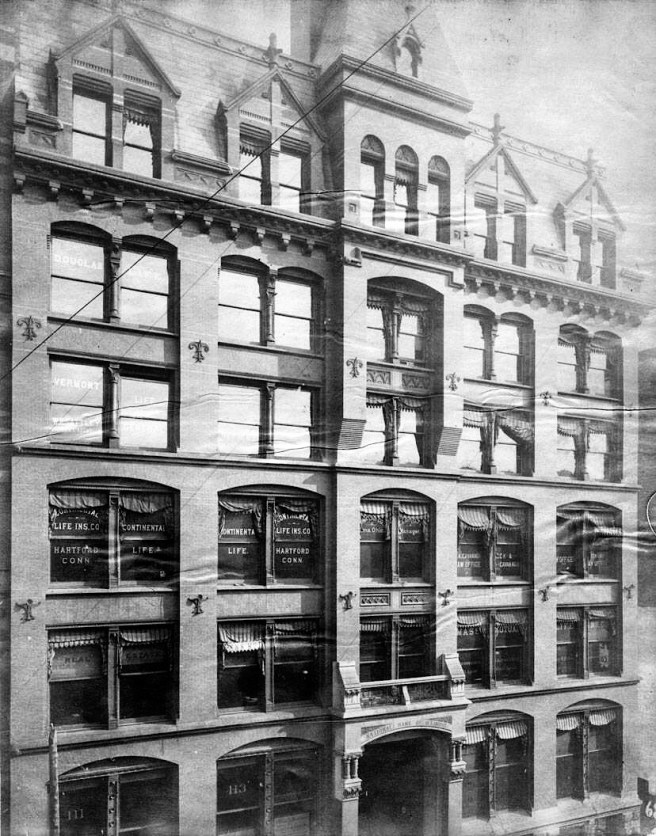
In December 1883, a rather well-off local architect, Henry Lord Gay, took it upon himself to establish a central exhibit for building materials and products called the Permanent Exhibition and Exchange of Building Materials that opened on February 1, 1884, for the comparative benefit of the public and the local building trades.  In January 1884, Gay freely offered his hall to be used for the organizational meeting of the Chicago Builders and Traders’ Exchange, in the formation of which Chicago sorely lagged behind other major American cities.  The leading force behind the new organization was George C. Prussing, who was ably assisted by such stalwart associates of Burnham and Root as Amos Grannis, who was elected Treasurer, and George Tappan, who was named to the Board of Directors.

Advertisement for Henry Lord Gay’s Permanent Exhibit and Exchange. Inland Architect, March 1885.

FURTHER READING:

Prestiano, Robert V. The Inland Architect: Chicago’s Major Architectural Journal, 1883-1908. Ann Arbor: UMI Research Press, 1973, pp. 5-6.

(If you have any questions or suggestions, please feel free to eMail me at: thearchitectureprofessor@gmail.com)

CHAPTER NINE. WESTERN SELF-AWARENESS: THE “INLAND” ARCHITECT AND THE W.A.A.

The year 1884 had been, indeed, a banner year for Chicago.  The Board of Trade’s tower had topped off at 303,’ finally dethroning New York (Trinity Church’s 281’ steeple) from its “higher than thou” attitude of having the tallest building in the country.  Chicago’s collection of skyscrapers was quickly catching up to New York’s.  And most impressive, Chicago’s population was the fastest growing in the country, and expected by many to surpass New York’s by 1900:

1880                                         1890

1. New York     1,2060,299        1. New York      1,515,301 (+309,011)

2. Philadelphia     847,170        2. Chicago       1,099,850 (+596,665)

3. Brooklyn           566,663        3. Philadelphia 1,046,964

4. Chicago            503,185         4. Brooklyn          806,343    

In fact, the “West” was growing like a proverbial wildfire, shifting the nation’s population centroid, aided by the railroads, farther away from the Atlantic Coast each year.  In the world of American architecture, it seemed to architects in the West that they no longer needed the Atlantic Coast.

9.1. THE EARLY HISTORY OF THE A.I.A.

The American Institute of Architects was originally chartered as a scientific society in the state of New York on April 13, 1857, by a group by nine architects from New York City. The organization slowly grew in size and geographic distribution (a three-year hiatus due to the Civil War notwithstanding) so that in its tenth year, 1867, the need was recognized for a more local focus for those members residing in cities other than New York.  The A.I.A. constitution and by-laws were, therefore, so amended to permit the formation of local chapters when so deemed appropriate by a city’s architects.  At the height of this organization’s activity during the mid-1870s, there were eight active local chapters: New York (1867), Philadelphia and Chicago (1869), Cincinnati and Boston (1870), Baltimore (1871), Albany (1873), and Rhode Island (1875).

The depression of the middle 1870s, however, had exacted a toll on many of the country’s architects who were forced to justify the cost of A.I.A. membership in the face of economic hardship.  Interest and support for the organization began to wane toward the end of the decade.  This decline was only compounded in the western chapters of Cincinnati and Chicago by a sense of growing isolation and disaffection with the A.I.A.’s increasing East Coast focus, in addition to major philosophic differences on a number of issues. (An opinion shared by even the architects in Western New York state.)  By 1879, neither chapter was a viable unit of the Institute; the Cincinnati Chapter having failed to submit a report to the annual convention in New York City that viewed the action as an outright secession. Western apathy was met by the A.I.A. Committee on Membership with a proposal at the convention  “that the relation now existing between the Institute and the Chapters should be changed, or rather abolished, making the Chapters completely independent,” in favor of a more honorary and literary (academic-oriented) organization modelled after the Royal Institute of British Architects.  The Boston Chapter led the push for “the dissolution of all organic connections between the A.I.A. and local chapters,” with the Boston-published American Architect, the magazine the A.I.A. had chosen to report its business, looking forward to the act as “a momentous event in the history of architecture in the United States.”  The 1880 convention, held in Philadelphia on November 17, approved the dissolution proposal, leaving the only operative connection between the national organization and the local societies as the requirement that the president of each chapter should be a Fellow of the A.I.A., that would entitle each local president to sit of the A.I.A. Board of Trustees.  Three years later, the divorce from the local chapters was completed by abolishing the rule that made members of local chapters automatic Associates in the A.I.A.

The A.I.A.’s elitist decision to cast off its chapters, more specifically the inactive groups in the West, was quite ill-timed, for by 1883, as has been seen, the construction boom in the West was giving western architects the opportunity to design buildings that were not only comparable in size and cost to those in the East but were also many times more significant with regards to the technology employed in them.  Quite simply, western expansion had begun to mature to the point that the earlier economic and cultural inferiority of the West seemed to many of its residents as unwarranted.  Midwestern architects, many of whom had actually grown up in the East, no longer saw any reason to hold the “dandies” on the East Coast in such high esteem.  Nowhere was this general attitude of indifference to the East more pervasive than in Chicago, the emerging capital of the West.

(If you have any questions or suggestions, please feel free to eMail me at: thearchitectureprofessor@gmail.com)
8.26. THE BROOKSES ADMIT DEFEAT AND “BUY” CITY HALL

Map of the Loop, 1885 (Author’s collection)

The loss of the Grannis Block by the Brookses may have been a blessing in disguise, for it freed up the capital they had invested in it at a very opportune time.  The new City Hall had finally been completed and occupied in November 1884. In an attempt to raise money to cover the cost overruns of its new building, the city planned to lease the site of the old “Rookery” to a developer who would promise to erect a fireproof building with a value of not less than $800,000.  There were three offers, of which the one chosen, that of Henry. S. Everhart’s was suspiciously the lowest.  While the other two had offered to start paying rent and taxes immediately, Everhart had asked to be exempt from rent and taxes from March 1885 to May 1886, a reduction to the city of $30,000 in rent and $6,000 in taxes.  Nevertheless, Everhart’s offer was chosen the week before the Grannis fire by a majority of City Council (who surely had been promised considerably less than the $36,000 for their vote).  Mayor Harrison wisely responded to the public outcry over the scandal by vetoing the council vote, coincidentally following the Grannis fire, and recommended that further bids be sought.  Three months of quiet negotiating resulted in an announcement on May 12, 1885, that the site would be leased to a group of investors led by Edward C. Waller for 99 years at an annual rent of $35,000.  In return, the group promised to erect the city’s largest office building, estimated to cost $1 million (for which it was reported that sketches for a 10-story structure had already been made) and would begin paying rent as of May 1, 1886. Waller, born in Maysville, Kentucky, had moved with his family prior to the Civil War to Chicago where his father had settled on the West Side, in the heart of Chicago’s affluent colony of former Kentuckians centered around the intersection of Ashland (the name of the home of Kentucky’s favorite son, Henry Clay) and Jackson.  The Waller children became close friends with the family across the street who had moved here from Louisville.  The father of the friends’ family was Carter Harrison who, long before he was elected mayor, had become like an uncle to the young Waller and his siblings.  A new insider deal had simply supplanted the earlier boodle scheme.

Intersection of La Salle and Adams, looking south. The Rookery (left) and the Insurance Exchange (right) as the portal to the Board of Trade district. The entrance of the Home Insurance Building with its famous columns is in the left front. The Maller’s Building with its corner turret of stacked vaults is in back of the Insurance Exchange. (Merwood-Salisbury, Chicago 1890)

Twelve days before the signing of the “Rookery” deal, the new Board of Trade, as well as the Insurance Exchange and the Home Insurance Building, had opened their doors for business on May 1.  The proposed largest office building in the city, to be built on the site of the old “Rookery” destined to also be named the “Rookery,” would not only cement the reputation of La Salle Street directly in front of the new Board of Trade as the city’s premiere financial district, but also reinforce the new Adams Street corridor, that began to read as a “who’s who in Chicago architecture” (from east to west: Interstate Exposition Building, Pullman Building, Post Office/Custom House, Rookery, Home Insurance Building, Insurance Exchange, the Burlington Building, and Union Station). 

Intersection of La Salle and Adams, looking north. At the left is the Insurance Exchange; opposite is the Rookery, with the Home Insurance on the other side of Adams. The Home is taller because of the two-story addition. (Merwood-Salisbury, Chicago 1890)

As the new building would sit only one block north of the Board of Trade, across La Salle Street from the Insurance Exchange and immediately south of the Home Insurance Building, it would make the intersection of La Salle and Adams one of Chicago’s most architecturally significant locations.  Among the stockholders of the company, the Central Safety Deposit Company, represented by Waller were the names of Peter C. Brooks, Owen F. Aldis, Norman B. Ream, William E. Hale, and Waller’s long-time friend, Daniel H. Burnham.  Evidently, Brooks and Aldis had seized the opportunity to gain a prime site in the heart of the emerging La Salle Street financial district that was also in the Adams Street corridor, by once again acquiring vacated public property (as they had done with the Montauk Block on the old Customs House site) to build another large office building designed by Burnham & Root.  If Aldis and Brooks couldn’t beat City Hall in their effort to develop Dearborn, they, at least, now had the “clout” to buy City Hall…

(If you have any questions or suggestions, please feel free to eMail me at: thearchitectureprofessor@gmail.com)

8.25. 13 YEARS LATER: THE END OF USING WOOD FLOOR STRUCTURES – THE GRANNIS BLOCK FIRE

Burnham & Root, Grannis Block, Chicago, 1880. (Chicagology.com)

The work on extending Dearborn Street, first promised in January 1882, was postponed to the Fall of 1884, then to the Spring of 1885.  Actually, it wasn’t until construction on the new C. & W. I. terminal was completed in September 1885, four months after the opening of the new Board of Trade and, more importantly, five and a half years after the first train had arrived in Chicago on the C. & W. I. tracks, that the extension of Dearborn from Jackson to Polk was completed.  It was obvious that La Salle Street had won the battle, and the Brookses shelved their grand plans for Dearborn during the next five years.  Instead, within two weeks of Aldis’ initial confession to Brooks of the defeat of the Monadnock, the Brookses first shored up their existing investment along the built-up portion of Dearborn by purchasing the Grannis Block for $175,000 (they already owned the land under it).  A month later in December 1884 they purchased the southeast corner of Clark and Van Buren, diagonally opposite the new Open Board of Trade and only two blocks east of the La Salle Street Station. Within a month they had obtained a building permit for the site for a 103′ x 103′, 12-story, 160′ high office building designed by Burnham & Root.  As the old adage goes, “if you can’t beat them, join them.”

Peter B. Wight, Porous Terra-Cotta Tile System for Fireproofing Wood Floors. (Inland Architect, February 1885)

Then the roof literally fell in, for on February 19, 1885, only three months after Shepherd Brooks had purchased the Grannis Block as a safe investment, it was destroyed by fire.  Although never confirmed, the consensus of the fire’s origin was friction caused by the elevator’s counterweights on their wooden guiderails.  The fire had quickly spread through the open elevator shaft and into the building’s wood floor structure, disproving the effectiveness of Wight’s porous terra cotta tile system’s ability to protect wood floor structures.  Apparently both Burnham and Root, whose office was located on the top floor, were the first to discover the fire and were able to escape with their lives, although the firm’s records and drawings were completely destroyed (that proved to be a great loss for architectural historians). 

“At times, when the wind blew aside the dense clouds of smoke and steam, and the flames showed through the great icicles that hung from every window and capital and ledge, the scene was beautiful and grand.  On either side of the street the buildings were enveloped in a white shroud, from which the flames reflected as from a mirror.  The men themselves look [sic] like moving icicles, so completely were they covered with ice.”

Ice-Encrusted Ruin of the Grannis Block, Feb. 20, 1885. (Chicagology.com)

Because of the severity of the winter, the ice-encrusted ruin of a supposedly fireproof building stood for weeks as a sober reminder that even though over thirteen years had passed since the great conflagration of October 8, 1871, Chicago had not yet learned not to build with wood:

“The burning of the Grannis Block has occasioned more comment than any similar event in years.  The building, though of timber construction, was so well built as to be supposed to be fireproof, and the sentiment in favor of fireproofing has set so strong that it is doubtful if in the future any office building will be constructed otherwise.  This should be carefully watched by the citizens’ committee, and if not a sufficient warning to owners who wish to build cheaply at the expense of the lives of their tenants, they should see that a law compelling the fireproofing of buildings of certain classes should be passed.  This law should apply not only to office buildings but all factories and apartment houses.  Another point in the construction of buildings that must be abandoned – and it is found in the designs of all architects – is the placing of wooden stairs around open elevator shafts.  In the Grannis Block fire, the architect who planned the building had a forcible example of the “disadvantage” of this system as he escaped down the burning stairway.  The stairs should be of iron and fireproofed, and the elevator shaft should be of fireproof material and open at the top, not among a mass of wooden joists and rafters, but like a chimney above the roof, and all doors should be iron and close automatically.”

Although wood floor joists would no longer be used in large commercial buildings in Chicago after the Grannis fire, heavy timber framing would still not disappear for a number of years to come.  While the city still refused to enact stricter building ordinances, Burnham and Root had learned this lesson the hard way: the offices of Burnham & Root were temporarily relocated next door to the Portland Block, until more permanent space could be rented in the Montauk Block, the first office building constructed with fireproof hollow tile floor arches.  Conservative Shepherd Brooks had learned a lesson too.  Instead of rebuilding the Grannis Block, he leased the site to Wilson Nixon, who rebuilt the building generally along the same lines of the Grannis Block, drawn up by Burnham & Root in their new, safer office.   

Root took the opportunity to update the design of the facade for the new client, the National Bank of Illinois. The outdated mansard roof and tower were removed and replaced with an extra floor that gave the building its up-to-date palazzo form. He combined the top two floors into a third horizontal layer above the base in which he detailed triple windows between the structural piers, imparting a 1:2:3 progression of windows in the layered arcades as they marched up the elevation.  Root reinforced the center bay that originally had supported the tower, by replacing the triple-arched motif of the outer bays of the top floor with one large, semicircular arch.  Then he topped the composition with a flat cornice that not only updated the building’s design, but also visually tied it better to the recent two-story addition in the Portland Block next door (and leads one to wonder if Aldis had also earlier assigned the design of the Portland’s addition to Burnham & Root).

Burnham & Root, Post-1885 fire Grannis Block. The Portland Block with its two-story addition, is at the far left. This image shows the original base was maintained while only two additional floors were added to the Grannis, begging the question of when was the base updated and the third new floor per the above photograph added? (Andreas, History-vol.3)

FURTHER READING:

Hoffmann, Donald. The Architecture of John Wellborn Root. Baltimore: Johns Hopkins University Press, 1973.

(If you have any questions or suggestions, please feel free to eMail me at: thearchitectureprofessor@gmail.com)