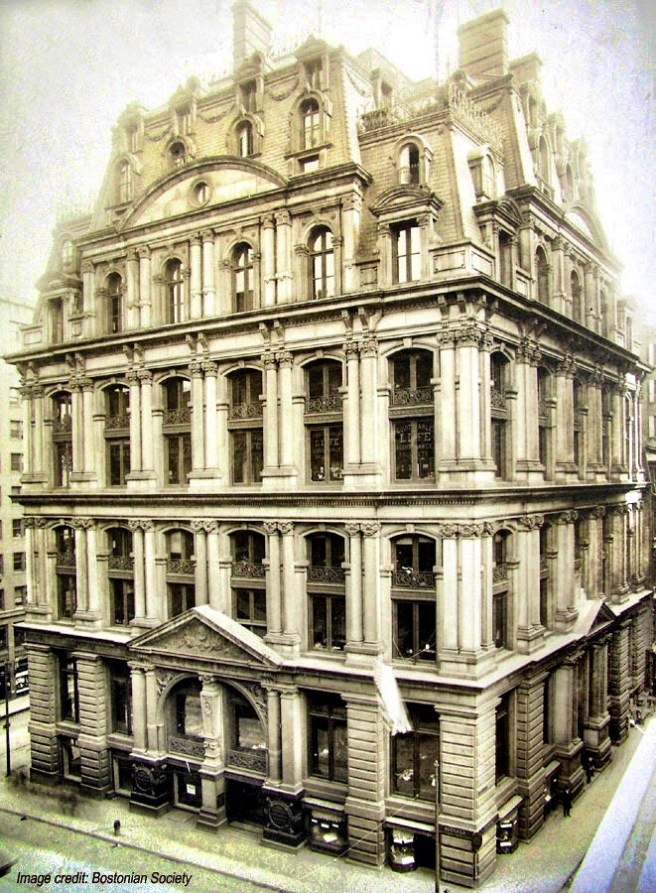
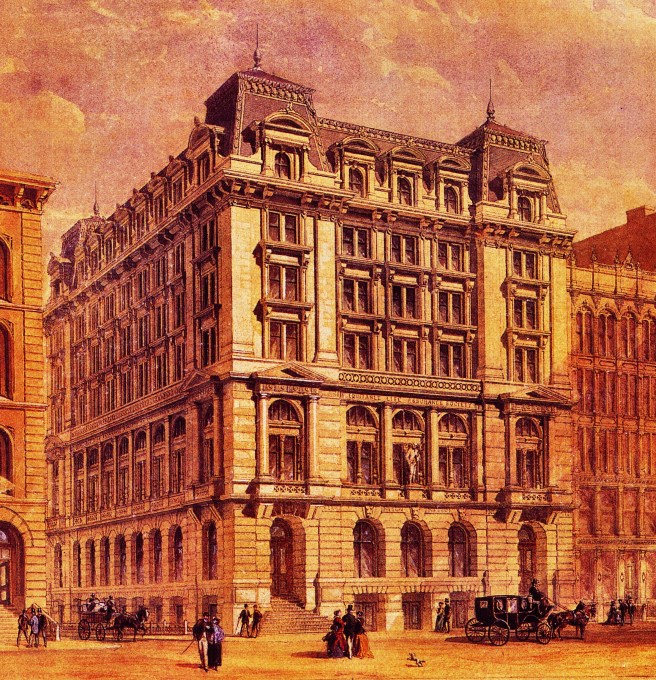
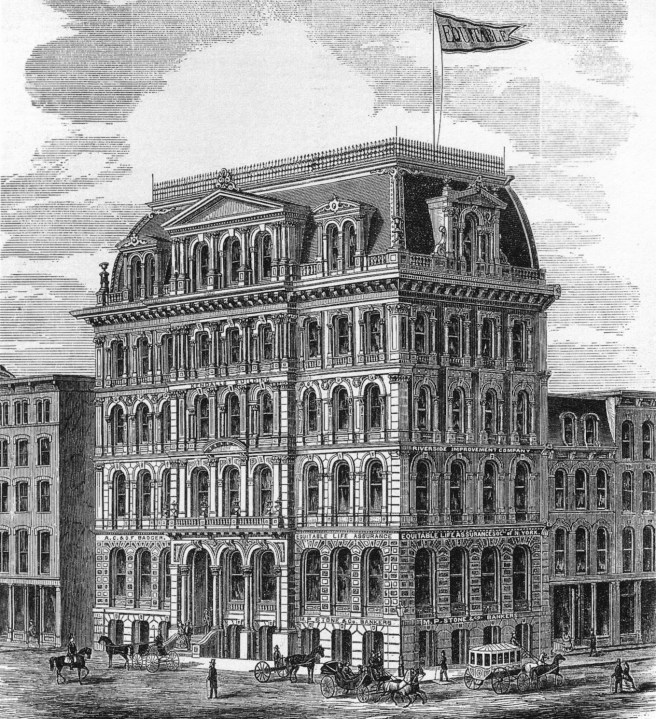
Arthur Gilman, Equitable Building, Boston, 1872. (Web)
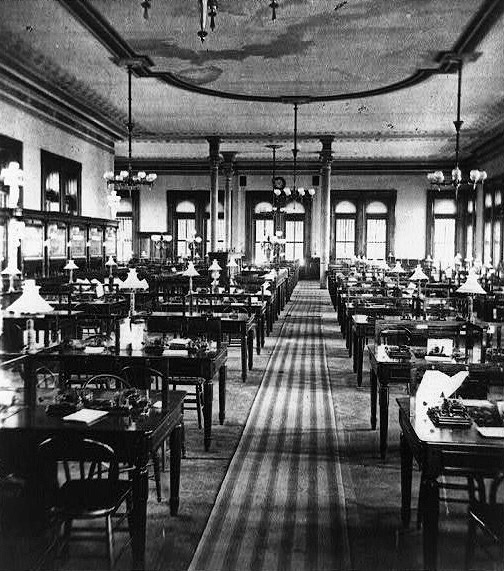
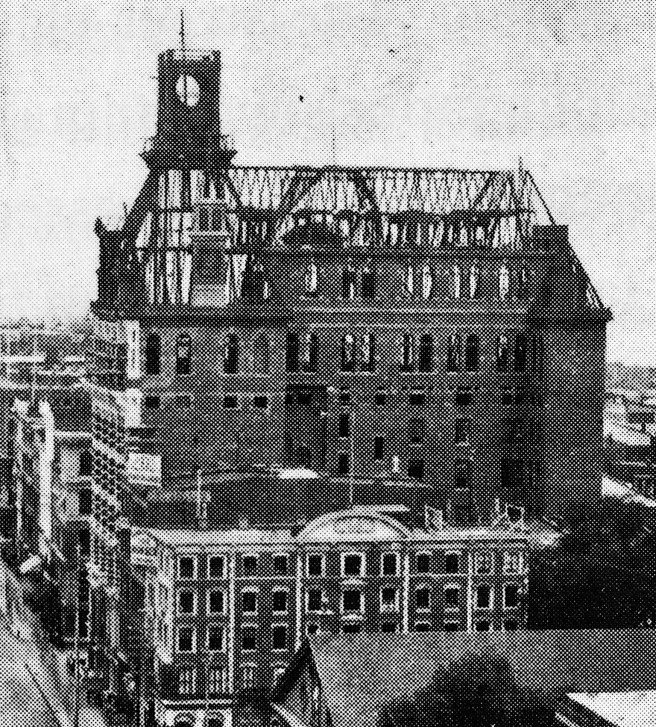
While Post was designing the Western Union, the unthinkable happened when Boston, that was considered to one of the country’s best-built cities, burned on November 8-9, 1872, with a similar intensity to that of the Chicago fire. While many professionals had expected Chicago, “the largest wooden city in the world” to eventually catch fire, almost everyone had been caught by surprise when Boston went up in flames the following year. With the conscious decision to shorten Equitable’s Kendall Building in Chicago following the 1871 fire, the Boston fire presented the company with alternate opportunity to build a larger version of the company’s pioneering experiment with the elevator that was not lost on Henry Hyde, or his father, Henry Hazen Hyde, who had been the head of Equitable’s Boston branch office since his son had decided to open its first branch outside of New York in 1863. The Hydes managed to assemble a number of small parcels on the block bounded by Devonshire, Federal, and Milk Streets, across from where the new Post Office was being rebuilt, upon which they had decided to build an even taller building than their original New York building. Arthur Gilman, who had conceived of the original design for the New York building, was commissioned to design, for all practical purposes what looked like a duplicate of his original 1867 design.
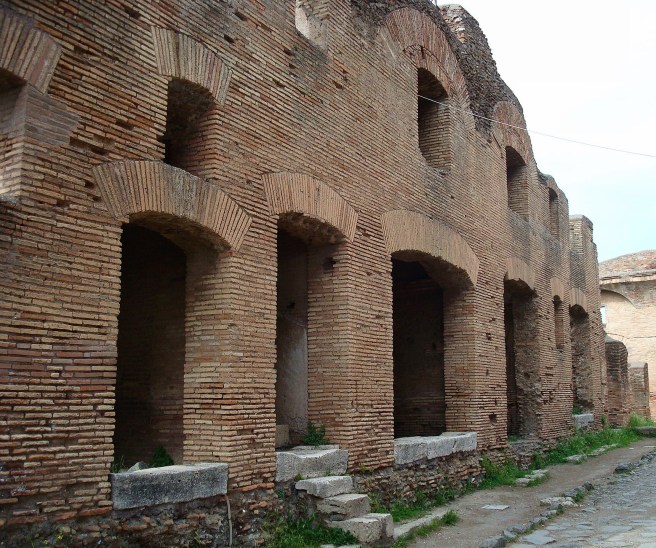
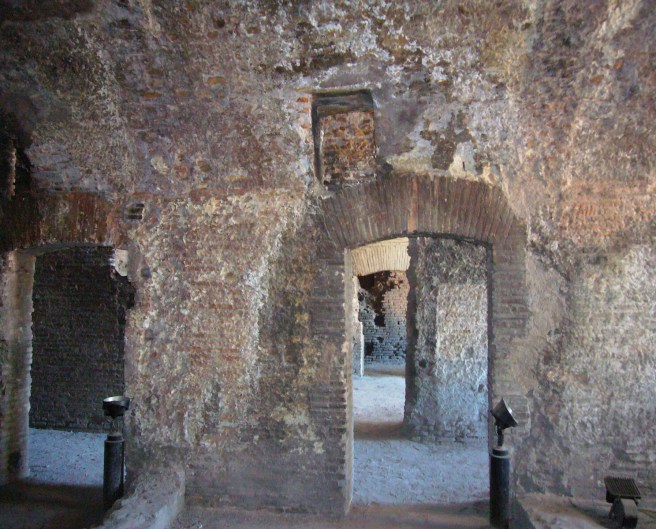
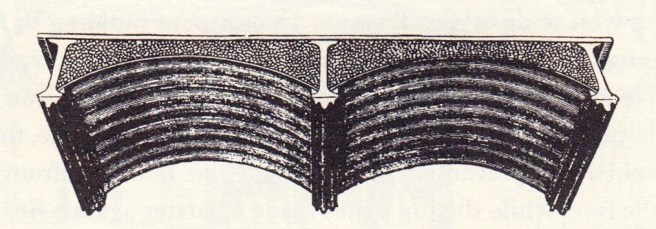
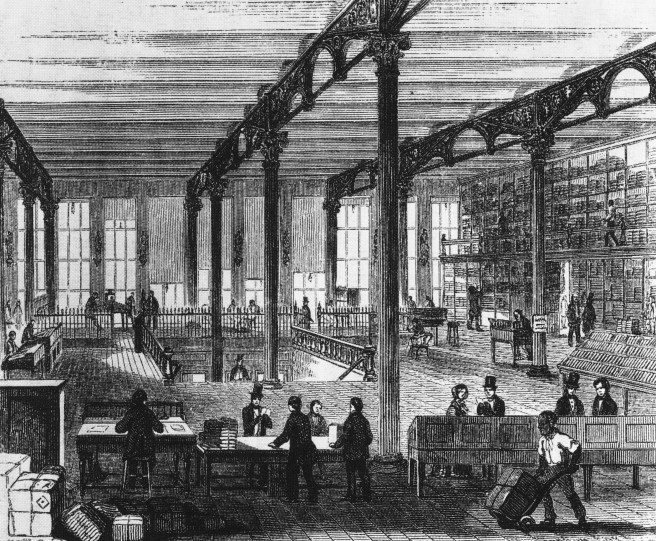
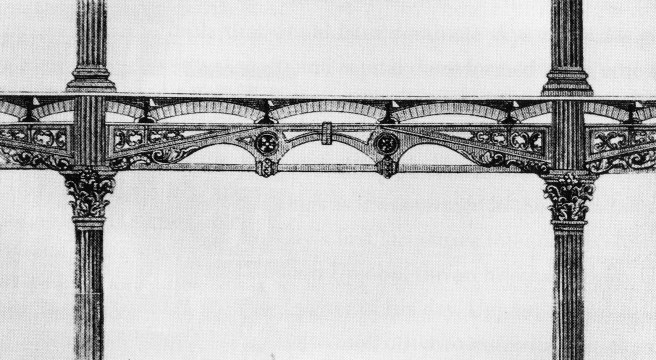
The Hydes increased the number of floors to nine that included a public sight-seeing observatory on the roof, using three elevators to access these. (A side note: neither of Equitable’s buildings sprouted a tower such as the Western Union. More than likely, Hyde saw the tower as an extravagance for which his money might be better invested.) In response to the damage wrought by the conflagration, Gilman was directed to employ only solid bearing walls throughout the building, Hyde obviously eschewing Post’s daring experiment with iron framing in his New York Building. The interior masonry walls supported either brick vaults, leveled with concrete, or iron beams and arches that were filled with concrete, similar to the Gilbert System. As with the impact that Equitable had created with its first experiment with the elevator in New York, the interior structure in their Boston building that had regressed to solid masonry walls would also be influential immediately following the country’s second major urban conflagration that had occurred within thirteen months of each other. For all practical purposes, we were back to Square One in the development of skyscraper construction: the Roman Insula (multistoried apartment building).
(Top) Roman “Insula” (apartment building), Ostia, 2nd century, AD. (Online); (Below) Insula dell’ Ara Coeli, Rome, 2nd Century, AD. (Online)
3.4. HUNT’S NEW YORK TRIBUNE BUILDING
Richard Morris Hunt, New York Tribune Building as constructed, New York, 1873. (Online)
With Hunt’s commission to design the New York Tribune’s building coming after the Boston fire as well as Equitable’s new building in Boston, the structure that Hunt employed in the Tribune Building was simply medieval. It was neither framed nor boxed construction: the entire structure relied on masonry bearing walls; there were no iron columns used in any part of the building.
Hunt, New York Tribune, 1873. First Floor Plan. (Landau and Condit, New York Skyscraper)
Given the ten floors in the Tribune Building and the nature of the weight of some of the equipment in the composing room on the top floor, the piers in the ground floor started at 5′ 2″ thick, and gradually were decreased in size by 4″ per floor until they were only 3′ 2″ in the top floor.
New York Building Code, 1892. Typical bearing wall required minimum thickness. (Landau and Condit, New York Skyscraper)
The anachronism of Hunt’s bearing wall structure was completely contrasted, however, by his employment of Leonard Beckwith’s lightweight tile flat-arches in all the floors (see later in this chapter for details).
Leonard H. Beckwith, Hollow Floor Tiles used in the New York Tribune Building, New York, 1873. (Brickbuilder, April 1897)
One does not have to do the math to understand that walls of 62″ of solid masonry, especially in the premier rent location of the ground floor, could not continue to grow much thicker and still be economically feasible, especially sitting on top of Chicago’s weak soli. Peter B. Wight would solve this problem during the 1870s, but only after overcoming the resistance to his idea of using terra cotta encased iron sections by those in the insurance industry, of all people, who championed the use of heavy timber instead of iron structural members.
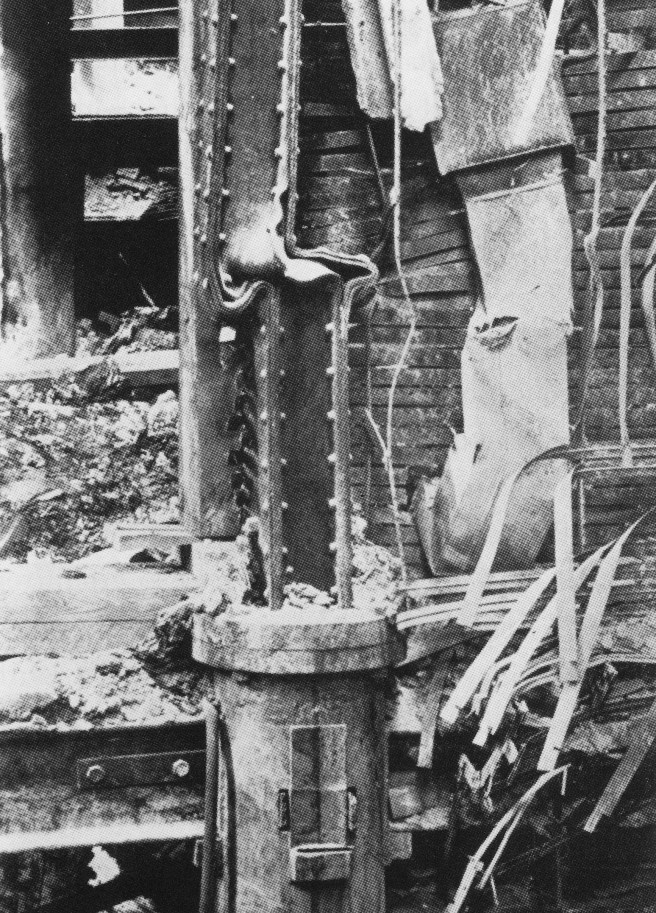
Post, Equitable Building. Interior iron structure exposed after a fire on January 9, 1912. The cast iron column is in the center bottom. Wrought iron girders frame into both sides of the column. Above the cast iron columns stands the built-up wrought iron column that supported the walls lining the lightcourt. (Landau and Condit, New York Skyscraper)
The second characteristic of Vitruvius’ definition of good architecture is “firmness,” that is, structural stability, something we naturally take for granted in our buildings. I purposefully stated that we “take for granted” this for few people actually understand or appreciate the engineering skills and risks taken in the construction of a building, especially in that of a skyscraper.
PART A. THE INTERIOR STRUCTURE: TIMBER OR IRON?
In Section 1.10 I differentiated between “boxed” and “framed” construction as two different methods of erecting a building. With the few exceptions that I had noted, the construction of the interior structure of buildings prior to the 1871 Chicago and 1872 Boston fire was boxed construction: exterior walls of masonry (stone and/or brick) within which was erected a skeleton frame, be it of timber or cast iron. Supported on top of this skeleton was some type of floor structure, the majority of which were wood joists and decking (the exact type of structure Jenney had used in the First Leiter Building), but Peter Cooper’s rolled wrought iron joists were slowing gaining a foothold in the market. We saw a variety of floor structures being experimented with that included corrugated sheet metal arches with a concrete topping and George Johnson’s fireclay tile segmental flat-arched floors.
Joseph Gilbert, Corrugated Sheet iron Floor Arches, c. 1865. (Wermiel, Fireproof Building)
And then the two fires occurred. I can use the interior structure of the Equitable Building and the Western Union Building as examples of contemporary constructional techniques prior to the 1871 Chicago fire and the 1872 Boston fire.
3.1. GEORGE POST REDESIGNS THE EQUITABLE’S INTERIOR STRUCTURE
George Post, Submission for the Equitable Competition, 1867. (Landau, George Post)
Although George Post had entered a design in the 1867 competition for the Equitable Building that was not chosen as the winner, as design work began on Gilman & Kendall’s winning design, it became obvious that the interior construction that they had envisioned would be cost-prohibitive and Post was commissioned not only to redesign its structure but also to supervise its construction. The interior structure of the initial design reflected contemporary New York fireproofing practices as it was originally planned to have been entirely of masonry walls. Although I have mentioned Post in the prior chapters, his background is now relevant to our story. Post was born and raised in New York City, and after graduating from NYU with a degree in Civil Engineering in 1858, was one of the three students that Richard Morris Hunt had accepted in the first class of his atelier. After having completed Hunt’s two-year program he partnered with a fellow student, Charles D. Gambrill that lasted until 1866, and by 1867 had, evidently, already gained a reputation as an expert with iron construction.
James Bogardus, Harper and Brothers Publishing Building, New York, 1854. (Above)View of interior of second floor, showing the iron structure. Cast iron columns support iron composite girders, that support wrought iron girders, between which spring brick jack arches. (Gayle, Borgardus) (Below) Cast iron girder with wrought iron tie rod used in the Harper’s Building. Note the use of brick floor arches. (Bogardus, Cast-Iron Buildings)
By substituting the planned interior masonry walls with iron columns and beams, brick floor arches, (that varied little from the internal structure designed ten years earlier by James Bogardus in the Harpers Building) and lightweight brick partitions, Post succeeded in reducing the cost of the interior construction by almost half of its original estimate.
Post, Equitable Building. Banking Hall as it appeared in 1889). (Landau and Condit, New York Skyscraper)
In the last chapter I noted that Equitable had required in the competition program the inclusion of the two-story banking hall. Historian Sarah Bradford Landau has shown that Equitable had complicated the design of this area, however, with the requirement for a mezzanine to surround the 35′ wide by 105′ long banking hall, so that the bank’s managers could observe from their mezzanine offices their employees on the Main floor under the skylight, as well as so that customers could look up and view the managers. The structural implication of this requirement was that the exterior masonry wall above the skylight that enclosed the offices above the mezzanine floor could not be continuous down through the banking hall, but would have to be supported by transfer beams either to piers or columns along the mezzanine so that it would open into the banking hall. The columns in the first two floors of the Equitable Building, including those in the banking hall that supported the exterior walls of the lightcourt above were cylindrical cast iron sections with a 16″ diameter. The twelve columns in the banking hall were covered in scagliola (an artificial marble appearance formed by mixing finely ground gypsum in a matrix that is polished after it has set). The floors were made of brick jack arches that spanned between wrought iron I-beams (no real change since the Harper and Bros. Building), that were supported on wrought iron girders that spanned between the columns.
3.2. POST AND THE WESTERN UNION BUILDING
George Post, Western Union Building, New York, 1872. (Silver, Lost New York)
Post was then commissioned in August 1872, after the first Chicago fire, to design the ten-story Western Union Building. The site’s dimensions were such that no atrium was needed, therefore, Post’s structure was straightforward traditional boxed construction: exterior masonry bearing walls surrounding a framework of cast iron columns with wrought iron beams and joists, that supported a floor structure of brick jack arches leveled with a bed of concrete. As an atrium was not needed, the interior structure was not as complex as was the structure for the Equitable Building. In fact, there was no difference in concept between the Western Union’s interior structure and that of the Harper’s Building. Was the fact that the Harper’s Building had been apparently successfully “fireproof” for this long of a period (18 years) the decisive factor in choosing to replicate it? The decision to use exposed, unprotected cast iron columns following the experience of the Chicago fire, however, is somewhat surprising at this time, yet it is understandable given the operative theory at this time that a building’s interior was protected if the building’s exterior was completely fireproofed. Peter B. Wight’s patented system to fireproof iron columns was still two years in the future.
FURTHER READING:
Bogardus, James. Cast Iron Buildings: Their Construction and Advantages. New York, 1856.
Gayle, Margot and Carol Gayle. Cast-Iron Architecture in America: The Significance of James Bogardus. New York: Norton, 1998.
Landau, Sarah B. George B. Post, Architect. New York: Monacelli Press, 1998.
Landau, Sarah B., and Carl Condit. The Rise of the New York Skyscraper, 1865-1913. New Haven: Yale University Press, 1996.
Wermiel, Sara E. The Fireproof Building: Technology and Public Safety in the Nineteenth-Century American City. Baltimore: John Hopkins University Press, 2000.
Holabird and Roche, The Tacoma Building (without awnings), Chicago, 1889. (Online)
Another often-debated topic related to the daylighting of nineteenth century skyscrapers is the role of the bay window. The bay window, when added to the exterior of an office building served only one purpose: to increase the amount of floor area for which an owner could charge rent, by projecting each floor of the building past the lot line of one’s property. Literally this detail usurped the air rights of the public’s sidewalk. Nobody had stated this fact more clearly than had Owen Aldis, who in a letter to Peter Brooks describing Burnham and Root’s final design of the Monadnock Block, relayed, “Numerous bays for extra floor space.” Even Frank Lloyd Wright referred to the bay windows in Louis Sullivan’s Stock Exchange as free real estate, “Calculate the floor space stolen, by ordinance, from the street and see ‘why’ they were there!” Some historians have argued that the role of the bay window was to increase the amount of daylight and ventilation. I want you to stop and think about this issue for a moment. If you are not increasing the size of the opening in the wall (the bay window is not making the opening larger, it is simply hanging a glass box over this opening), how is more light able to enter through the opening? If the opening is the same size, how could more light be admitted into the interior with the addition of a bay window? While the slight angle of the projecting bay may have marginally increased the amount of ventilation on days when the wind was blowing parallel to the face of any particular wall, just the opposite resulted with regards to daylighting.
The reduction of daylight penetration caused by the projection of the ceiling of an oriel window.
By projecting the ceiling of the bay window beyond the plane of the building’s exterior, the depth of the penetration of daylight into the interior was correspondingly reduced, not increased. Right? (Remember the 24-5’ rule of the depth of daylight penetration from the window head at the ceiling. If you push out the window head 24,” the maximum penetration of the daylight correspondingly moves 24” closer to the exterior.)
William Le Baron Jenney, Manhattan Building, Chicago, 1889. Note that the size of the opening in the exterior wall does not increase with the addition of a bay window. In fact, because of the projection of the ceiling, the daylight penetrates not as far into the interior with a bay window. (Turak, Jenney)
One other architectural issue related to the need to maximize the daylighting in the design of an early skyscraper was the potential solar heat gain that could result from so much glass in the exterior walls of these buildings, especially on the south and west faces. If our only knowledge of these buildings came from the first histories of the modern European International Style, that attempted to make a direct connection between the early skyscrapers of the Chicago School and the all-glass buildings designed in Europe during the 1920s, we would have to believe that either the occupants of the early Chicago skyscrapers baked during the summers, or the amount of natural ventilation provided by the operable windows provided sufficient air movement to flush the sun’s heat on a regular basis.
Louis H. Sullivan, Schlesinger and Mayer Department Store (Carson, Pirie, Scott). (Left) With awnings; (Online) (Right) Photo from Sigfried Giedion’s Space, Time and Architecture, 1941.
Fortunately, there are different photographs of Chicago’s early skyscrapers than the ones chosen by the authors of these early histories. The last thing one would want to put on an International Style glass box would be an awning, and yet, that is precisely the solution nineteenth century American architects employed to respond to the solar heat gain.
Holabird and Roche, The Tacoma Building (with awnings), Chicago, 1889. (Online)
For the longest time, I had assumed that the awnings on the early skyscrapers that I saw in photographs had been placed there by unsophisticated tenants, who simply had no appreciation for the building’s aesthetics. Then one day I came across a series of renderings by Louis Sullivan of skyscrapers he had designed, but were never built, and to my astonishment, he had drawn on each building a number of awnings! I had stumbled upon a well-kept secret: the early historians of the International Style had only used photographs of the Chicago School buildings in the winter when their awnings had been removed in order to prevent the snow and ice from damaging them…
Louis H. Sullivan, (Left) Trust and Savings Building, St. Louis, 1893; (Right) Burnet House remodeling, Cincinnati, 1894. (Twombly, Sullivan)
There are a number of other issues that pertain to commodity, such as improvements in elevators (see Lee Gray’s excellent book: A History of the Passenger Elevator) and plumbing, forced ventilation systems, the telephone, and steam-powered construction equipment, that each, obviously, played their parts in the evolution of the skyscraper. I have had to limit my research somehow and, quite simply, did not have the time or the space to include studies of these important issues in this work. There is, however, one mechanical issue that did play an important role that I will include in the early chapters. The fact was that the first skyscrapers grew at a pace faster than that of contemporary firefighting techniques and equipment. For many years, buildings were built that were higher than the limit of a fire department’s ability to throw water upon a fire. The are countless reports of fires starting in the top floors of buildings which the firefighters either could not reach with the water pressure available or failures in the equipment intended to assist them in getting up to the height necessary to fight such a fire. The firemen simply had to wait until the fire reached a floor low enough for their water to reach. I have already documented in Volume One this phenomenon that occurred immediately after the 1871 fire that had forced owners to stop building such tall buildings, if even for a just a short period.
(Left) John M. Van Osdel, Pre-Fire Kendall Building, Chicago, 1871. (The Landowner, October 1871) and (Right) Post-Fire Kendall Building, Chicago, 1872. (The Landowner, February 1872)
Post, Equitable Building. Close-up showing the window wall in the lightcourt above the Banking Hall’s skylight, as it appeared in 1889. (Landau and Condit, New York Skyscraper)
The Equitable Building had just such an interior lightcourt. The competition program had required the inclusion of a two-story banking hall that was to be located in the least desirable, i.e., lowest rentable area: in the middle of the building at the second floor. This would have required an overhead skylight to provide sufficient daylight as the area was too far from the exterior windows.
Post, Equitable Building. Banking Hall as it appeared in 1889. (Landau and Condit, New York Skyscraper)
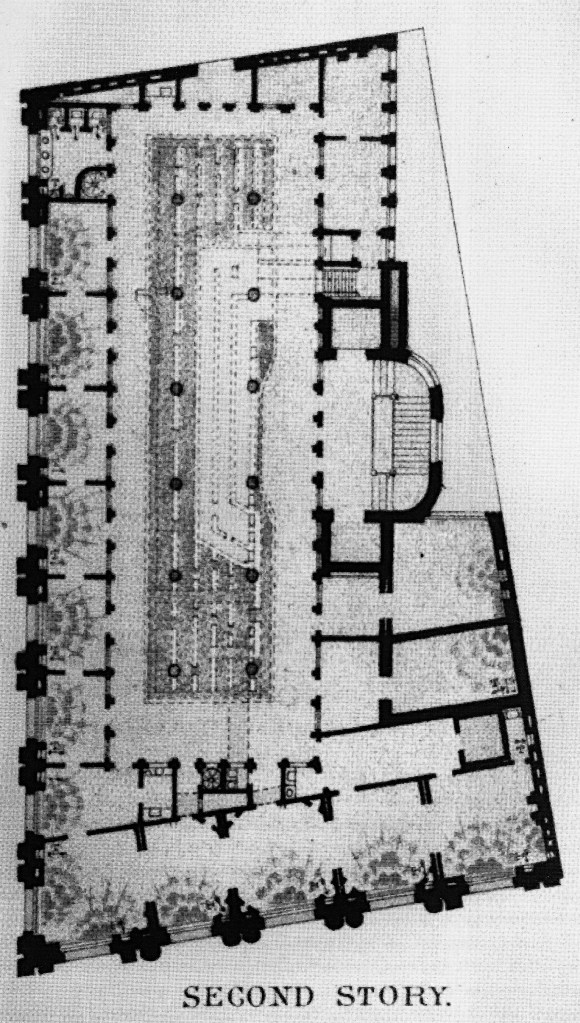
Above the two-story banking hall, there were three floors of rental offices, intended for professionals such as lawyers. These were planned in a single-loaded corridor scheme lining the lightcourt needed to bring daylight down to the banking floor. These floors were contained within a rectangular volume, as the structure reveals on the Second Floor plan. The building’s perimeter (on the upper right corner of the plan image) did not follow the outline of the site but was pulled back far enough away from the party wall of the adjacent building in order to provide daylight to the elevator bank, stairs, and the offices along this side.
Post, Equitble Building. Second floor plan showing the location of the banking hall. Note the location of the two elevators at either side of the stairway and how the building was pulled inside the lotline to form a lightwell. (Landau and Condit, New York Skyscraper)
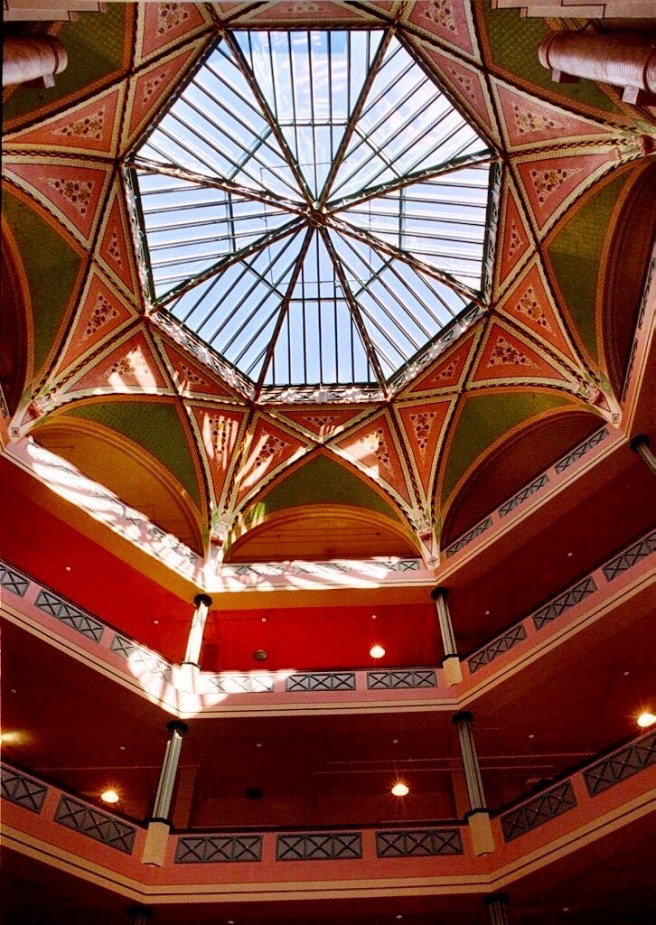
What historians, including William Birkmire, Sarah Bradford Landau, as well as myself, have been unable to definitively determine is whether there was a second skylight at the roof that would have weatherproofed the skylight over the banking floor. If there was, then the perimeter of the atrium at each floor could have been open balconies that lined the atrium. If Post had determined that he needed as much daylight as possible to penetrate down to the banking floor, he would have left this skylight open to the sky above, meaning that he would have had to enclose the corridors around the lightwell with walls and windows. A close-up image (at the start of this post) through the lower skylight of a photograph taken after 1889 reveals an exterior wall with windows lining the atrium. However, this wall may have been a later addition based on Post’s detailing in the 1881 Produce Exchange. (If the wall was part of the original design, it would have been the prototype for the detailing in the New York Produce Exchange: see later chapter.) I will return to the construction of this wall in the next chapter on ‘Firmness.”
George Post, Produce Exchange, New York, 1881. Elevation of the lightcourt’s exterior walls. (Landau, George B. Post)
In Post’s Western Union Building, the site’s width was such that no atrium was required as a double-loaded corridor scheme was efficiently accommodated. In contrast, the site for the New York Tribune Building was larger than needed for a simple double-loaded scheme, and Hunt planned the building with a lightcourt in the rear (and to the left of the plan) that would also provide daylight when a double-loaded corridor addition was added in 1881.
Hunt, New York Tribune, 1873. First Floor Plan. (Landau and Condit, New York Skyscraper) Below: 1881 Addition showing the extra single-loaded wing forming a lightcourt. (Gray, History of the Elevator)
FURTHER READING:
Gray, Lee E. From Ascending Rooms to Express Elevators:A History of the Passenger Elevator in the 19th Century. Mobile, AL: Elevator World, 2002.
Landau, Sarah B. George B. Post, Architect. New York: Monacelli Press, 1998.
Landau, Sarah B., and Carl Condit. The Rise of the New York Skyscraper, 1865-1913. New Haven: Yale University Press, 1996.
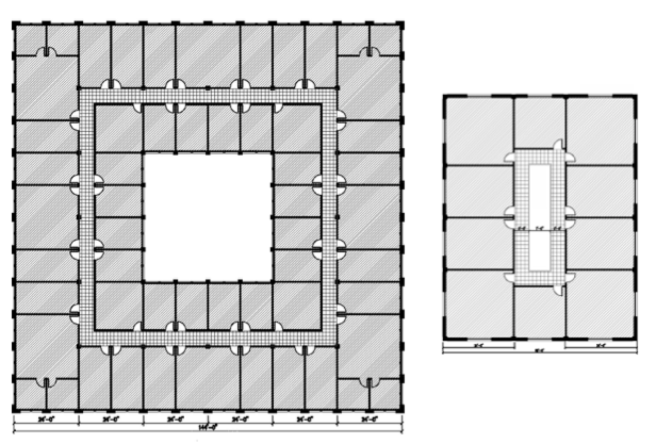
Typical floor plan of a double-loaded corridor scheme for a site with a width greater than 125’ compared to a single-loaded corridor on a site with a width less than 125.’ (Drawing by Kyle Campbell)
As the dimensions of the site continued to increase, for example, an entire block of downtown Chicago, the dimensions of the interior lightcourt reached a size where an additional ring of offices/hotel rooms could be located across the corridor from the perimeter ring of offices and still, a sufficient central void remained to provide light and ventilation to the additional offices. The exterior wall that was now needed to enclose the lightwell would typically be surfaced with a white glazed brick in order to maximize the reflection of daylight down, deep throughout the space.
Burnham and Root, The Rookery. Exterior lightcourt. (Author’s collection)
Root claimed that a view into such a lightcourt “has proven to be in Chicago quite as desirable” as looking out toward a street. In other words, a double-loaded corridor scheme that lined the site’s perimeter, would also result in a hollow doughnut plan. The Grand Pacific Hotel in Chicago, designed by W.W. Boyington in 1870, (and located immediately to the south of the Rookery, i.e., same size lot) was one of the earlier local examples of this scheme.
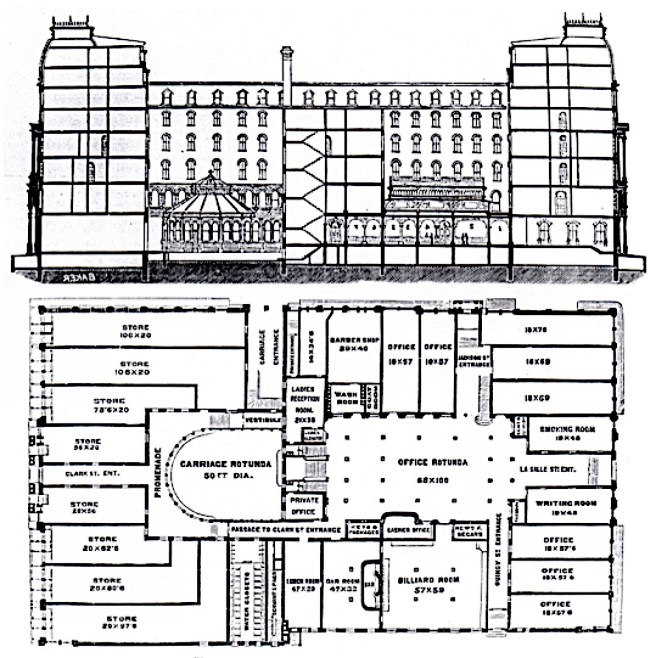
W.W. Boyington, Grand Pacific Hotel Chicago, 1869. Ground Floor Plan and Building Section. (The Landowner, April 1870)
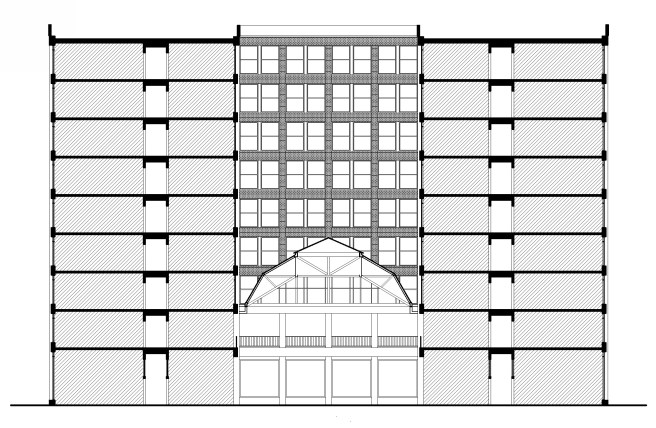
There was one notable difference, however, between the previous single-loaded schemes and this new double-loaded scheme: in order to provide fresh air to the inner ring of offices, the skylight that had always been located at the roof, now had to be brought down to the ground floor so that the rooms lining the lightcourt would be exposed to the exterior.
Building section of a double-loaded corridor scheme, showing that the skylight has been lowered from the roof to the second floor and the atrium walls are lined in white glazed brick. (Drawing by Kyle Campbell)
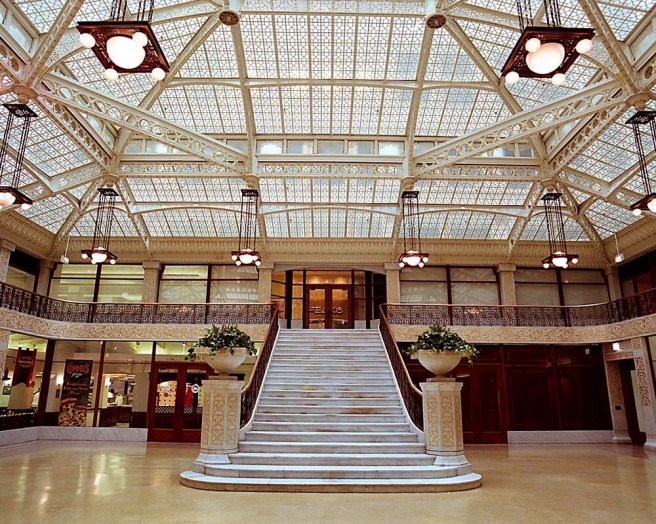
In section, instead of walking into a soaring, multistory atrium, one walked into a rather low, skylighted lobby that was similar to a greenhouse.
Burnham and Root, The Rookery, Atrium. (Online)
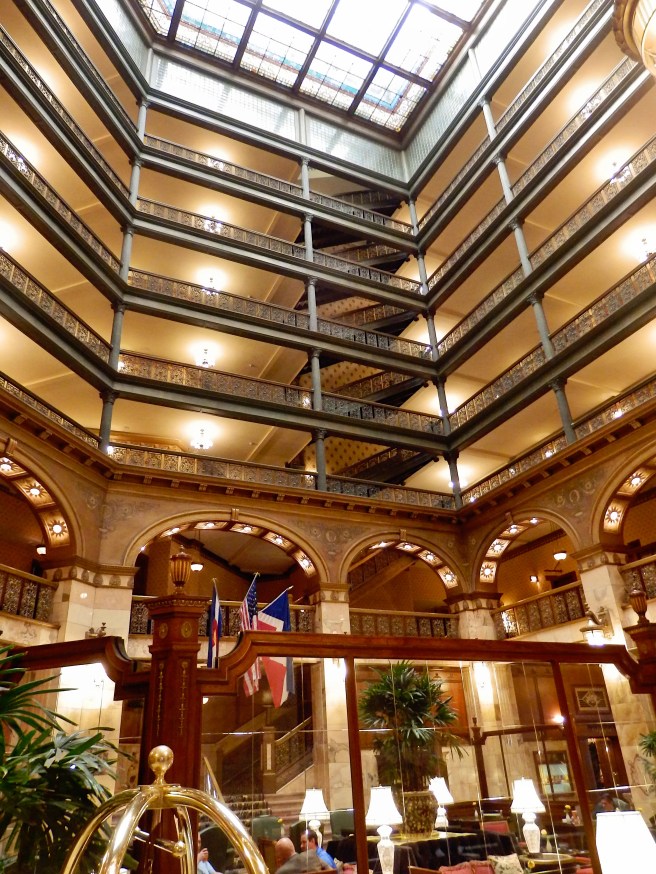
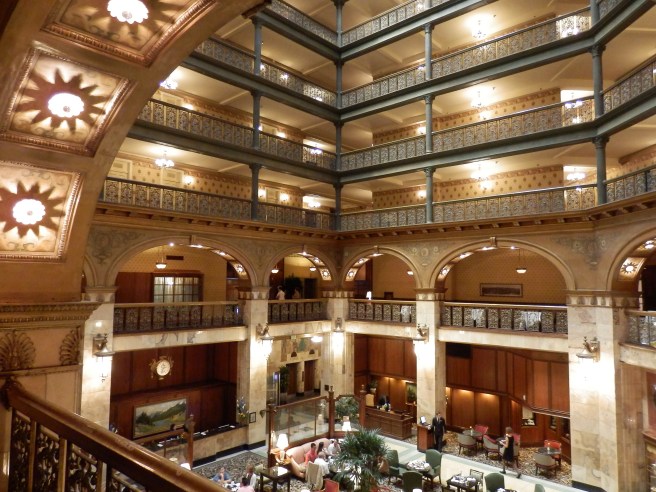
Therefore, when one walked into a new skyscraper for the first time, it was easy to perceive if the building was a single- or a double-loaded corridor scheme: if the skylight was down at the second or third floor, the building was a double-loaded corridor scheme; if you walked into a breathtaking, tall multistory atrium, the building was a single-loaded corridor plan.
Frank E. Edbrooke, Brown Palace Hotel, Denver, 1893. Atrium. (Author’s collection)
2.11. THE LIGHTCOURT EXPOSED ON THE EXTERIOR
Adler & Sullivan, Union Trust Bank, St. Louis, 1892. (Online)
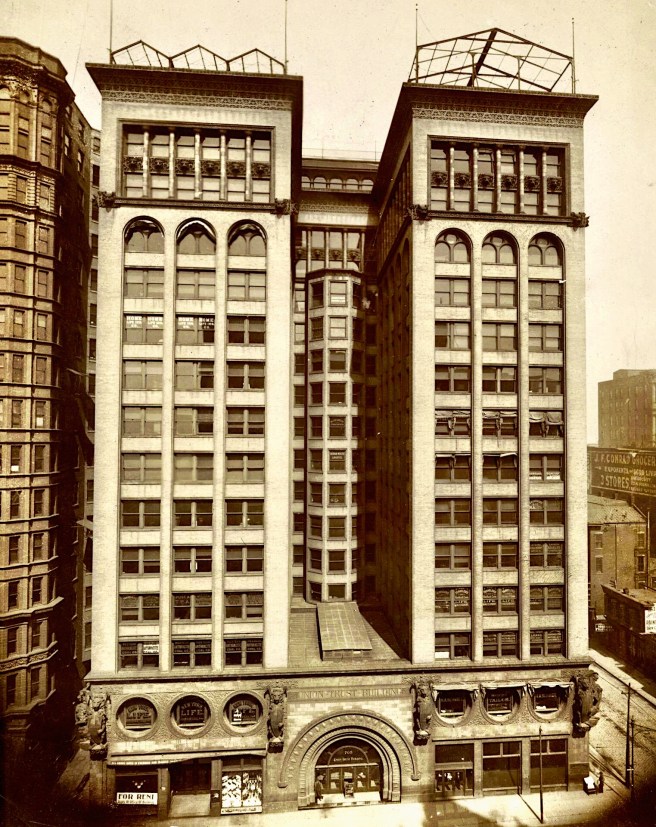
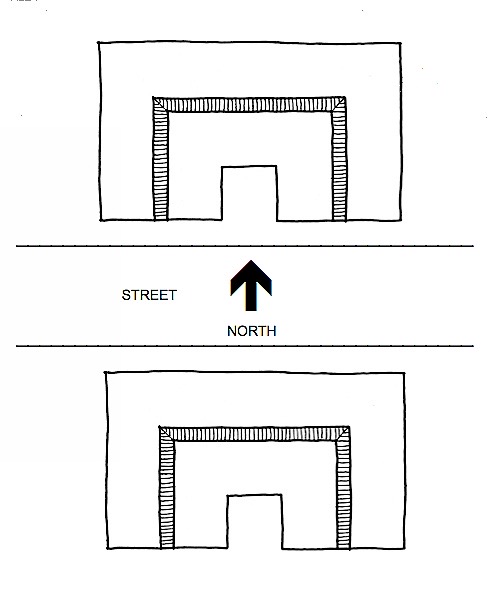
These rules held only for sites that were free from adjacent buildings on all four sides, a rare opportunity seldom granted to a nineteenth century architect. More often than not, an architect would have to modify these rules to take into account such factors as the shape of the site, the site’s orientation with respect to the south or the sun’s direction, the widths of adjacent streets and the corresponding shadows of all surrounding buildings. For example, a building’s overall image could depend upon what side of the street it was to be erected. It was most desirable to have the lightcourt open to the south to maximize daylight AND to minimize the effect of shadows cast by the building itself. Therefore, if the street ran East/West, and if the site was on the north side of the street, the lightcourt would be exposed in the street front. However, if the site was located on the south side of the street, the street front would read as one continuous plane. Therefore, the exact same building would have a completely different street front depending upon which side of the street it was to be erected.
Diagram showing an exterior lightcourt on the north and south sides of a street. (Author’s collection)
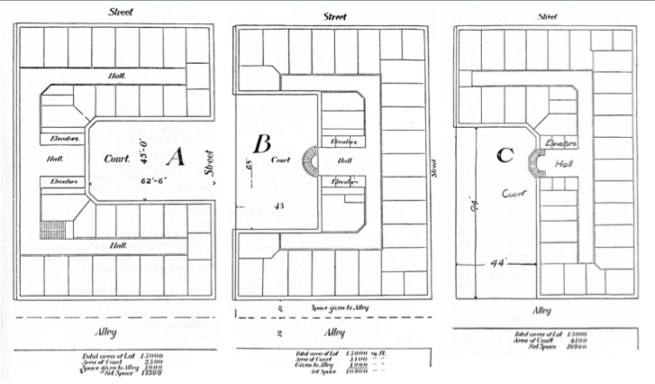
In his talk, Root chose such a site so that he could show the number of plan variations that an architect would experiment with, and how each would be evaluated, during the process of designing a skyscraper.
John Wellborn Root, Studies of planning a skyscraper. (“A Great Architectural Problem,” Inland Architect, June 1890.)
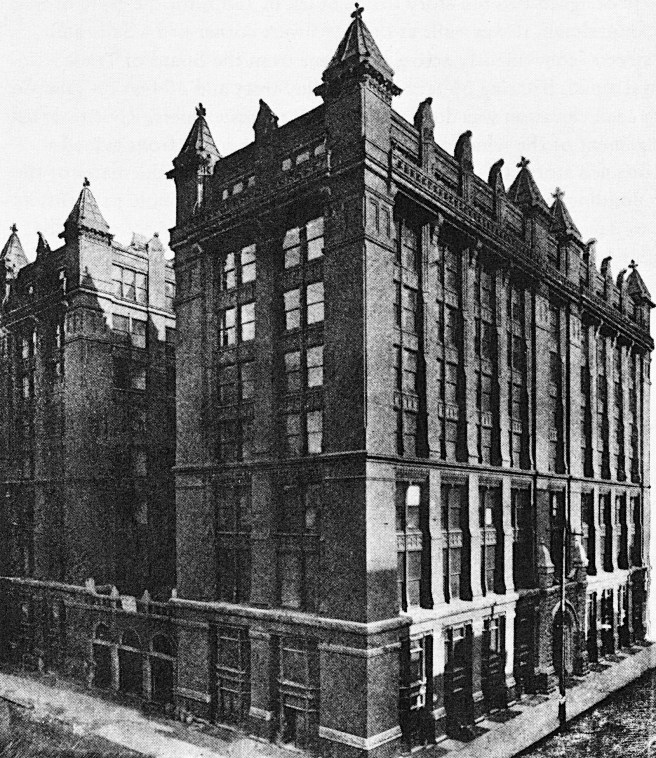
The exterior lightcourt could not, however, always be completely enclosed within a building’s interior. In his study of alternative floor plans, Root included some that placed the lightcourt in such a manner that its existence was revealed on a street front of the building. In addition to how this detail would impact the daylighting of the building, he also emphasized how this option would impact the design of the building’s exterior.
Burnham & Root, Chicago, Burlington and Quincy Railroad Building, Chicago, 1881. (Hoffmann, John Wellborn Root)
Instead of presenting to the street a solid plane that ran the length of the lot the building’s mass would be broken into flanking wings at each corner which would be separated by the void of the lightcourt.
Burnham & Root, Rialto (Armour, Kent, and Bensley) Building, Chicago, 1883-5. Both types of street facades are visible in this photo. (Hoffmann, John Wellborn Root)
This would give the building’s perception from the exterior a completely different read, or feel, that, obviously, also had to be put into the final design equation. The lightcourt, then, played a central role in the early design process of a skyscraper. Historically, we will see that it will be one of the most important aspects of the early skyscrapers. Not only did the lightcourt determine the overall plan of a skyscraper, and in some buildings it provided an exhilarating spatial experience, especially when one boarded an open cab to ride up to the top floors with the rush of air and space as the elevator made its way to your floor: there were no walls surrounding you, you were in an iron cage that whisked you up at a speed you probably had never experienced until then.
Burnham & Root, Masonic Temple. Elevators at Ground floor. Note the full glass wall behind the elevator bank and no walls in front or to the sides of each cab. A thrilling ride, indeed, for 20 stories. (Hoffmann, John Wellborn Root)
The lightcourt will also be the location in a skyscraper where architects would historically first experiment with reintroducing iron skeleton framing into the exterior wall, following the Chicago and Boston fires.
S.S. Beman, Pioneer Press Building. Atrium. The glazing enclosing the stairs and elevators was added in a recent renovation. (Online)
FURTHER READING:
Hoffmann, Donald. The Architecture of John Wellborn Root. Baltimore: Johns Hopkins University Press, 1973.
Hoffmann, Donald. The Meanings of Architecture: Buildings and Writings by John Wellborn Root. New York: Horizon, 1967.
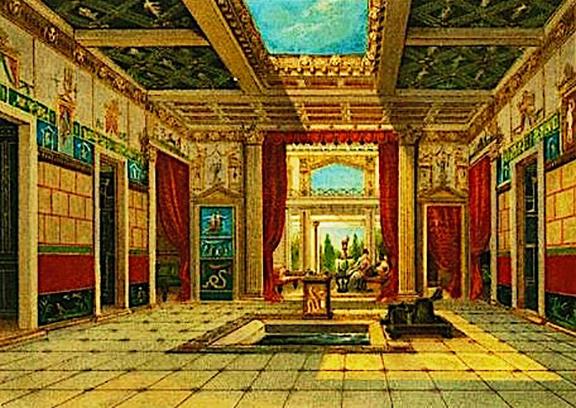
Reconstruction of House of Sallusti, Pompeii. (Online)
The skyscraper was first, and foremost, commodity. That is, the commodity of rentable (that is, usable) square feet. The single reason for its existence was to multiply the amount of usable area of one’s property by stacking one floor on top of another. The key word in a nineteenth century skyscraper was “usable.” As interior space in buildings throughout history, up to the advent of air conditioning and fluorescent lighting in the early twentieth century, was completely dependent upon access to daylight and natural ventilation provided by operable windows, there was a natural limit as to how far from a window a person could be located and still be able to reasonably function. We only need to go back to the Roman house to see how a building must be designed in order to perform “naturally,’ that is without the aid of electricity. A Roman urban house was planned around the open-air atrium, a central, unroofed space that provided daylight, ventilation, spatial relief, and fresh rainwater for its inhabitants.
Palazzo Strozzi, Florence. (Online)
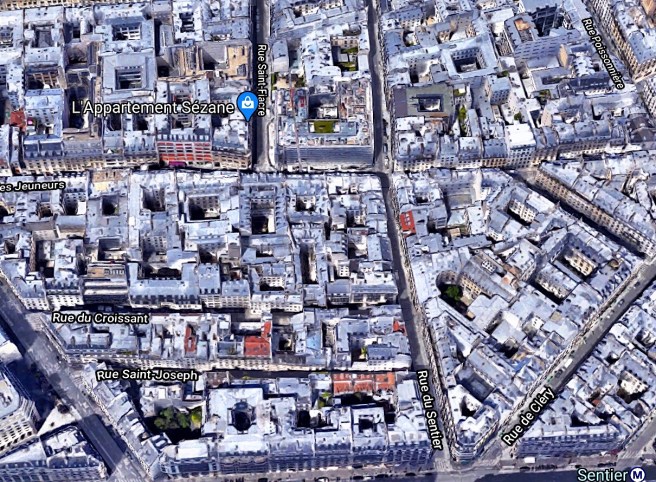
This was updated in the Renaissance to a multi-storied exterior space. In essence, a traditional urban building, stretching back to ancient Rome, therefore, was a hollow box: a person would build walls up to, and around one’s lotlines, and then line these walls with usable space that relied on the central opening, the atrium, for daylight and ventilation. When one looked down from above, a pre-electric city comprised of hollow buildings.
Birdseye View of Paris, showing the use of lightcourts in 19th century buildings. (Online)
2.8. THE DOUBLED-LOADED CORRIDOR WITHOUT AN ATRIUM
Depth of Daylight Penetration Through a Window (Online)
The maximum distance from a window to ensure effective daylighting is 24′ to 25,’ depending upon the height of the ceiling. An 11′ ceiling, with the windows pushed right up to the edge of the ceiling could provide sufficient daylight up to 24′ away from the window. A lower ceiling would obviously reduce the penetration depth of the daylight, reducing the distance from the window that would be provided sufficient daylight to function. In a paper that Root delivered to an architectural class at the Art Institute in June 1890 on the subject of designing a skyscraper, this is precisely where he stated an architect would start:
“Of course, the first radical question to suggest itself is that of light. And this will at once dictate certain general and entirely preliminary conditions of plan upon the ground. Experience has demonstrated that all spaces within the enclosure of four walls which are not well lighted by sunshine, or at least direct daylight, are in office buildings non-productive. The elementary question is, therefore, how to arrange the building upon its lot that every foot within it shall be perfectly lighted, and all spaces which would be dark thrown out.”
Typical floor plan of a double-loaded corridor scheme for a site with a width of 56.’ (Drawing by Kyle Campbell)
In laying out the floor plan for a skyscraper on a site, a planning module of 32′ was standard: an office depth of 24′ from the window wall plus an 8′ wide corridor, that was usually lit from the daylight within the adjacent offices by a transom located above the doors, and sometimes the corridor walls themselves. If the minimum dimension of the site was at least 56′ wide, one could use a double-loaded corridor scheme (24′ + 8′ + 24′) with little wasted area. A site dimension smaller in size would obviously require reducing the depth of the offices, until only a single-loaded corridor, 32′ would work. The challenge came when one’s site had a minimum dimension greater than 56.’ As this dimension grew, while the office depth from the window wall had to remain 24,’ the width of the corridor correspondingly increased until the overly wide hallway was simply wasteful in construction costs. The corridor would become darker and darker as the walls with the transoms grew farther apart.
Typical floor plan of a single-loaded corridor scheme around an internal atrium for a site with a width greater than 60.’ (Drawing by Kyle Campbell)
2.9. THE SINGLE-LOADED CORRIDOR WITH AN ATRIUM
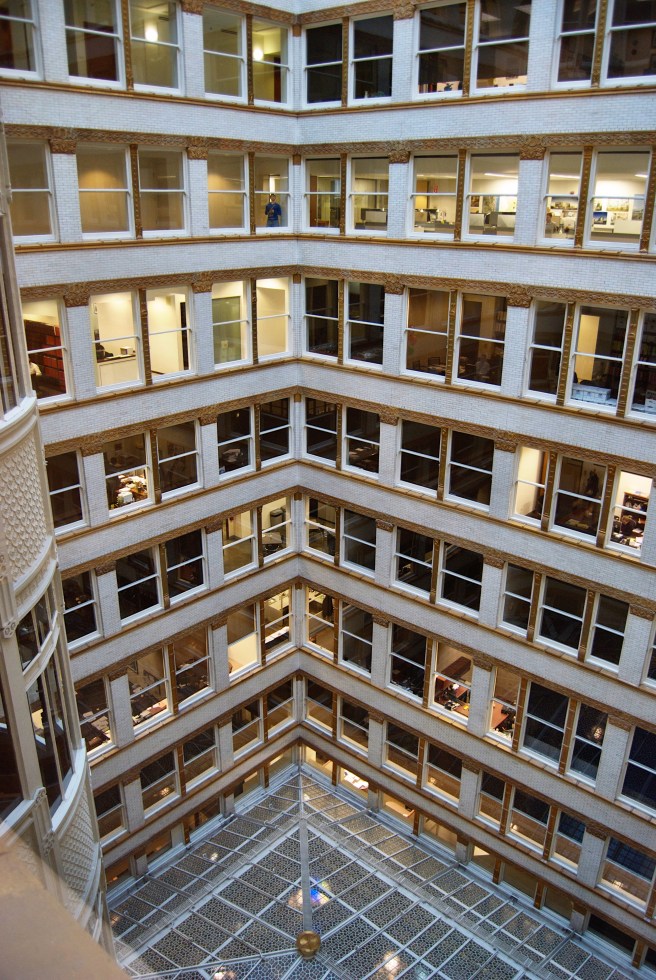
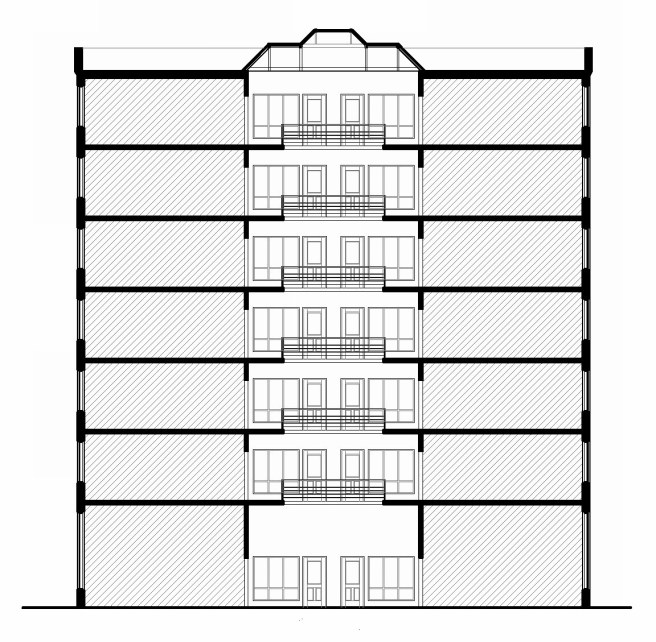
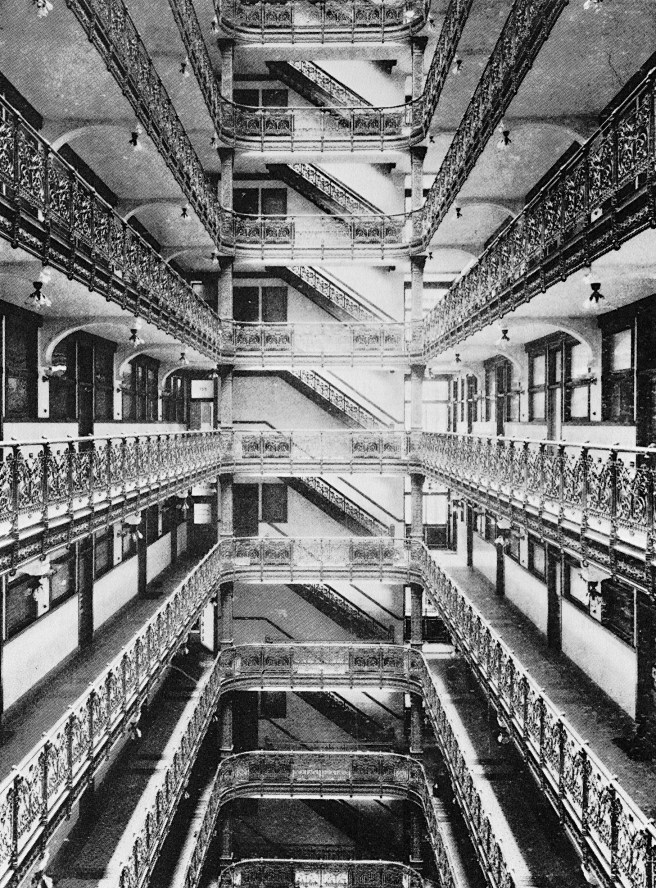
As this dimension grew larger than 60,’ it was more economical to line both edges of the site with single-loaded corridors using shallower hallways (24′ + 5′ hallway) leaving a void between the corridors that could act as a lightwell, usually running all the way to the ground floor. This permitted the daylight from a skylight at the roof to penetrate as deep into the interior as possible. This type of covered interior space, in which the corridors open into the space I define as an “atrium” as opposed to a similar type of space, with the exception that the skylight is located at the ground floor so as to make all of the floors above it open to the exterior, which I define as a “lightcourt” (although the space below the skylight will still be referred to as an atrium.
Building section of a single-loaded corridor scheme around an internal atrium for a site with a width greater than 60.’ (Drawing by Kyle Campbell)
Necessity, therefore, dictated that buildings on larger lots would always be hollow on the inside. The hallways in such a plan would feel like balconies or galleries running around the perimeter of the lightwell.
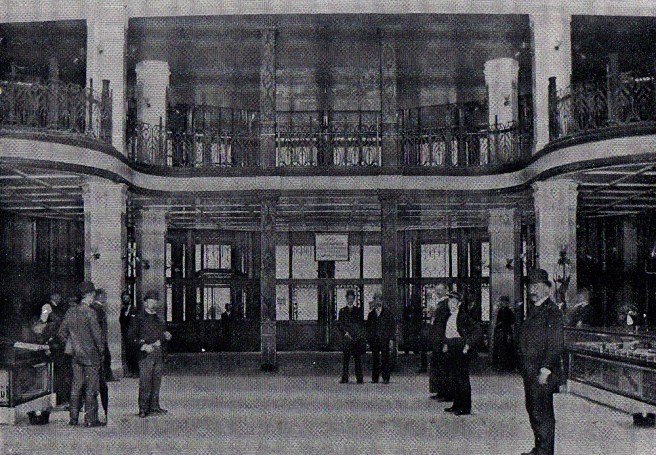
Baumann & Baumann, Chicago Chamber of Commerce, 1889. Atrium. Note the windows in the walls lining the balconies to also provide daylight. (Condit, Chicago)
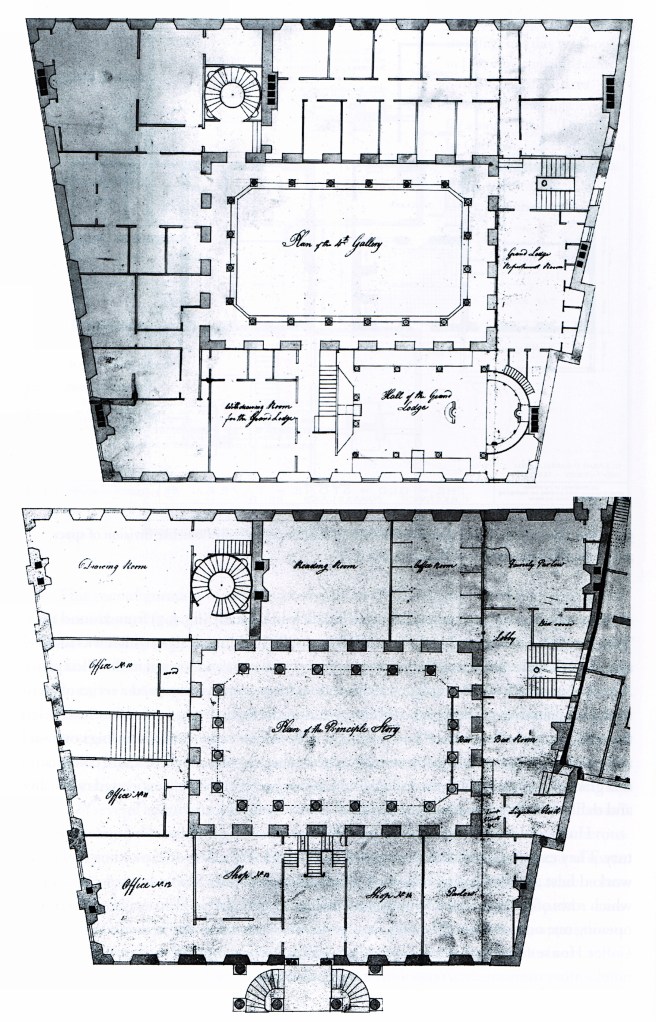
An early American manifestation of the interior lightcourt was the five-story high rotunda in the Boston Exchange Coffee House and Hotel designed in 1806 by Charles Bullfinch.
Charles Bulfinch, Boston Exchange Coffee House and Hotel, Boston, 1806. (Sandoval-Strausz, Hotel)
As technology improved by the end of the Civil War, the floors of these galleries typically would be made with glass lenses placed in the floor, so that the light could penetrate to the story below each gallery.
We will see lightwells that were as narrow as three and four feet, for the light from even these narrow slits of space was appreciated in lighting the corridors of a multistoried building, and as wide as 80.’
S. S. Beman, Pioneer Press Building, St. Paul, 1888. Atrium. (Author’s collection)
Frank E. Edbrooke, Brown Palace Hotel, Denver, 1893. Atrium. (Author’s collection)
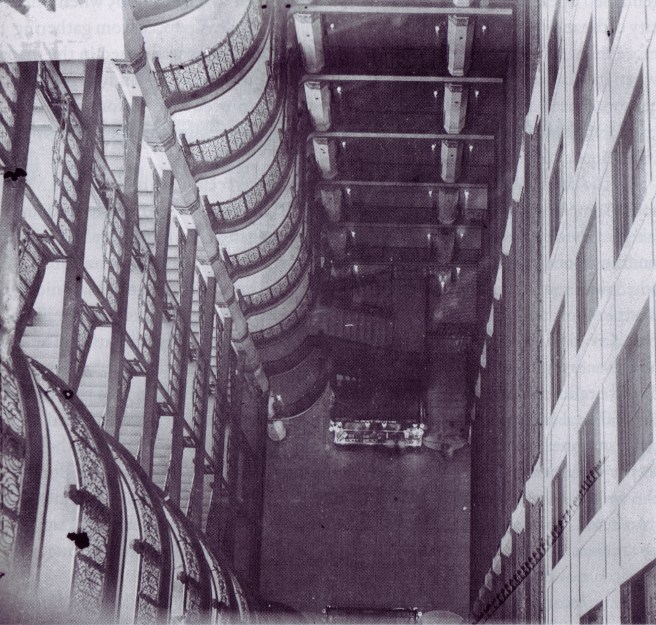
As an example, if one’s site was 65′ square, with streets or alleys on all four sides, a single-loaded corridor scheme hugging the perimeter of the lot would result in a hollow doughnut plan with a 7′ by 7′ lightwell. As the dimensions of the site grew larger, the office depth of the single-loaded corridor still remained at 24,’ so only the size of the lightcourt would increase correspondingly. The tallest atrium constructed in the nineteenth century was the 20-story high court inside the Masonic Temple in Chicago, designed by Burnham & Root:
Burnham and Root, Masonic Temple, Chicago, 1890. Atrium. (Merwood-Salsbury, Chicago 1890)
A fallacy perpetuated by many historians has been the idea that a lightcourt was “optional.” In other words, some authors would claim that the architect “chose” to incorporate a lightcourt. The nineteenth century architect had no such choice. As soon as the minimum dimension of a site reached around 60,’ a lightcourt that ran from the ground floor to the roof had to be part of the solution. This did not depend upon whether the building was an office building:
John P. Gaynor, Palace Hotel, San Francisco, 1871. The Grand Court. (Lewis, Bonanza Inn)
James McLaughlin, Shillito’s Store, Cincinnati, 1877. Atrium. (Author’s collection)
Any distance more than 25′ away from a window was simply too dark to support any effective human function. There was no option; the lightcourt was a necessity in a building up to the early twentieth century. (A sidenote: when John Portman’s Regency Hyatt House first opened in 1967, newspapers and magazines called its interior atrium “futuristic.” This, most likely, was due to the fact that most of these 19th century buildings that had atriums had been demolished to make room for even larger buildings. In other words, an entire generation had grown up having no idea that the interior atrium was a traditional component of a building, having been made obsolete with the advent of fluorescent lighting and air conditioning.)
FURTHER READING:
Sandoval-Strausz, A.K. Hotel: An American History. New Haven, Yale, 2007.
The skyscraper was a new type of building without any precedent in the history of architecture. Nobody appreciated the profundity of this fact better than Root:
“the vast edifices which have lifted themselves in New York, Boston, Chicago and other cities, until they tower heavenward nine, ten, twelve and sixteen stories, containing sometimes three or four thousand people upon whom depend the support of eight or ten thousand souls. These buildings, the result of commercial conditions without precedent, are new in every essential element.”
The fact that the skyscraper was ‘new in every element,’ however, did not release the design of one or its architect from having to respond to the universal requirements that good architecture has always had to aspire. Thus, we are initially confronted with one of the primary themes of this period: tradition vs. innovation. Throughout the nineteenth century, and especially during the early history of the skyscraper, the conflict between new ways of thinking and doing, that is, innovation, and tradition, the way things had “always” been done or thought of, will have an impact on every facet of human thought, action, and existence. The evolution of the skyscraper will not be able to escape this conflict, in fact as we will see, it was born out of this conflict.
No one throughout the history of architecture has defined the traditional requirements of good architecture more succinctly than Marcus Vitruvius Pollio, a Roman architect/engineer who lived during the first century BC. He was the author of the only complete treatise on ancient classical architecture, de Architectura, that had survived intact following the fall of the Western Roman Empire, (a copy was discovered in 1414 in the library of Switzerland’s St. Gall Abbey) in which he stated:
“All (architecture) should possess strength, utility, and beauty. Strength arises from carrying down the foundations to a good solid bottom, and from making a proper choice of materials without parsimony. Utility arises from a judicious distribution of the parts, so that their purposes be duly answered, and that each have its proper situation. Beauty is produced by the pleasing appearance and good taste of the whole, and by the dimensions of all the parts being duly proportional to each other.”
This famous quote was initially translated rather “freely” into English by Henry Wotton in 1624 as: “Well building hath three conditions: firmness, commodity, and delight.” These three words, commodity, firmness and delight, and all their variations, have been used by architectural theorists ever since as the prime objectives of good architecture. As an example, all we need to do is to return to Van Brunt’s quote at the start of this chapter: “no part of [the skyscraper] complex being overlooked, all the details of its manifold functions being provided for in the laying of the first foundation stone, and the whole satisfying the eye as a work of art as well as a work of convenience and strength.”
The skyscraper was not an exclusively American phenomenon, but it was a new type of building that evolved during the second half of the nineteenth century in which America played a leading role. Three of the most important ideas that impacted Western society and culture in this period, would also play a central role in the development of the skyscraper. These were, in no particular order of importance or chronology:
1. Technological innovation: iron, steam power (the elevator), electricity (electric light and power), the telephone, and improvements in indoor plumbing
2. Economic growth: fueled by many factors, including the technological growth above, the size of business companies increased, as did the opportunity for real estate investment
3. Nationalism: the period of 1865-1900 was beset with rampant nationalism. In 1859, Italy was unified; in 1871, German unification was completed, and America was fast approaching the 100th anniversary of the signing of the Declaration of Independence. By 1876, not every European-American (let alone African- and Asian-Americans) was an immigrant. First, second, and even third generation Americans had been born in America, and had never visited Europe nor spoke the language of their immigrant forbearers. For them, the vexing question was “What did it mean to be an American?” Was there anything unique that made them different from a person who was born and lived in Great Britain, France, Spain, or Germany? Could there, or should there be an American style of architecture that was different from the European styles that had been adopted by antebellum American architects?
These three issues can be readily mapped onto the Vitruvian ideas of good architecture:
economic growth: commodity
technological innovation: firmness
nationalism: delight
When one reviews the past histories of the skyscraper, the two central issues that historians have focused on are the development of the structural technology needed to support taller and taller buildings (firmness) and the corresponding evolution of the architectural expression of the skyscraper (delight). Commodity has been the poor cousin, as most historians have usually just assumed it occurred. This was not the case, however, for those who had to actually design an early skyscraper, as Root clearly stated over and over in his many talks on the subject, “Art in architecture is merely the expression in solid material that someone has thought about our comfort and delight.” At a very basic level, these three issues as they pertained to the design of a nineteenth century skyscraper are one in the same: that is, a skyscraper’s exterior expression (delight) at this time was dependent upon its underlying structural system (firmness), that was influenced by the need to provide a maximum of daylight for the interior (commodity). And this is where I want to begin this chapter, how these three factors, especially in terms of invention vs. tradition, influenced the design of a nineteenth century skyscraper.
John M. Van Osdel, Pre-Fire Kendall Building, Chicago, 1871. Southwest corner of Dearborn and Washington. (The Landowner, October 1871)
Hyde was quick to repeat this success with a proposal to build a similar building, based upon what Equitable had learned for its branch office in Chicago, on the site immediately across Dearborn from the Portland Block. The honor of designing Chicago’s first skyscraper was assigned to John Van Osdel, who started designing the building in early 1871, about the same time that Potter Palmer had commissioned him to design the second, larger Palmer House. Known as the Kendall Building (note the Equitable name on the flag as well as “Equitable Life Assurance” on the second floor’s spandrel), his design of Chicago’s first planned tall office building reflected the design and incorporated many of the improvements used in the Equitable Building. The Kendall’s floor heights were correspondingly increased, as can be seen when it is compared to the buildings adjacent to it. As opposed to the facade of the New York building where the floors were grouped into two-story layers, however, Van Osdel articulated each floor as its own layer, with the result that the building’s scale actually made the Chicago building look taller than its New York sibling. As such, it was the logical next step in the evolution of the precedent established with the Equitable Building and marked Chicago’s first serious entry into the competition with New York in the development of the skyscraper. The Kendall’s foundations had been laid and the lower walls were under construction when, unfortunately, the great fire started on October 8, 1871, thereby preventing Chicago from running head-to-head with New York in the further development of this new type of building. Instead of completing the original design after the fire, the building was completed without the perceived firetrap of the mansard roof, denying it the opportunity to be “tall.” New York would go unchallenged in the race to develop the skyscraper for the next ten years, while Chicago had its hands full just trying to rebuild.
John M. Van Osdel, Post-Fire Kendall Building, Chicago, 1872. The mansard roof was eliminated in the post-fire version. (The Land Owner, February 1872)
2.4. THE SKYSCRAPER GROWS UP IN NEW YORK: THE WESTERN UNION BUILDING
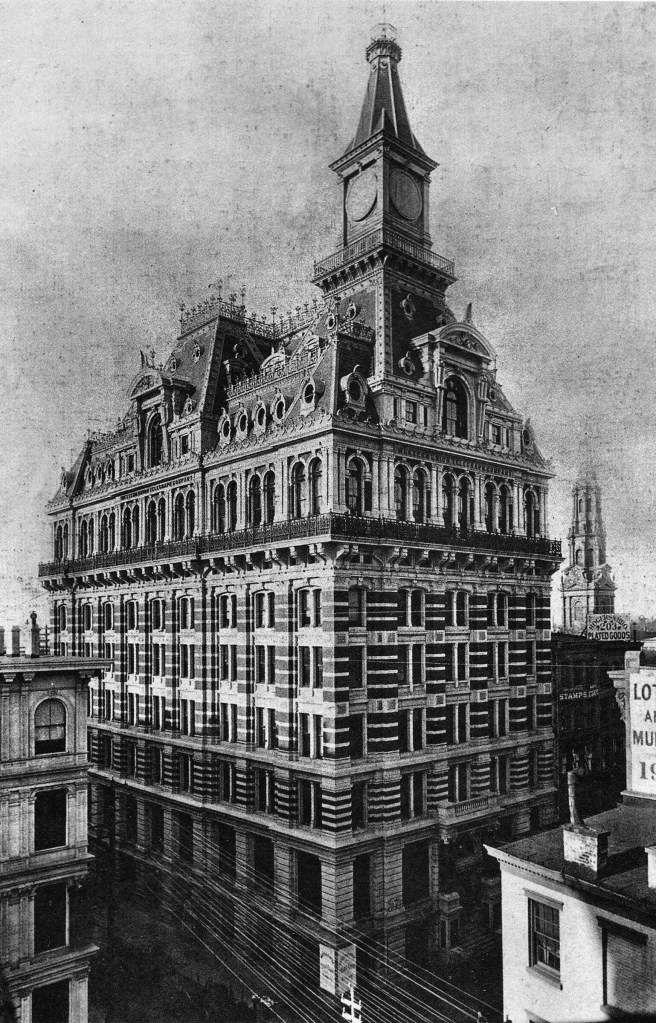
The birth of the skyscraper in New York between 1868 and 1873 was a direct result of needing more income to pay for the increasing price of Manhattan real estate, as no company as of then was so large that it required that much floor area solely for its own operations. In 1891, the Chicago publication Industrial Chicago had stated outright that “This [commercial skyscraper] style began with the Western Union building, New York, in 1873.” The Western Union Telegraph Company, whose corporate experience during the Civil War had been comparable to that of the Equitable company, had been inspired by the success of Hyde’s experiment with the elevator in his new building. Therefore, they invited its architects, Arthur Gillman and George Post, as well as Hunt, to submit designs in a competition for their new building. In August 1872, they chose Post’s design that revealed the quick acceptance of the elevator, for it was essentially an extruded version of the Equitable, with the addition of a tower. (I had mused in Volume Two’s Section 5.4. that the tower may have been a response to the recent announcement of the tower planned for Philadelphia’s new City Hall.) Equitable had proven the financial wisdom of including rental offices in a project like this to initially generate income to offset the high cost of the land in the short run, and eventually to provide space in which to expand operations as a business grew in the long run. (This was a more a cost-effective long-term alternative to the addition of more floors to an existing building at a later date.) Western Union, therefore, had increased the number of rental floors in its building to four.
George Post, Western Union Building, New York, 1872. (Silver, Lost New York)
Post located the space dedicated to the telegraph operators at the top of the building apparently for two reasons. First, as the telegraph wires were hung in the air from poles, it would be easier to bring the wires into the building at a higher level, without any potential conflict with the traffic in the street. Second, locating this huge space on the top floor meant that it could be virtually free of columns and walls, as there was no need to extend the building’s interior structure into this space because it could be spanned with deep trusses between the exterior walls.
George B. Post, Western Union Telegraph Building, New York, 1872. Top floor, operations room. (Online)
Post increased the ceiling height of this space to 23,’ not only to make it feel even more open and airy, but also to make the perimeter windows taller so that more light could penetrate deeper into the space. The column-free interior of the eighth floor would give the company as much flexibility as possible in locating the desks and equipment needed by the telegraph operators. The floor below, the seventh, was correspondingly reduced in height and dedicated to the electrical equipment, as well as to the unfettered distribution of the myriad of wires coming into the building. This type of space, now referred to as “interstitial,” gave workers easy access to all of the wires that could be rerouted in this space under the eighth floor to the appropriate operator’s station. The company’s public business operations were logically located on the ground floor, leaving the five floors between one and seven available for rental offices. The company needed one floor for its executives and management, so it chose the least desirable/rentable floor, the one in the middle of this layer, the fourth. Floors two and three were closest to the street (better access), and floors five and six were the highest above the street (better views and smells-horses!). Coupled with the four floors it needed for its operations (and two inserted within the roof trusses) as well as the gratuitous tower, the Western Union Building would be much taller (230’) than the Equitable’s height of 130.’ The skyscraper had begun to grow up.
Post, Western Union Telegraph Building. Photograph of it under construction, showing the king post trusses that will frame the mansard roof. (Landau and Condit, New York Skyscraper)
2.5. THE NEW YORK TRIBUNE BUILDING: PRE-DEPRESSION BUT POST-URBAN HOLOCAUST
The value of the “skyscraper principle” was quickly acknowledged, as the New York Tribune followed with its own new tall building. The Tribune, owned and edited by Horace Greeley, was the nation’s leading Republican newspaper, but Greeley had become disenchanted with Pres. Grant, so much so that he eventually resigned in order to run against him in the 1872 election. Fortunately, Greeley had groomed his replacement, Whitelaw Reid, who not only took over the newspaper, but bought it outright upon Greeley’s death some three weeks after the election. Reid, similar to Equitable’s Henry Hyde, was of the next generation coming into power after the Civil War who were not afraid of the latest technology. As such, he wanted the tallest building in the city to proclaim the newspaper’s position in the country’s politics and decided to do Western Union one better: he wanted a taller building with seven floors of rental offices.
Richard Morris Hunt, Study for the New York Tribune Building, New York, 1873. (Online)
Richard Morris Hunt won the competition in early 1873 to design the new building. Similar to the Western Union Building, the Tribune building’s vertical organization was also determined by function. In the case of a newspaper, the type composers needed as much daylight as possible, meaning they were always located on the top floor to take advantage of skylights. Meanwhile, the printing presses were dependent on steam power, meaning the presses were always located in the basement, which also minimized the structural impact of the machines’ deadloads and vibrations. The composers would set the lead type in a metal box and then send the finished box to the basement via a freight hoist. Again, following Post’s lead, the composing room in the top floor allowed Hunt to take advantage of the roof’s clearspan trusses to open the space as much as possible. The paper’s editorial staff occupied the ninth floor, directly under the composing room. The paper’s public contact offices were located on the ground floor, with floors two through eight leased as private offices. To claim the record of the tallest building in New York, its tower extended 30′ higher than the Western Union’s tower to a total height of 260.’
Richard Morris Hunt, New York Tribune Building as constructed, New York, 1873. (Online)
FURTHER READING:
Landau, Sarah B., and Carl Condit. The Rise of the New York Skyscraper, 1865-1913. New Haven: Yale University Press, 1996.
Burnham & Root, Insurance Exchange, Chicago, 1884. Southwest corner of La Salle and Adams. (Hoffmann, John Wellborn Root)
While thirty-year old John Root had been “in the field” for the past ten years, including having been the architectural supervisor for the construction of the country’s longest span roof (New York’s Grand Central Terminal), he had never designed a seven-story building when Owen Aldis offered him the commission for the Grannis Block in September 1880. Twenty-seven-year old Owen Aldis had even less experience with this typology, as he had only recently been hired by Peter Brooks to manage the Portland Block only the year before. When put in such a situation, a person can rely on two things: first, an objective study of the problem/s to be solved, and second, a study of the precedents, that is, what people had done in the past to solve these problem/s. Although its seven stories truly doesn’t qualify it to be called a “skyscraper,” all those involved in the building’s design, construction, and operation viewed it as a speculative office building that should take advantage of the lessons learned from the exploitation of the elevator in this type of building. Over the course of the next decade, Aldis, Root and his partner Burnham, would develop the “skyscraper” as first invented in New York, into a work specifically engineered for Chicago and as a work of art specific to the United States. No one has better summarized their achievements than America’s premiere architectural critic at this moment, Henry Van Brunt:
“A ten-story office and bank building, fire-proof throughout; with swift elevators for passengers and freight, a battery of boilers in the deep sub-basement giving summer heat throughout, and supplying energy for pumps, ventilating fans, and electric dynamos; equipped like a palace with marbles, bronze and glass, flooded with light in every part; with no superfluous weight of steel beam, fire-clay arch, or terra cotta partition; no unnecessary mass of masonry or column; the whole structure nicely adjusted to sustain the calculated strains and to bear with equal stress upon every pier of the deep foundation, so that no one shall yield more than another as it transfers its accumulated burden to the unstable soil beneath—such a problem does not call for the same sort of architectural inspiration of a vaulted cathedral in the Middle Ages, but, surely, for no less of courage and science, and in providing for the safe, swift and harmonious adjustment of every part of its complicated organism, for a wider range of knowledge. The one required a century of deliberate and patient toil to complete it; the other must be finished, equipped, and occupied in a year of strenuous and carefully ordered labor; no part of its complex being overlooked, all the details of its manifold functions being provided for in the laying of the first foundation stone, and the whole satisfying the eye as a work of art as well as a work of convenience and strength. Whether one compares a modern building of this sort with a cathedral of the first class, with one of the imperial baths or villas of Rome, or with the Flavian Amphitheatre itself, it must hold equal rank as a production of human genius and energy, not only in the skillful economy of its structure and in its defiance of fire and the other vicissitudes of time, but as a work of fine art developed among practical considerations which seem fundamentally opposed to expressions of architectural beauty.”
2.1. THE SKYSCRAPER PRINCIPLE: THE EQUITABLE LIFE ASSURANCE BUILDING
Henri-Jules Borie, Aérodômes, Paris, 1867 redesign of his original 1865 proposal. (Design Quarterly, 85, 1972)
Van Brunt’s summation was an elegant accounting of the achievement in evolving the Chicago skyscraper. But to better appreciate what had been accomplished during the 1880s, we need to have a starting point: what did Burnham and Root have in the way of precedents to inform their design in 1880? Where were architectural design and skyscraper science in 1880? In Volume One, I documented the design and construction of the Equitable Life Assurance Building, what I consider to be the first skyscraper, or at least the first manifestation of what I call the “skyscraper principle.” However, I also pointed out that in was in Paris, two years earlier in 1865, that Henri-Jules Borie, an engineer and social philosopher had proposed not just an individual tower but had designed an entire utopian urban complex that comprised of not one or two, but twenty-five 11-story towers and two 11-story four-block long monster courtyard blocks. By 1865 at the height of the Second Empire, the population of Prefect Georges-Eugène Haussmann’s reconstructed Paris was exploding as people flooded into the city from the rural countryside in search of work, and it appeared that the ballooning population of Paris would eventually have to be housed vertically. Marrying the new technology of the passenger elevator to the by then well-understood iron skeleton frame, Borie had designed his Aérodômes, the first skyscraper as a multistoried apartment building, not as an office building, as would be the case in the U.S.
Kendall & Gilman with George Post, the Equitable Building (left center) in relation to the Bowen & McNamee Warehouse (center). Image has been altered by removing the Mansard roof that was added later to the warehouse. (Weisman, Art Bulletin, December 1954)
Following the end of the Civil War, Equitable Life Assurance Company’s indefatigable and single-minded founder, Henry Baldwin Hyde had planned the erection a new building to house its growing operation. In October 1867 eight local architects were invited to submit drawings in a competition for the design of the building. The committee chose Gillman & Kendall’s design of a building that contained seven floors above a raised basement. Seven floors in a commercial building at this time should raise some eyebrows, as the typical limit of floors in such a building, even in Paris at this time, was usually five, or if it was pushed, six. One is also struck by the exaggerated height of the Equitable’s first floor that would only add more stairs to climb for those going to the upper floors. The extra height in the Equitable Building could only have been feasible with the use of an elevator. Although elevators had been incorporated into New York buildings prior to the Civil War, apparently no one prior to Hyde had yet to realize that individual stories, let alone entire buildings could be made taller with the use of an elevator without any physical inconvenience in reaching the upper stories. The building had two elevators manufactured by Otis Tufts that were located across from each other in the building’s stairway, that was efficiently located midway in the floor plates. Contrary to contemporary practice, the elevators ran not in open caged shafts, but masonry shafts, more than likely a response to Hyde’s concern over fire. This significantly reduced the light available in the elevators that was provided by a skylight at the top of the shaft, windows in each floor’s door, and a gas chandelier in each cab. The building had opened in May 1870 and the actions of a new group of people, “the rising generation,” were documented by the Insurance Times:
“It was remarked that the members of the rising generation invariably availed themselves of the “lift,” while many of the adults and aged were content to ascend the stairs by use of the pedal extensions which Dame Nature herself had provided for their locomotion. Is this a sign of the degeneracy of the times, or of Young America’s innate and practically appreciative adoption of every mechanical improvement?”
Another result of the post-war increased demand for office space was the steep increase in the price of Manhattan real estate. The decision to include an elevator was made by Hyde so that three floors of rental space could be included that would help to pay for the increased price of land in downtown Manhattan. (While this was the initial reason for the inclusion of the extra floors, one must also think that Hyde also foresaw the continued growth of his company, with an eventual increase in the need for more office space.) An elevator would also permit the floor-to-floor heights in the building, such as the ground floor, to be increased, therefore, not only would more window area be available for daylighting, but the higher ceiling also allowed the light to penetrate farther back into the interior of the building, meaning that a greater percentage of the lot’s square footage could be utilized as rentable space on each floor. This interrelationship between the use of an elevator to add more floors to a building that would generate extra income to offset the increasing price of urban real estate is what I refer to as the “skyscraper principle.”
2.2. WHAT IS A “SKYSCRAPER”?
Can we agree that a skyscraper is simply a multistory building that is taller than the conventional pre-elevator building that throughout history had been limited to five or six stories, because the human body with normal effort, could walk up five flights of stairs? However, with the advent of the passenger elevator, the number of floors, as well as the floor-to-floor height of each floor, in a building could be increased, simply because access to the higher floors had been divorced from the vertical dimension one had to physically traverse via stairs. It goes without saying then, that without the invention of the elevator, there could be no skyscrapers.
Kendall & Gilman, with George B. Post Equitable Life Assurance Building, New York, 1868. (Landau, George B. Post)
A skyscraper must also be a “building,” whose interior space has a daily function: residential, office, and/or commercial. This definition, then, rules out church steeples, monuments, and bell towers. People do not live in these types of structures on a daily basis, and therefore, do not have to contend with the physical effort to climb to top of these structures on a daily basis. This does not mean that these types of structures were unimportant in the history of the skyscraper. Quite the contrary is true, as these structures often provided the inspiration and details for an architect during the process of designing a skyscraper. As such, these types of structures will be discussed in this study when it is appropriate to do so.
Therefore, a skyscraper is a multistoried building used by people on a regular basis whose height is taller than the five-six story urban datum of pre-elevator equipped buildings. Simple as this seems, many definitions over the past century have been developed to describe tall, multistoried buildings. Some of these were developed by architectural historians to be highly exclusive in order to promote one narrative over another. One city wanting to claim as having been “the birthplace of the skyscraper,” or an historian wanting to champion a specific architect as “the father of the skyscraper.” By the very nature of attempting to be exclusive, the result, intentional or not, would leave tall buildings that were constructed earlier than the one being championed by the particular definition, needing to be called a term other than a “skyscraper.” Some of these invented terms included protoskyscraper, elevator building, and even cage construction (to differentiate from the “real” skyscrapers that had to be iron-framed). The tall buildings that were constructed before the “chosen one” first skyscraper could be called any term but a “skyscraper.” That word was reserved for the particular building that the historian was attempting to posit as having been “the first.” As far as this study is concerned, the Equitable Building, as was first articulated by historian Winston Weisman in 1953, was the first skyscraper.
FURTHER READING:
Gray, Lee E. From Ascending Rooms to Express Elevators:A History of the Passenger Elevator in the 19th Century. Mobile, AL: Elevator World, 2002.
Hoffmann, Donald. The Architecture of John Wellborn Root. Baltimore: Johns Hopkins University Press, 1973.
Landau, Sarah B. George B. Post, Architect. New York: Monacelli Press, 1998.
Burnham and Root, John B. Sherman House, Chicago, 1874. Southwest corner of Prairie and E. 21st.. (Online)
In Volume Two, we saw that Peter B. Wight, after he had moved to Chicago following the 1871 fire to join Asher Carter and William Drake in Carter, Drake and Wight, had brought the twenty-two year old John Root to Chicago in early 1872 and made him the foreman of the office. Later that same year, as a favor for a friend, Wight had also hired his friend’s peripatetic twenty-six year-old adult son, Daniel H. Burnham as a draftsman. The younger Root seems to have had a maturing influence on Burnham, and the two young men quickly became good friends, moonlighting together on small jobs. With the economy in full bloom and a promised commission to plan a new suburb procured by Burnham, the two left Wight with his blessing and started their partnership on July 5, 1873. However, ten weeks into the partnership, the roof caved in on September 19 with the stock market crash. The projects on their boards dried up, leaving them to fend as best they could during the winter of 1873-74. Root gained some income by playing the organ in Boyington’s First Presbyterian Church, attesting to his innate musical abilities. (Harriet Monroe in her biography of Root related a tale that on one Sunday morning, the impish Root played a theme and variations on ”Shoo-fly” so slowly that nobody had recognized it.) They used their “down time” wisely to sharpen their knowledge of architectural history, by copying details from books and magazines and then quizzed each other until both could identify a detail from which country it was from within ten years of its design.
They survived with a few small house designs until their first major commission proved eventually to be responsible for much of the enormous success of the firm. In 1874, George Chambers, a mutual friend of both Root and John B. Sherman, who had by then become the general superintendent of the Union Stockyards, had recommended them to Sherman who was looking for an architect to design a new house for his family at 2100 Prairie Avenue. Root’s design reflected the latest architectural stylings: the Néo-Grec of Hunt and Furness, the English “picturesque” Queen Anne in its overall form, details inspired by Viollet-le-Duc’s just published Second volume of his Discourses, and Ruskin’s constructional polychromy: red pressed brick, beige sandstone, black slate, columns of dark blue granite, black slate roof tiles, and red and beige terra cotta chimney pots. Root added his own residential touch, a steeply-sloped gable roof, for he believed in snow-plagued Chicago, that “in this climate no house standing alone can be good without a visible roof.”
Burnham and Root, Entry Gate to Union Stockyards, 1876. The influence of Frank Furness, following Root’s trip to the 1876 World’s Fair is evident in the corbelled window frame to the left, and the framed segmental arched portals to either side of the main gate. (Online)
During the design and construction of the house, Burnham fell in love with Sherman’s daughter, Margaret, whom he married on January 20, 1876. The marriage into the Sherman family not only immediately established connections with the stockyards (for which Burnham and Root designed the buildings erected after 1874, allowing the young firm to stay in business during the depression), but more importantly would also establish contacts through Sherman with all of the power brokers of Chicago’s railroads and the Board of Trade. With Burnham’s marriage, Burnham and Root had moved onto the fast track to success.
But then Root did Burnham one better, for on January 15, 1880, he married Mary (Minnie) Louise Walker, the daughter of Sherman’s boss, James Monroe Walker who at the time had been the president of the Stockyards since 1873 (by this time Sherman was its vice-president). After James Walker (1820-1881) had graduated from the University of Michigan in 1849, he joined the Michigan bar and soon became the General Solicitor for the Michigan Central. This required him to move to Chicago in 1853 where he in addition to his work for the MC, he established a private practice, eventually taking on Wirt Dexter as his junior partner. In 1855 he also became the General Solicitor for the Chicago, Burlington, and Quincy Railroads, becoming its president between 1871 and 1876, when he returned to being its General Solicitor. Root’s joy was tinged with great sadness, however, as Minnie had contracted tuberculosis after the engagement but before the wedding and died on February 22, only six weeks after the wedding.
Nonetheless, Root continued to live with his in-laws for a while. Therefore, Burnham and Root had, by 1880 consummated their relations with Chicago’s upper crust (both young men had rich and powerful fathers-in-law who lived on THE STREET: Prairie Avenue. Walker at 1720 Prairie, just north of where the Glessners will build, and Sherman three blocks farther south at the southwest corner of Prairie and 21st). They now had intimate connections with both the Board of Trade (whose directors were at this moment secretly planning to vacate the Chamber of Commerce building for a new building they were planning to build opposite the La Salle Street Station) soon to be on S. La Salle Street and Boston’s railroads to Chicago for which the Bostonians were planning the construction of the C. & W. I. station and the corresponding development of Dearborn Street. They were about to have their cake on La Salle Street and eat it on Dearborn. As they had married into Chicago’s elite, they were undoubtably invited to the same functions that Owen Aldis attended, where that one fateful Summer evening Root and Aldis found themselves at the same house and the fortunes of Root and Burnham took a quick turn to greatness. Personally, the recently bereaved Root needed just such a challenge that Aldis had presented to him the next day to help him through the grieving process over the loss of Minnie. There was only one problem as Aldis walked out of Burnham & Root’s office the next day, however: none of these three men knew much about designing a seven-story office building.



















 The Architecture Professor