2.13. ST. LOUIS AND CINCINNATI MAKE THEIR BIDS FOR THE CONVENTIONS

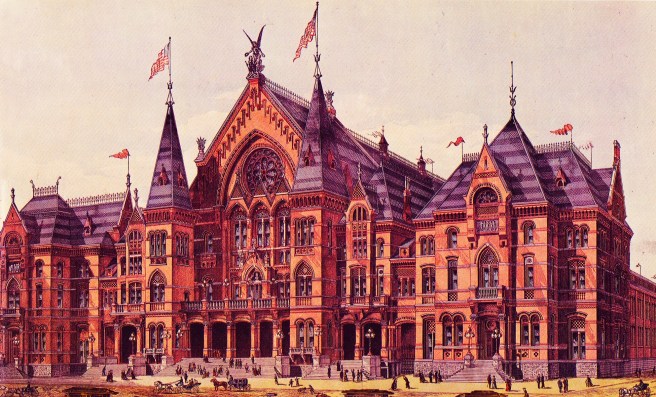
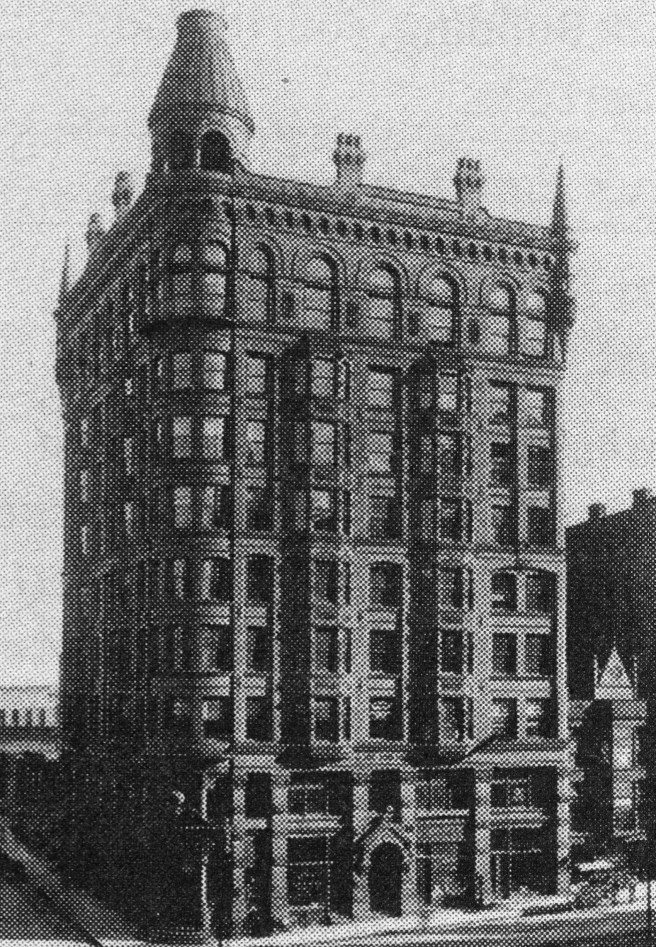
Jerome Bibb Legg, St. Louis Exposition and Music Hall, 1883. (Online)

While Peck had succeeded in getting the President to come to Chicago for the Cornerstone parade, the 1888 conventions were another matter. True, Chicago had pulled off a minor miracle by hosting both conventions in 1884, but their return in 1888 was, by no means a foregone conclusion. Chicago’s monopoly in 1884 had only ignited the ambitions of its rival cities.  St. Louis, that had lost its title of the “largest city in the West,” that it had wrestled from Cincinnati during the Civil War, to Chicago only after the 1871 fire, was finally beginning to appreciate the value/worth of “culture.”  In 1883, more than likely after Chicago had bagged both conventions, the city began construction of a facility to challenge Cincinnati’s Music Hall, the St. Louis Exposition and Music Hall. Designed with a seating capacity of 3500 (vs. Cincinnati’s 3627), the entire facility covered over six acres and boasted an early installation of electric lights.

But six acres was chump change compared to how Cincinnati responded to the challenge.  1888 would be Cincinnati’s centennial, having been founded in 1788 (Chicago was only 55 years young in 1888).  The city had planned an expanded version of its annual Ohio Valley Expositions for that year (July 4 – October 27) as an appropriate celebration (and as a lure for either convention).  Music Hall with its two exhibition wings would still be the nucleus of the 47 acres of landscaped fairgrounds, that were to be expanded with the erection of two temporary buildings. 
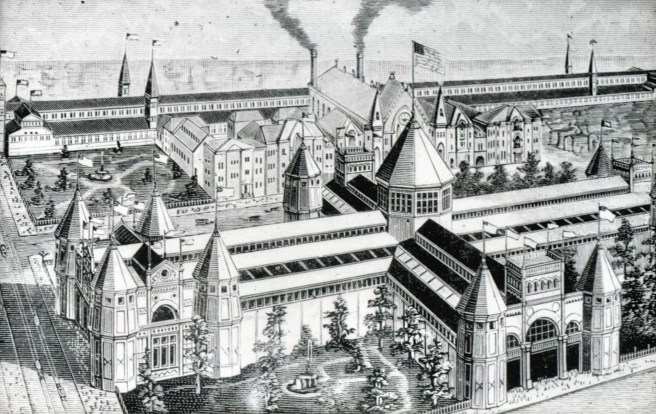
1888 Cincinnati Centennial Exposition. Foreground: Park Hall (Main Building); Midground: Music Hall; Background: the 1300’ long Machinery Hall, built spanning the Erie & Miami Canal. (Online)

The large main exhibition, Park Hall, erected across Elm Street from Music Hall in Washington Park had a two-storied cruciform plan, one arm being 600’ x 110’ while the smaller arm’s plan was 400’ x 110’ with their intersection covered with a dome that offered a public observatory.  (Park Hall alone was larger than the St. Louis structure.)
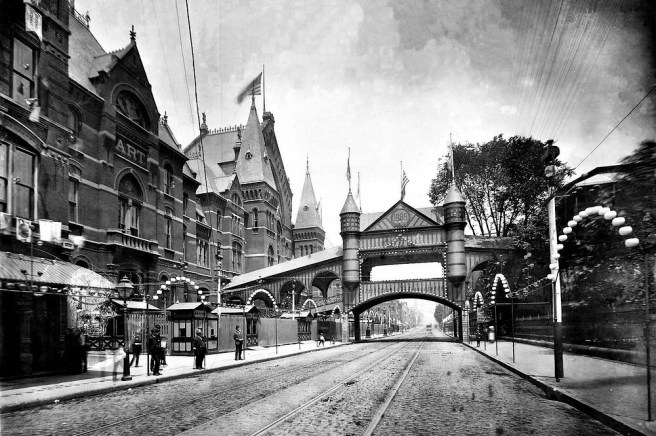
1888 Cincinnati Centennial Exposition. View north up Elm Street with Music Hall’s entrance on the left. Note the electric lights erected on both sides of the streets. (Online)
1888 Cincinnati Centennial Exposition. The buildings were open every night until 10 PM, made possible with the celebration of the electric light. (Miller, Cincinnati’s Music Hall)

Meanwhile, at the rear of Music Hall, what became the public’s favorite attraction, a gargantuan 1300’ long by 150’ wide Machinery Hall spanned the Erie & Miami Canal. It was designed by James McLaughlin (i.e., Shillito’s and the Cincinnati Art Museum) to be a Venetian delight. Four bridges, inspired by Venice spanned the canal within the building, where gondolas and their gondoliers, imported from Venice poled their boats up and down the canal that summer, including a daily parade of decorated barges, attempting to give Americans a taste of what the Italian city proffered, (and offering a tempting invitation to both political parties).
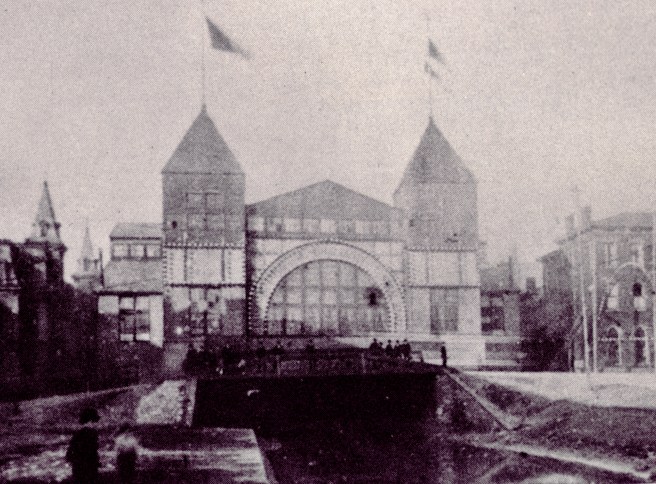
James McLaughlin, Machinery Hall, 1888 Cincinnati Centennial Exposition. Above: Boat entrance. (Miller, Cincinnati’s Music Hall); Below; Venetian gondolas being poled by gondoliers. Note the electric lights at the far left. (Online)

Between the two new buildings, there was more than 950,000 sq. ft. (21.5 acres) of exhibition space located within the 47 acres of landscaped grounds and this didn’t include Music Hall.  As had St. Louis done, the Cincinnati fair buildings and the grounds were lit day and night with gas and electricity, in all colors.   Fifteen states and three foreign countries presented a variety of delights for visitors.  Unfortunately for Cincinnati, neither party took the bait, and the Centennial Exposition was to be the city’s swan song, as Chicago’s Auditorium was rapidly nearing completion.

2.14. PREPARING FOR THE 1888 REPUBLICAN CONVENTION

Hannaford & Proctor, Music Hall, Cincinnati, 1877. (Online)

Looking back at these two projects, Peck’s urgency to push forward with his plan to build the Auditorium makes more sense, especially before the Haymarket bombing.  When he had first posed the project in front of the audience on the last night of the 1885 Opera Festival, the St. Louis Hall was nearing completion and plans for the Cincinnati Centennial had to have been under discussion. Peck could project forward three years and see Chicago falling woefully behind the convention/music facilities of its two regional competitors.  But he could convince none of his civic-minded (and “frugal”) associates to financially back his project for over a year,  that is, until the bombing and its aftermath had brought his equals to their collective senses.

The month following the cornerstone laying saw a hardening of the positions of both the master masons and the unions following the execution of four of the Haymarket defendants on November 11, 1887, that propelled both political parties into the Presidential election of 1888.  Peck was hoping for a repeat of the 1884 nominating conventions, that both took place in Chicago’s Exposition Building, which would secure his vision for the Auditorium.  The Inter-Ocean stated Chicago’s case in its usual, “detached” manner:

“Cincinnati is bidding high for the National conventions in 1888.  This is not discreditable to Cincinnati, but it constitutes no good reason why the conventions should be held there.  Cincinnati has been tested.  The 1880 Democratic convention was a trying mouthful, and Cincinnati surely remembers the wry faces the gentlemen from the South made over it.  Courtesy would require Cincinnati to wait until she is asked for the second test; but already she is urging the Democrats to try again what they clearly enough sickened over before.  In the meantime the Democrats have been to Chicago, and are eager to come again… So far as the Republicans convention is concerned Chicago will be favored by the friends of the leading candidates, because to come to cosmopolitan Chicago is to escape from sectional or State bias and to meet under conditions fair to all… The moral to all this is that Chicago ought to have both the National conventions in 1888.

Both parties initially were favorable to such a plan, with the Republicans committing first in December, to hold their convention on June 19-25.  Peck was hoping that this would force the Democrats to return to Chicago, especially as it had been the site of the start of Cleveland’s successful campaign.  But the United Carpenters Council of Chicago would have none of it, and notified the Democratic National Committee “that the consolidated building trades of the United States would refuse to support any man who was nominated in the Auditorium Building… and a political boycott would be declared that would cost the offending party 250,000 votes.” The Democrats chose St. Louis for their convention, held first between June 5-7, and still Cleveland lost the election, but the Auditorium would never host a Democratic Presidential Convention, to the utter dismay of Peck.

St. Louis Exhibition and Music Hall. 1888 Democratic National Convention. (Online)

FURTHER READING:

Siry, Joseph M. The Chicago Auditorium Building. Chicago: University of Chicago Press, 2002.

(If you have any questions or suggestions, please feel free to eMail me at: thearchitectureprofessor@gmail.com)

2.11. ONE YEAR AFTER HAYMARKET: TURNING BRICK INTO STONE – DESIGN #4

The construction of the foundations was well under way when Lautrup’s third and final rendering was made public in mid-April.  At this time, the exterior above the two-story granite base, including the tower, was still designed to be brick and terra cotta.  It had been a relatively quiet winter (1886-7) primarily because of the heavy-handed response to the bombing by Chicago’s business leaders, as the eight Haymarket defendants had been found guilty and their appeals were making their way through the legal system.  But as May 1, 1887, the traditional start of new leases and corresponding construction contracts, and the first anniversary of the May 4 bombing approached, Chicago’s construction unions were regaining their confidence as they were gearing up for their annual contract demands.  Among these were the eight-hour workday, a uniform minimum wage, union shops, and a Saturday payday.  The most powerful of these unions at this time was the United Order of American Bricklayers and Stonemasons of Chicago.  On Friday, April 29, the union had presented its demands to the city’s Master Masons, the local masonry contractors.  Prudently, the Master Masons waited for the anniversary of the bombing to come and go, before they rejected these demands on the following day, May 5.  The Union countered on May 10 with the demand for a strict union shop that the Master Masons not only rejected, but also instituted a lock-out throughout all of the city, that shut down all construction and idled an estimated 30,000 construction workers that lasted for two months until the union finally caved in and agreed to arbitration on July 11.

On May 6, the day after the Master Masons had rejected the initial demands of the bricklayers’ union, with only 13 months until the start of the Republican National Convention, the Executive Committee of the Auditorium Association adopted a resolution that unilaterally changed the material on the upper eight floors in the latest design from brick to Indiana limestone.  (Lautrup’s rendering of the third design had been finished only the month before!) It is obvious from the chronology of these events that the Master Masons had already decided to resort to the lockout to weaken the Bricklayers Union, and the Executive Committee was in no mood to either have the construction on the project halted during the lockout, or even show the slightest support for any union.  (Siry pointed out the local stonecutters had succeeded in having their demand for an eight-hour day agreed to by the local stoneyards, so this may have emboldened the Board to switch to stone, knowing that the supply of stone would not be threatened.) What better message could be sent to the bricklayers’ union than to strip all of the brick from the exterior of the largest construction project in the city?!  Of course, stone is denser and heavier than brick, and therefore, this decision on the part of the owners would result in the building’s significant differential settlement between the interior footings and the now heavier-loaded perimeter footings  because Adler’s carefully calculated footings, were already under construction (the settlement of the exterior is 18” more than the interior at places that slanted the floors towards the outside walls and eventually made the floor of the Main Foyer a skateboarder’s dream).

Undoubtedly, Adler had warned his betters against such a decision, but sometimes one must cut off one’s nose to spite one’s face…  And so, the most important aspect of the design of the Auditorium’s exterior, what material to use to enclose the interior, that from the beginning had been designed to be pressed brick, was changed solely by the building owners as an anti-union political statement.  (Therefore, one cannot link the Auditorium’s stone exterior to Richardson’s Field Store, as many historians have done in the past.) Unfortunately for them, they made this decision too late and it resulted in the undulating floor surfaces that at times made it quite impossible for those same owners and their wives to easily make their way to their private boxes.  

2.12. LAYING THE CORNERSTONE

Curiously, while the 1887 lockout agreed to by all of Chicago’s owners, builders, and suppliers had completely shutdown construction throughout the city, the sounds of construction, including those of non-union bricklayers, continued to be heard at the corner of Michigan and Congress during May, June, and July… Peck was trying to walk a dangerously thin tightrope: while his ultimate goal was to create a national monument where both the Republicans and the Democrats would gather every four years to nominate their presidential candidates, he was damned if he would let his archrivals, the radical labor unions, prevent him from completing his lifetime objective: the Auditorium, as a response to the unions’ agenda and activities, would be built solely with non-union labor.   Unfortunately for Peck’s dream, his worldview was not shared by all those in the Democratic Party…

Construction on the Auditorium’s substructure continued throughout the summer of 1887 and Peck looked forward to the next opportunity for national exposure, the laying of the building’s cornerstone on October 6, 1887.  During the nineteenth century, this event, especially for large public buildings, was celebrated with Masonic rituals and the accompanying grand oratory.  Peck had personally invited Democrat President Cleveland to come to Chicago for his first official presidential visit to the city where he had been nominated three years earlier, to participate in the ceremony.  Cleveland had agreed to Peck’s proposal and all was going as planned until the carpenters’ union got wind of Peck’s plans.  There had been no love lost between the unionized carpenters and the Auditorium Association.  The carpenters had attempted to gain recognition for their union during the spring of 1887 until the bricklayers’ union’s action had forced the owners and builders to initiate the lockout, that affected all of the building trades.  With only a week before the President was scheduled to arrive, the union informed the President, in no uncertain terms, that if he participated in Peck’s ceremony, they would not only boycott it, but also view his participation as supporting Peck’s anti-union stance, with the obvious implication for the upcoming Presidential election.

While Cleveland correspondingly gave in to the union’s threat and reneged on his promise to Peck, the President tried to please both sides (as any good politician does) by agreeing to review the usual parade that accompanied such a ceremony, if it was moved up a day to October 5, 1887.  This would divorce it directly from the cornerstone ceremony, and implicitly, the Auditorium.  Peck deferred to the President’s offer, but still coyly maximized what public exposure he could by having the President’s reviewing stand constructed on the Auditorium’s site, overlooking Michigan Avenue and the lakefront.  Meanwhile, the date of the first day of the Republican Convention was scheduled for June 19, 1888.  Adler & Sullivan had eight months (with at least four of these during the winter) left to redesign and redetail the exterior, redraw the working drawings accordingly, and erect the country’s largest permanent concert hall. Fortunately, the first two floors of granite were not effected so their construction could proceed as scheduled, The rest of the city, however, was quiet. Following the end of the lock-out on July 11, owners were in no hurry to begin construction just before the traditional winter slowdown began.  Their plans could keep until spring of 1888.

Adler and Sullivan, The Auditorium. (Cannon, Sullivan)

FURTHER READING: 

Cannon, Patrick F. Louis Sullivan: Creating a New American Architecture. Petaluma, CA: Pomegranate, 2011.

Historic American Buildings Survey-The Auditorium: https://loc.gov/pictures/item/il0091/

Morrison, Hugh, Louis Sullivan: Prophet of Modern Architecture. 1935. Reprint, New York: W.W. Norton, 1962.

Siry, Joseph M. The Chicago Auditorium Building. Chicago: University of Chicago Press, 2002.

Twombly, Robert. Louis Sullivan: His Life & Work, Chicago: University of Chicago Press, 1986.

Twombly, Robert and Narciso Menocal. Louis Sullivan: The Poetry of Architecture. New York: Norton, 2000.

(If you have any questions or suggestions, please feel free to eMail me at: thearchitectureprofessor@gmail.com)

2.10. DESIGN DEVELOPMENT: THE FOUNDATIONS

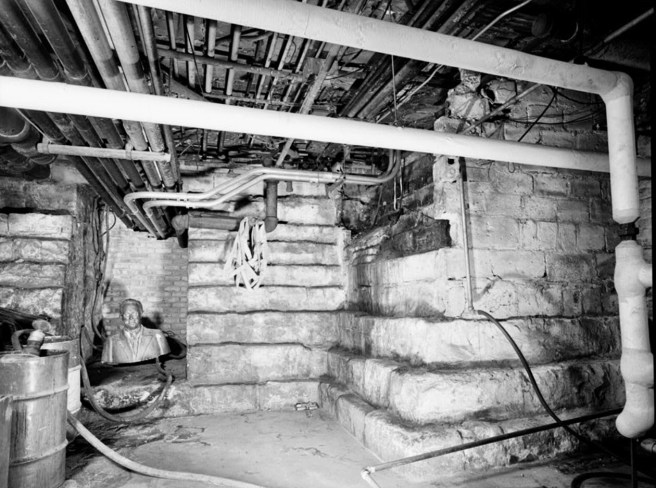
Adler & Sullivan, The Auditorium. Photograph showing the stepped stone foundations. (Historic American Building Survey IL-1007)

During the four-month period between mid-December 1886 and mid-April 1887, in which Sullivan was thoroughly immersed in revising the overall design of the building’s exterior to gain the approval of a majority of the Board, Adler was hard at work planning its engineering and construction.  As we have seen during this period, many of Chicago’s architects were still providing the services of what we now call the general contractor/construction manager, that is, responsible for the building’s actual construction.  While Adler would be responsible for overseeing the contracts and construction of the building’s structure and exterior enclosure, Sullivan would serve the same role for the building’s interior fittings.

Adler & Sullivan, Auditorium Building. Construction photo. Looking from the NW corner on Wabash towards the lake. (Inland Architect, March 1888)

Peck and his supporters were in a hurry to get the project under construction if for no other reason than to send a message to the rest of the country that things had quieted down since the Haymarket Square bombing and the ongoing court case, and that business was getting back to normal so it was now quite safe to renew investment in the city’s real estate.  Today, starting construction before the design of a building is completed is standard practice, but for such a large building as the Auditorium, to start construction before the design was finalized, however, at that time in history presented those responsible with a series of great risks.  Adler knew he had a few months to play with as it would take that long to clear and excavate the site to the depth required for the building’s foundation that had begun on January 28, 1887. Nonetheless, at some point, if he was going to keep the project moving forward, the building’s final design and size would have to be frozen soon so that he could accurately design its footings so that their construction could start as soon as the excavation had been completed.  This occurred immediately following Sullivan’s trip to New York to consult with Ware on February 12, with the entire office going into full production mode to produce the final design, layout, dimensions, and the over 200 hand-drawn drawings needed to assist the construction workers in their efforts.

Adler & Sullivan, The Auditorium. Section. Note the depth of the stage basement and the thickness of its slab/foundation. (Siry, The Auditorium)

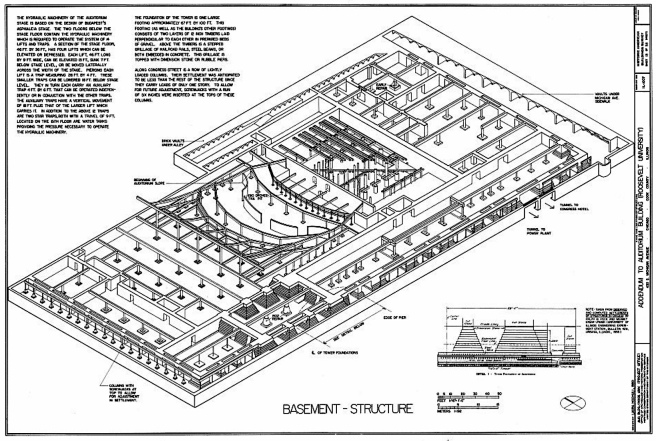
Adler used these drawings to calculate the loads in every wall and column so that he could accurately size the required bearing area of each footing.  Among the issues that Adler had to contend with were, 1.) the proximity to the lake and the corresponding high watertable and its hydrostatic pressure; 2.) the foundations of adjacent buildings, especially those of the Studebaker Building adjacent to the north (excavation had to be done in such a manner that the foundations of existing buildings didn’t move); and 3.) the desire to locate a basement below the stage as deep as possible to permit the usage of the latest stage equipment (that posed its own problem as the building’s own foundations immediately surrounding the stage would be at a much shallower elevation, and thereby, potentially could exert pressure on the stage’s foundation walls. Another unique foundation problem that Adler faced was the construction of the water-tight basement under the stage to house the stage’s hydraulic equipment. This required a space that was 18’ below the floor of the stage, a depth of 22’ below grade, which put this floor at an elevation that was seven feet below the mean level of Lake Michigan.  The hydrostatic pressure of the ground water at such a level required a great amount of sheer weight to resist its potential uplift.  Adler designed a three-foot thick “laminated floor built up of several layers of concrete, Trinidad asphalt, and asphalt-saturated felt, counterweighted by concrete and steel rails.”  Wanting to keep the Ground Floor level with the sidewalk for commercial reasons and still have a basement under it with a ceiling height of ten to fourteen feet for “a boiler and machinery plant of nearly 2000 horse power, incidental to the lighting, heating, cooling, ventilating, elevator, kitchen and laundry apparatus of the building required for its suitable accommodation an area equal to fully two-thirds that of the entire building,” Adler was forced to push the foundations to a level seventeen feet below street grade, a depth heretofore never attempted as it was thought to be of questionable strength (thirteen feet had been the traditional limit up to this time).

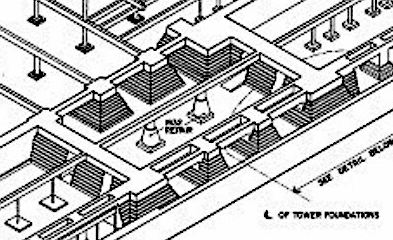
Adler & Sullivan, The Auditorium. Above: Cut-away isometric showing the foundations; Below: Close-up of the tower’s foundations. (Historic American Building Survey IL-1007)

Of particular concern to him was to get the foundation for the 16-story tower right.  By this time the Board of Trade’s 303’ tower was beginning to show signs of distress as a direct result of Boyington’s naïve attempt to spread the tower’s concentrated weight over the entire building’s foundation raft, rather than isolating it on its own footing. The result of this decision was that the tower was settling at a greater rate than the rest of the building simply because it weighed much more than the body of the building.  Even the six-foot thick raft foundation of stone, concrete, and timber that Boyington had placed under the entire building was not strong enough to resist this.  Therefore, as the tower was settling at a faster rate, it was pulling the immediate material of the adjacent body with it, creating some very large cracks. (Eventually this would force the building owners to remove the tower completely, in order to preserve the rest of the building.) This Adler, obviously, was committed to avoiding, and so, he dedicated a foundation just for the tower that he knew would be more heavily loaded than the rest of the foundation.  He sized it employing Baumann’s theory of isolated footings in an attempt to equalize the settlement of the tower and that of the rest of the building, and in so doing, hoped to eliminate the differential settlement that was tearing the Board of Trade apart. 

Adler & Sullivan, The Auditorium. Section of the tower foundations. The 5’ thick raft foundation consisted of, from the bottom: two layers of 12” x 12” timbers, laid perpendicular to one another. The wood was presoaked anticipating its being wet from the groundwater; a 12” layer of concrete; three to four layers of steel rails or beams (depending upon the loads) crisscrossed to each other; these were embedded in a 3’ thick concrete slab. Note the continuous 15” steel beams used to join the tower’s footings to the adjacent footing. (Online)

Adler designed the tower’s foundation to be a five-foot thick raft or mat comprised of a series of layered materials.  First, Adler placed two layers of water-saturated heavy timbers directly on the ground (they were saturated as a response to the presence of the ground water to minimize any chance of dry rot caused by an alternating cycle of being dry, then wet).  On top of this were laid “three layers of criss-crossed steel rails and three layers of iron I-beams.”  The whole was surrounded into a monolithic slab with concrete.

Because he was still going to use masonry stepped pyramidal foundations under the entire building (Root had only used the first rail-reinforced footings the previous winter and the jury was still out on how well these would perform over time), the tower’s foundation would be even more heavily-loaded, requiring a greater area of bearing to spread their loads at the same pressure as the other footings, with a corresponding increase in their height.  This meant that the footings for the tower would have to be taller than those of the rest of the building, and therefore, would need to be even deeper than those of the rest of the building so that the extra height of these foundations didn’t extend into the floor of the tower’s vestibule.  Adler placed these at eighteen feet below grade.  Nonetheless, Adler still “hedged his bet” somewhat, in that he tied the tower’s foundation to the footings that were immediate adjacent to those of the tower with 15” deep steel beams that ran continuously through the tower’s entire foundation, hoping that any extra settlement of the tower would be resisted by and spread to the adjacent footings via these beams. Adler also understood that the tower would take longer to construct than the lower body of the building. This may seem obvious to you, but it presented a significant problem: because the tower weighed more, he had to make the tower footings so much larger than those of the rest of the building in order to have the same bearing pressure and resulting settlement, once construction had been completed. So far, so good… However, this meant that because the tower’s footings were larger, during the erection of the first ten stories, the pressure under the larger tower footings (and its settlement) would be less than that of the rest of the building (i.e., both the tower walls and the body walls were 10 stories high, thereby weighing the same; but the footings were larger under the tower, spreading the load over a greater area resulting in less settlement than the walls). When construction of the tower above the body began to impose more weight on its footings, the tower would continue to settle while the body did not and would tear apart the tower from the body, much like wha was happening in the Board of Trade.  Adler, therefore, “preloaded” the tower footing with bricks and pig iron that equalled the weight of the six extra stories of the tower before the construction of the main block began, and then once construction of the tower above the body began, removed, floor by floor, an amount of dead wright from the footing that corresponding to the weight of the floor that was being constructed.

FURTHER READING: 

Historic American Buildings Survey-The Auditorium: https://loc.gov/pictures/item/il0091/

Morrison, Hugh, Louis Sullivan: Prophet of Modern Architecture. 1935. Reprint, New York: W.W. Norton, 1962.

Siry, Joseph M. The Chicago Auditorium Building. Chicago: University of Chicago Press, 2002.

Twombly, Robert. Louis Sullivan: His Life & Work, Chicago: University of Chicago Press, 1986.

Twombly, Robert and Narciso Menocal. Louis Sullivan: The Poetry of Architecture. New York: Norton, 2000.

(If you have any questions or suggestions, please feel free to eMail me at: thearchitectureprofessor@gmail.com)

2.9. THE THIRD DESIGN (BY WILLIAM WARE)

Adler & Sullivan, Auditorium Building. Construction photo. Looking from the NW corner of the lot on Wabash towards the lake. (Inland Architect, March 1888)

Adler wasted no time with work clearing the site beginning on January 28, 1887. The next day, the Board approved a series of changes that Adler & Sullivan had made “in the main” (the second design) and directed the architects to “complete the drawings of the exterior of the building in substantial accordance with the recommendation of Prof. Ware.”  Peck reported back to the papers that the design was changing “in the direction of severe treatment.”  I want to emphasize the importance of the Board’s directive to their architects to follow Ware’s recommendations.  For all practical purposes, much of the final overall design of the Auditorium’s exterior would be the product of William Ware and not Louis Sullivan.

Adler & Sullivan (with William Ware?), Design for the Auditorium, April 1887. Note that the exterior material above the granite base is still brick and terra cotta. Watercolor by Paul C. Lautrup. (Siry, The Auditorium)

To prove this point: Peck and Sullivan then traveled to New York to consult with Ware on February 12 to finalize the design, after which it was then fully detailed in a set of drawings and another watercolor by Lautrup that were finished in April 1887, that for all practical purposes represented the penultimate design.  One must assume that the majority of the changes in this version were the result of Ware, as the Board had given him what amounted to de facto control over the design of the building’s exterior.  In addition to his recommendation of January 17 to remove the pyramidal roof, the entire surface of the building appears to have been greatly simplified and unified.  Adler assigned responsibility for this to the budget realities facing the building team, but one can also credit Ware’s more sophisticated design experience for the starkness of the exterior. Ware had simply removed all of Sullivan’s characteristic ornamental proclivities (bay windows and gratuitous arches) from the body of the building in order to reveal the repetitive bay nature of the building’s structure, an appropriate expression for such a monumental building.  The naked body of the building’s structure needed little else, other than just the right amount of rhythm.

Adler & Sullivan, The Auditorium. Left: Second Design, Dec. 1886; Right: Third Design, April 1887.

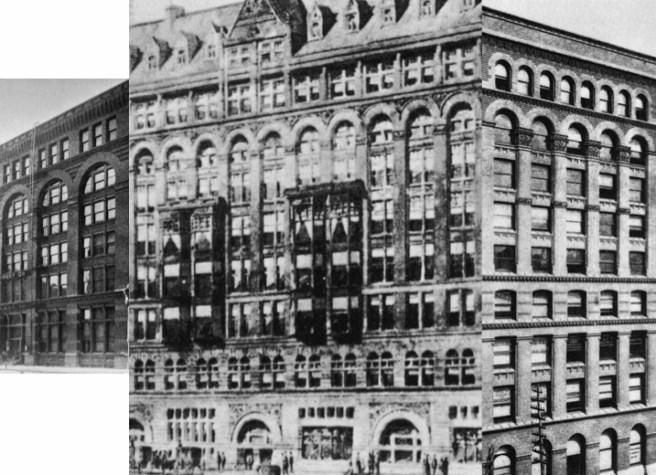
The overall appearance of this version of the exterior is much more resolved than either of Sullivan’s earlier attempts.  In no uncertain terms this was due to the complete elimination of the bay windows, the elimination of continuous sillcourses at the eighth and ninth floors, à la the Field Store (thereby achieving Ware’s recommended 3-4-3 layering scheme), and the redesign of the arcade replacing Root’s detailing from the Insurance Exchange with the employment of George Post’s detailing of telescoping, concentric arches from the Produce Exchange (which concept, we will soon see, was also used by Adler in the theater’s cross-sectional profile).  

George B. Post, Produce Exchange, New York, 1880. (Online)

The telescoping arches focused one’s sight upon the arcade as the dominant element of the elevation (there was no focus on Sullivan’s two attempts) by pushing the windows farther back, allowing the depth of the wall to be read, as well as reducing the visual thickness of the piers without impacting their structural section. Quite frankly, it is hard not to assume that Ware had accompanied the pair of Chicagoans during their visit on a personal tour of the Produce Exchange to get a firsthand look of what he was recommending for the similarly-scaled Auditorium.

Adler & Sullivan (with William Ware?), The Auditorium. Design for the Auditorium, April 1887. Detail showing the “transitional” Third Floor carrying the rock-faced texture of the lower two floors into the third floor rendered in the darker color of the pressed brick upper floors using either a matching-colored terra cotta or stone.

This latest design kept the two-story granite base but revised the third story transitional layer by extending the rock-face texture of the granite base into this story while being rendered with a darker stone or terra cotta to match the brick in the upper seven floors.  Ware then revised the top seven floors into a layered progression of openings that was a masterful blend of the best of Post’s and that of Richardson’s designs.  He used Post’s rhythm of 4:2:1 in the number of floors in each layer, while he incorporated a 1:2:3 ratio in the number of openings in each bay (even though both of his precedents had used a 1:2:4 ratio).  Meanwhile, Ware rejected Post’s strict horizontal rhythms and kept Sullivan’s original use of Richardson’s technique of extending the rhythm of the main structural piers into the upper layers to give the building a counterbalancing vertical accent to the block’s dominant horizontal proportions.  

Left: George Post, New York Produce Exchange. Note that Post had used a three-arched entry; Right: Adler & Sullivan, The Auditorium. Third Design, April 1887.

A very subtle difference from both Post’s and Richardson’s designs was in the detailing of the upper arcade that instead of grouping floors eight and nine into a two-story arcade by recessing the spandrel at the ninth floor, Ware cut the windows of each story into the smooth wall surface, thereby merging floors eight through ten into the “top”layer of his 3:4:3 layering that also allowed the arcade in the middle layer to be the dominant focus of the elevation. Ware used of a continuous sillcourse at the eighth floor (that Ware had stopped short of the corner pier à la the Field Store) that reinforced the boundary of this layer that was then broken at the ninth floor to allow the main structural piers to extend continuously for both floors.  If for no other reason than this move in and of itself, I must credit Ware and not Sullivan for the design of this elevation, as this detail is simply too subtle to expect the inexperienced thirty-year old Sullivan to appreciate, let alone employ it.  

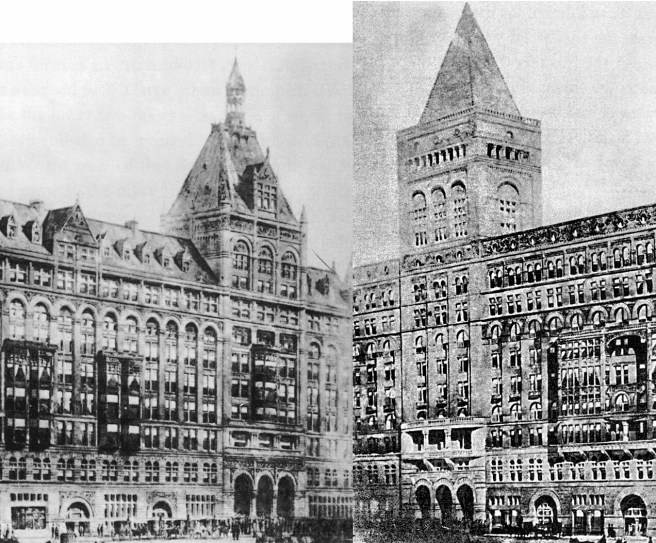
Left: Adler & Sullivan, The Auditorium. Second Design, December 1886; Middle: Third Design, April 1887; Right: George Post, New York Produce Exchange. Note how Ware had revised the tower detailing so that it read as a continuous vertical element, similar to how Post’s tower read. In Sullivan’s second design on the left, the cornice continues past the tower, visually separating the upper part of the tower from what should be its lower body.

The influence of the Produce Exchange can also be seen in the redesign of the Auditorium’s tower, that in true “Windy City” fashion, was projected to a height of 236,’ some twelve feet taller than its Gotham precedent.  While the incongruous pyramidal roof was eliminated from the tower, the tower itself was correspondingly elongated with the addition of another floor to a total of 16 stories to compensate for the loss of the height of the pyramid so that it still had a vertical proportion complementary to the horizontal body of the building. Once again, Ware’s greater sophistication is evident in how he articulated the tower versus Sullivan’s earlier design.  In Ware’s design, the tower was given a vertical dominance over the horizontal body by simply projecting its mass subtly in front of that of the body’s, thereby also allowing it to be visually linked with the Theater’s entrance. There is no question that the larger vertical weight of the tower is the dominant force in this scheme in that Ware had stopped the uppermost piece of the body’s cornice trim from continuing through the tower. The tower’s continuity was reinforced by detailing its four piers as seven-story unbroken vertical surfaces, in front of and stopping the sillcourses at floors eight and ten. In Sullivan’s second design, the cornice continues past the tower, visually separating the upper part of the tower from what should be its lower body.  This confusion is further blurred by Sullivan’s carrying the sillcourses at eight and nine past what should have been the tower’s unbroken piers.

FURTHER READING: 

Historic American Buildings Survey-The Auditorium: https://loc.gov/pictures/item/il0091/

Morrison, Hugh, Louis Sullivan: Prophet of Modern Architecture. 1935. Reprint, New York: W.W. Norton, 1962.

Siry, Joseph M. The Chicago Auditorium Building. Chicago: University of Chicago Press, 2002.

Twombly, Robert. Louis Sullivan: His Life & Work, Chicago: University of Chicago Press, 1986.

Twombly, Robert and Narciso Menocal. Louis Sullivan: The Poetry of Architecture. New York: Norton, 2000.

Van Zanten, David.  Sullivan’s City: The Meaning of Ornament for Louis Sullivan. New York: Norton, 2000.

(If you have any questions or suggestions, please feel free to eMail me at: thearchitectureprofessor@gmail.com)
2.8. PLAYING FOR TIME: WILLIAM WARE IS INVITED TO REVIEW THE DESIGNS

Adler & Sullivan, Design for the Auditorium, December 1886. Watercolor by Paul C. Lautrup. (Siry, The Auditorium)

Four days later Peck tried to move the Board towards his choice of Adler & Sullivan by proposing to invite outside experts to come to Chicago and review their designs, hoping that such approval would sway a majority of the Board.  Peck had added the caveat to his proposal that Adler had to personally agree to such a review that he did at the next meeting on December 22.  Martin Ryerson (the Ryerson Building, among other Adler & Sullivan projects) then quickly followed up Adler’s consent with a motion that Adler & Sullivan be confirmed for the commission, but the opposition would have nothing of it.  Why be in a hurry to make such a decision until the experts weighed in…?

The expert agreed to by the Board who was invited to Chicago to review the designs was none other than Prof. William Ware of Columbia University, the same person who had chosen Burnham & Root’s entry in the Kansas City Board of Trade competition only six months earlier.  Siry wondered out loud why Peck and the Board had not turned to Nathan Clifford Ricker, the founder of the architecture program at the University of Illinois, the second collegiate school started in the country, to review the design?  He claimed that this revealed “how far Chicago architects and patrons were willing to cede aesthetic judgment to eastern architects.”  His implication is the obvious: if this group was as dedicated to a “Midwestern” architectural movement as later historians have portrayed it, why did they bring in Ware instead of Ricker to judge the design? 

Although it is true that Marshall Field viewed eastern architects in such a light (his house was designed by Richard Morris Hunt and Richardson had designed the Wholesale store), my interpretation of Ware’s invite differs from Siry’s.  Peck viewed the project as a national conventional center (as we will soon see). Ware was recognized as the country’s leading authority on architectural education, and as such, was chosen undoubtedly to lend an air of national legitimacy and publicity to the entire project.  If we view the construction of the Auditorium as a campaign on the part of the city’s business leaders to overcome the negative publicity of the Haymarket Square bombing, then it would reinforce the campaign to bring in a national expert, rather than Ricker, a regional expert to review the building’s design.  It also must be remembered that Peck needed the Burnham & Root camp to approve the choice and Ware had successfully run the competition for the Kansas City Board of Trade that Burnham & Root had won, so there would be little hesitation to approve the choice of Ware from Peck’s opposition. Therefore, I view the choice of Ware as having been politically expedient and in no way ideological.

While Ware had probably taught Sullivan thirteen years earlier during his sole year at MIT, there is no evidence that Ware had any recollection his former student.  There was also no opposition to Ware’s invitation from the Burnham & Root camp, who more than likely were successful in suggesting Ware as compensation for the loss of holding a direct competition.  Ware traveled to Chicago in mid-January and after reviewing both designs, recommended three significant revisions to the second design: 1.) remove the pyramidal roof, 2.) add two more stories to the tower to compensate for the visual loss of the pyramid, and 3.) rework the detailing of the elevation in order to achieve a 3-4-3 composition by making a three-story base, a four-story arcade, and a three-story top.  New Yorker Ware’s recommendations, especially those revising the overall massing bore a striking relation to George Post’s red brick box design of the New York Produce Exchange.  The influence of George Post on Chicago’s architecture would continue to spread.

George B. Post, Produce Exchange, New York, 1880. (Online)

Following Ware’s presentation of his recommendations to the Board on January 17, 1887, it was time for the Burnham & Root camp to play their cards, as reported by Sullivan in a letter he wrote to his brother, Albert, three days later:

“Mr. Pike: Professor Ware, I judge from the tenor of what you have just said, that you have confined your effort solely to estimating the artistic quality of the present designs, and to a search for means to improve them in detail, -assuming always that these designs are a finality in the eyes of this board. 

“Professor: Certainly, I understand it was that purpose that I was called here.

“Mr. Pike: Very good.  Now let me ask you this question.  Assuming that you your self, instead on Messrs. [Adler & Sullivan] had from the inception of this project been engaged to design this building.  Would you, in your opinion, have arrived at a result substantially similar to theirs, or do you believe that you would have produced a result somewhat or a great deal better?

“Professor: Had I been entrusted with the designing of this building, I do not believe I should have reached the same result.  But had I reached such a result, I should consider it the inspiration of my life!

“To the question next put (to be exhaustive) as to whether there was any reasonable probability that by calling in the services of other prominent architects, a sufficiently better design could be secured, to justify the board in such action, the professor replied, -that while there was no telling what might be done, he thought it extremely problematical, and that in his judgment the board would not be justified in waiting a couple of months for such purpose.”

Waiting a couple of months was not a viable option for Peck for he was hoping to bag both of the 1888 Presidential conventions (in less than 18 months!) as Chicago had done in 1884. Ware’s glowing endorsement of Adler & Sullivan’s design completely deflated the last hopes of the Burnham & Root faction, finally settling the issue once and for all. The following day, the Board approved the first payment to the firm of $10,000, of their contracted fee of $50,000.  And so Adler & Sullivan had gained the commission for Chicago’s largest building, and Burnham & Root had lost their second large public project and corresponding opportunity to design the city’s tallest structure within four years.  

FURTHER READING: 

Historic American Buildings Survey-The Auditorium: https://loc.gov/pictures/item/il0091/

Morrison, Hugh, Louis Sullivan: Prophet of Modern Architecture. 1935. Reprint, New York: W.W. Norton, 1962.

Siry, Joseph M. The Chicago Auditorium Building. Chicago: University of Chicago Press, 2002.

Twombly, Robert. Louis Sullivan: His Life & Work, Chicago: University of Chicago Press, 1986.

Twombly, Robert and Narciso Menocal. Louis Sullivan: The Poetry of Architecture. New York: Norton, 2000.

(If you have any questions or suggestions, please feel free to eMail me at: thearchitectureprofessor@gmail.com)

2.6. THE FIGHT OVER THE CHOICE OF AN ARCHITECT

Adler and Sullivan, The Auditorium, Chicago, 1886. Design for the Auditorium, September 1886. Watercolor by Paul C. Lautrup. (Siry, The Auditorium)

Peck and his close associates Nathaniel K. Fairbank and Wirt D. Walker were most likely responsible for commissioning the initial design from Adler & Sullivan as a legal corporation for the project had not yet been formed.  It wasn’t until July 1886, that these three familiar names topped a petition to the Illinois legislature to organize the Chicago Grand Auditorium Association that would be authorized to issue stock to generate the funds necessary to purchase the land, build the structure, and manage its events.  Then in November with Adler & Sullivan’s preliminary design in hand, the association began to issue shares in the organization, of which Peck led the purchase by pledging $100,000, with an additional pledge of $30,000 by the Peck Estate.  Marshall Field was the only person who matched the estate’s (but didn’t come close to Peck’s personal) pledge of $30,000, while Martin Ryerson and Charles Counselman each pledged $25,000.   Fairbank, who had promised to donate $100,000 to the project five years earlier, would now only commit $10,000, as did Charles Hutchison, the president of the Art Institute and Edson Keith. 

Suspiciously it was also reported that Adler & Sullivan had also pledged $25,000.  I say suspiciously, as neither of the architects’ net worth even remotely approached that of the businessmen named above.  It is inconceivable that either of these architects could afford such an extravagant amount that equaled a full fifty percent of their total three-year design fee of $50,000 for the project. This begs the question of how and from whom did they get the money?  I suspect that Peck may have quietly advanced Adler & Sullivan the sum from his personal funds simply because truly neither architect, nor for that matter, their firm, could afford such a massive expenditure.  Lo and behold, at the end of the project, the Board reported that the firm was compensated the $50,000 design fee and with $25,000 in company stock.  Nonetheless, Peck’s ultimate motive in having Adler & Sullivan’s name appear on the public pledge list with such a large commitment was to ensure that they would eventually be awarded the design commission for the project.  As opposed to Henrotin and Kerfoot’s decision to hire a firm inexperienced in theater planning to design the Chicago Opera Block’s house, Peck was determined to use the same architects who had served him so well on past auditorium projects.  The thoroughness of Peck’s political anticipation with regards to this action would be vindicated within a month, as Burnham and Root, who had lost the commission for the Board of Trade some four years earlier due to a backroom deal, were also hard at work trying to secure Chicago’s largest architectural commission through their own supporters within the Association. Fresh from winning the competition for the Kansas City Board of Trade, they had confidence that they could also win a competition for the Auditorium (especially because they had written the W.A.A. rules for competitions).

By December 4, 1886, when the Association’s organizational meeting was chaired by Marshall Field, Peck had successfully widened the number of stockowners, purposefully to increase the number of Chicago’s residents who were personally invested in the scheme. (Approval of its incorporation by the State legislature was simply a formality because it didn’t occur until December 8, four days later.) Of course, this had opened the door for Burnham and Root to get their clients/supporters on to the Board of Directors.  In addition to Hutchinson (Art Institute) and Charles Counselman (Counselman Building), who had both pledged when the shares were first offered, William E. Hale (Midland Hotel), Norman B. Ream (Rookery), and Eugene S. Pike (Chicago Hotel-1890) had also purchased stock in the project.  These five represented some of Burnham & Root’s closest friends and clients, who were at the meeting in which Peck was elected as President. (Sullivan later noted that Hale was the leader of the opposition.) Rumors that some of the Board’s members were dissatisfied with Sullivan’s design of the exterior had been leaked to the Tribune prior to the meeting, undoubtedly to aid the Burnham & Root faction’s recommendation that a competition, as was done for the Kansas City Board of Trade, should be held to determine the architect for the project. This proposal was “strenuously opposed by the President, Mr. Ferd W. Peck, who stated that these architects (Adler & Sullivan) had really from the first been a part and parcel of the enterprise [hence, the reason for Peck’s preemptive $25,000 pledge made the month before by Adler & Sullivan with somebody else’s money], and without whose assistance nothing would have come out of the idea.”  While Burnham & Root’s supporters didn’t get the competition they were hoping for, they did get a compromise that effectively slowed down the rush to award Adler & Sullivan the commission so that another try could be mounted at a later date: Adler & Sullivan were told to produce “an amended plan, supplementary to the first,” that they did within a week which was formally presented to the Board at its next meeting on December 11.

2.7. THE SECOND DESIGN

Adler & Sullivan, Design for the Auditorium, December 1886. Watercolor by Paul C. Lautrup. (Siry, The Auditorium)

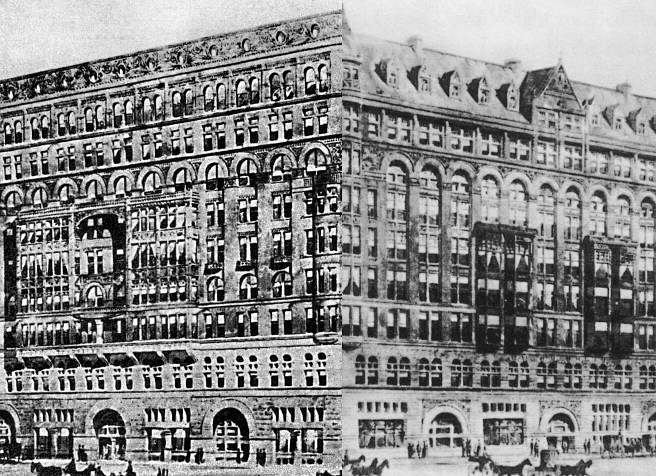
There were at least three months between the first and this second design.  At first glance, it is quite obvious that for whatever reason as we will investigate below, Sullivan had once again aped Richardson’s lead, this time adopting his new flat cornice of the Marshall Field Wholesale Store.   

H.H. Richardson, Marshall Field Wholesale Store, 1885. (Online)

The Field Store had literally begun to grow out of the ground during the intervening three-month period between Sullivan’s original design and this new one.  By December, its construction had sufficiently progressed to allow one to perceive its inherent monumentality, that was appreciated by many of those involved with the Auditorium project.  After all, its owner, Marshall Field himself was second only to Peck in being financially committed in the project and had chaired the organizational meeting that directed Adler & Sullivan to produce this alternative design.  Only the month before Adler himself had praised the Field Store:

“How American is Richardson’s reproduction of the somberness and dignity of the Palazzo Strozzi in the Marshall Field Building.”  Peck had also quickly taken to Richardson’s building, that he later revealed to the Inter-Ocean in January 1889: “What is more typical of the artistic taste of any people than the architecture of their community?… Where can our great business buildings be equaled?  Study the Field Mercantile Building… In no city on this continent will be found so much art in modern architecture.”  

After the Auditorium’s completion, Adler. in the April 1892 Architectural Record had reflected back upon how Richardson’s design had not only influenced the final design but also the Board’s corresponding reaction to Sullivan’s ornamental excess in these early designs: a “reaction from a course of indulgence in the creation of highly decorative effects on the part of its architects” in comparison to “the deep impression made by Richardson’s ‘Marshall Field Building’ upon the Directory of the Auditorium Association.”

Adler & Sullivan, The Auditorium. Left: Second Design; Right: First Design.

Sullivan had, for the most part, retained his original design of the lower seven floors, including its stone base and pressed brick upper stories. The only minor revisions were an increased number of the bay windows and the addition of a gratuitous arched window in the fourth floor that diluted the integrity of the original upper arcade.  In the eighth floor, Sullivan replaced the original run of continuous windows with a second, smooth-faced transition floor that was similar to the third floor, thereby framing the four-story arcade at its top and bottom, and making it cleaner for him to add the building’s two new additional floors.  The ninth floor comprised paired arched windows and the tenth floor was detailed as a highly ornate cornice punctuated with oval (these may have been circular that were skewed by perspective) windows.  While being much more restrained in its overall massing, Sullivan had more than compensated, however, by resorting to his earlier practice of increasing the amount of ornament as one worked their way up the façade to the finale in the cornice.

Adler & Sullivan, The Auditorium. Left: First Design; Right: Second Design.

The other noticeable change in the second design was that the height of the tower had been increased from ten stories to fifteen and its hipped roof was replaced with an elongated pyramid.  Siry equated its shape to the top of an obelisk, specifically, the Washington Monument, then the tallest structure in the world.  Sullivan’s pyramid was projected to be 300’ high, an obvious challenge to the 303’ Board of Trade’s reputation of being the city’s tallest structure, and second, only to the Monument, as the tallest in the country.  Due to its southernmost location on the fringe of the business district, the proposed tower would have easily been the first object on the horizon that would have greeted visitors arriving from the east and south as their trains approached Chicago. 

Adler and Sullivan, The Auditorium, View from the south. (Siry, The Auditorium)

While the revised design generated more discussion at the Board’s next meeting, no action once again pertaining to the choice of an architect was taken: the Burnham & Root faction was in an obvious stall mode, playing for more time.  The Tribune reported on December 19 that the uncertainty among the board that although the architects and design “were about decided upon… there was a chance that there would be a radical change in both.” 

FURTHER READING: 

Historic American Buildings Survey-The Auditorium: https://loc.gov/pictures/item/il0091/

Morrison, Hugh, Louis Sullivan: Prophet of Modern Architecture. 1935. Reprint, New York: W.W. Norton, 1962.

Siry, Joseph M. The Chicago Auditorium Building. Chicago: University of Chicago Press, 2002.

Twombly, Robert. Louis Sullivan: His Life & Work, Chicago: University of Chicago Press, 1986.

Twombly, Robert and Narciso Menocal. Louis Sullivan: The Poetry of Architecture. New York: Norton, 2000.

(If you have any questions or suggestions, please feel free to eMail me at: thearchitectureprofessor@gmail.com)

2.4. PROGRAMMING THE AUDITORIUM: THE HOTEL

During Peck’s talk to the Commercial Club, he had proudly announced that the young Walker had transferred this land to the Grand Opera Association (the precursor to the Chicago Auditorium Association).  As such, the project was no longer simply a dream, but at the beginning of becoming a physical reality.  Peck had continued to encourage his associates to purchase the last remaining lot, the northeast corner of Wabash and Congress, but found no one willing to make such a financial commitment and finally, had to purchase it himself for $193,000.  Finally, a Chicagoan had matched the civic generosity of Cincinnati’s Reuben Springer in funding its Music Hall some ten years earlier.

Adler & Sullivan, The Auditorium, Chicago, 1886. Design for the Auditorium, September 1886. To the right are the Studebaker Building and the Art Institute. Watercolor by Paul C. Lautrup. (Siry, The Auditorium)

Foiled from being able to replicate Cincinnati’s donation of public land for the project, the inclusion of income-generating space in the project was once again required, as had been done in the Central Music Hall and the Opera Block, to offset the increased cost of acquiring the land.  As the final site was adjacent to hotels, and initially thought to have been too far south of the business district for rental offices, Peck directed his architects, Adler & Sullivan, to incorporate a hotel into their design (note that Peck was acting and compensating the architects unilaterally because the Auditorium Association wasn’t officially incorporated in Springfield until Dec. 8, 1886).  His motives for adding a hotel to the project, however, were not simply driven by a need to generate offsetting funds for the expected losses to accrue from the operation of the theater.  Peck’s father. Philip F.W. Peck, had been a major investor in the erection of the original Grand Pacific Hotel (he owned the eastern half of its lot), and following his death, his son had inherited the management of this site and thus, became personally involved in the intense competition among hotel owners in Chicago to own the bragging rights for “the best hotel in the city.”  The Grand Pacific had been designed as such, only to have been quickly surpassed by Potter Palmer’s second Palmer House, that had held the reputation as Chicago’s premiere location for banquets and receptions since its opening in 1874.  When one adds the political dimension to this competition of Palmer being a leading Democrat (with all Democratic functions taking place in the Palmer House) and Peck being a leading Republican (with all Republican functions taking place in the Grand Pacific), Peck’s opportunity to finally eclipse the Palmer House with the newly-planned hotel comes into full resolution.

2.5. THE FIRST DESIGN

Adler & Sullivan, The Auditorium, Chicago, 1886. Early floor plan, Chicago Tribune, August 1, 1886. Note that the hotel continues around all three sides, there is no plan to include office space in the original project. (Siry, The Auditorium)

Logically, Adler & Sullivan had initially placed the theater in the center of the site, pushed up against the site’s northern lotline, and surrounded it on the three street fronts with the hotel.  As a critic best summarized the operative synergies in such a plan: 

“To build a theater in the center of a block and surround it wholly or in part with an outer building is to insure [sp] perfect freedom from any of the noises of the street; while to build a hotel on the outer edges of a block gives it the great length of street frontage and large proportion of front rooms that every hotel architect strives for.  The incidental advantages to bar and restaurant business that proximity to an opera house gives are worth taking into consideration, and still more important is the access of the hotel trade proper that an opera season brings.

The oldest surviving rendering of their early designs is a watercolor by Paul C. Lautrup that dates to September 1886.  Sullivan’s predilection towards a “highly active” exterior exhibited in his recent buildings manifested itself once again in his first design of a large building, a nine-story block that was capped with a picturesque gable roof.  To better understand Sullivan’s design, we need only refer back to his last two commercial designs we reviewed in Vol. 3, Sec 10.23.  

When confronted with the Troescher and the Ryerson Buildings designed in 1884-5, two years earlier, I gravitate to the Ryerson as the more indicative of Sullivan’s inclinations as revealed in his first attempt to design the exterior of the Auditorium.  First, I am not surprised to find in his first design none of the “structural openness” with regards to Sullivan’s detailing of thin, continuous piers and triple windows that was evident in all of his earlier storefronts, especially the Troescher Building. Why? Because these were short, six-story buildings, in which the gravity loads were not severe nor overcome by concerns of wind loads.  

Now he faced the design of a ten-story building, in which not only were the gravity loads almost doubled, but the wind loads, because they are a function of both the increased surface area and the increased height (the wind can be treated as a concentrated load [accumulate the 10 stories of surface load] applied at the midpoint of the façade) that resulted in a tripling of the applied rotational force or moment over that of a five-story building).  In such a building, one cannot “throw caution to the wind.”  So there are no thin piers and large windows in this design, i.e., the Troescher design offered nothing usable. 

Therefore, we turn to Sullivan’s design of the Ryerson Building as his point of departure.  Not for its skeletal scheme, but for its “lack of repose,” a euphemism for “too many notes” and the lack of a synthetic, coherent ornamental strategy.  Mario Manieri Elia in his book, Louis Henry Sullivan, posed that Sullivan’s lack of synthesis in his early buildings was a conscious attempt on his part to develop a new language.  If this was the case, why did Sullivan not employ this language of vertically-accented continuous piers with recessed spandrels in this first elevation?  I think this opinion is far too kind and viewed through hindsight.  Architectural synthesis is a skill not easily mastered if one is not born with it, (and I state this as a former studio teacher with over 40 years of experience) and it is quite obvious to me from his early attempts at exterior design that Sullivan was not as facile in architectonic design as he was in ornamental design.  The lack of resolution in Sullivan’s early exteriors, especially his early designs for the Auditorium, was the straightforward result of his inexperience in architectonic design, one that he would eventually overcome, as most of architects (including myself) do, with practice.  This was the gist of Root’s comment, if true, in the apocryphal story recorded in Theodore Tallmadge’s book, Architecture in Old Chicago that Paul Mueller, Adler & Sullivan’s engineer during the design of the Auditorium, had claimed that a remark by Root had been repeated to Sullivan, to the effect that “Louis couldn’t build an honest wall without covering it with ornament.”  Whether Root had actually stated this or not, after looking over Sullivan’s first design of the Auditorium, Root more than likely had thought as much… Sullivan needed much more practice, and as we will see, some much needed assistance from a more experienced designer.

In attempting to discern the precedents that the young Sullivan had relied upon to assist him, I find the following influences:

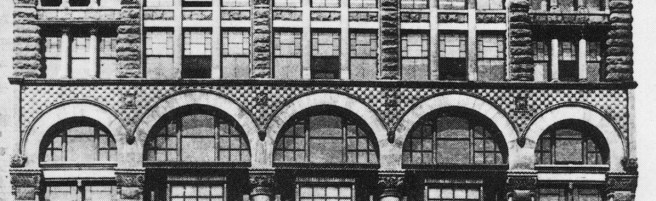
First, the lower eight floors were articulated as would have been any Chicago lotline extruded business block in the early 1880s: a two-story granite base from which rose six stories of brick and terra cotta (not stone!), that were articulated into a one-story, smooth-surfaced transition layer, a four-story arcade, and a one-story run of continuous square-headed windows.  The four-story arcade bore a striking resemblance to the arcade that Root had detailed in the McCormick Building and the Insurance Exchange..

Left: Burnham & Root, McCormick Building; Middle: Adler & Sullivan, First design for Auditorium; Right: Burnham & Root, Insurance Exchange.

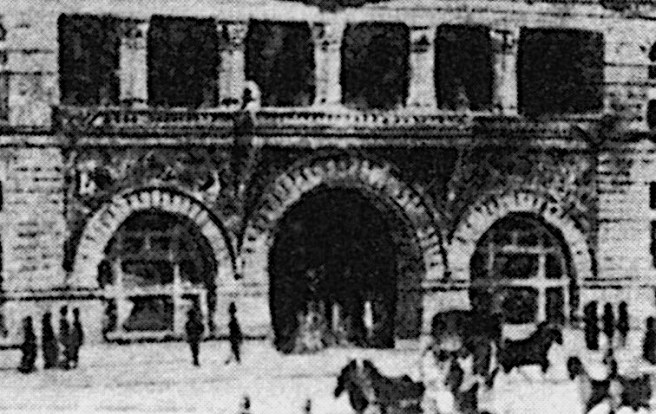
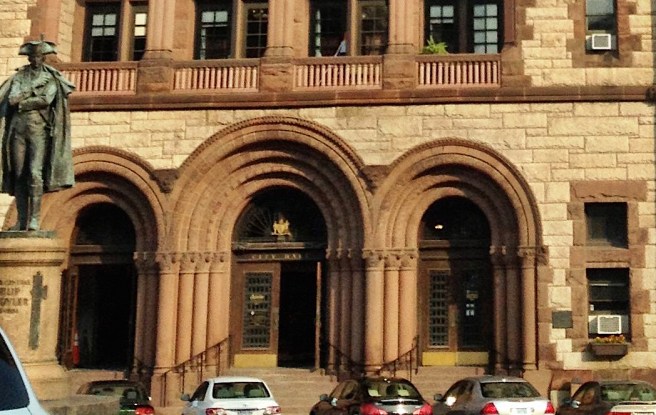
In the top floor, he could return to his thin piers/large window motif because the loads were minimal. Within the granite base, Sullivan had placed a triple triumphal arched-entry, a favorite motif of Richardson’s at the base of the tower for the theater, and another triple arched-entry on Michigan Avenue for the hotel.  The hotel’s three arches were not symmetrical, for Sullivan had increased the radius and height of the central arch (as Richardson had done in the Albany City Hall), perhaps as a nod to the similar proportions of the midrange arches in Beman’s adjacent Studebaker Building. 

Second, Sullivan would ideally have to make the hotel look different from the typical Chicago business block and he chose to do this with the addition of a gable roof punctuated with small dormers à la Richardson.  

He even incorporated a gratuitous Richardsonian gabled dormer midway between the tower and the Michigan Avenue façade, where he terminated the gables at both ends by echoing Root’s gable plus tourelles in the Art Institute that stood at the opposite corner of the block, thereby attempting to create along Michigan Avenue a set of gabled bookends framing the Studebaker Building.  

(One might also speculate the corner cylindrical bay window topped with the conical roof to be a recapitulation of Beman’s Pullman Building at the northern end of the Michigan Avenue vista.) I consider these urban design attempts on the part of Sullivan to have been quite mature for such an inexperienced designer.  In an attempt to give the building a further residential character symbolic of a hotel, Sullivan sprinkled a number of bay windows across the two street fronts, similar to those in the Studebaker, except that they were detailed in a similar manner to how he in the remodeled McVicker’s Theater.

Lastly, the formal centroid of the composition was a 12-story tower with a steeply pitched hip roof on the Congress façade that marked the entrance to the theater.  The tower extended above the roof by two more stories before Sullivan again resorted to quoting Root in terminating the tower.  Sullivan took Root’s hip roof from his competition winning entry in the Kansas City Board of Trade Building that had just been published in the August issue of Inland Architect., the month before the watercolor had been made.

Sullivan biographer Willard Connely noted that the tower’s hip roof and cupola bore a striking resemblance to that of Paris’ Hôtel de Ville that had been torched by the Communards during the last days of the Commune.  If this was designed on purpose, the intended symbolism was obvious: Peck was throwing the gauntlet down to Chicago’s communists: not only had their French comrades failed in their attempt to destroy Paris’ city hall as it was being reconstructed in all its past glory, but Chicago’s new civic institution would bear a similar crown, visible from every point in the city.  

Hôtel de Ville, Paris. (Online)

Sullivan’s first attempt to design the exterior of the Auditorium, therefore, can be described as having employed Richardson’s standard picturesque silhouette that was fleshed out with four details taken from Root’s latest designs.  It was very au courant for August/September 1886, except that Richardson (who had just died four months earlier) had recently abandoned the picturesque roofline in his Root-inspired palazzo box design for the Field’s Wholesale store, that had just begun to grow out of the ground.

FURTHER READING: 

Historic American Buildings Survey-The Auditorium: https://loc.gov/pictures/item/il0091/

Morrison, Hugh, Louis Sullivan: Prophet of Modern Architecture. 1935. Reprint, New York: W.W. Norton, 1962.

Siry, Joseph M. The Chicago Auditorium Building. Chicago: University of Chicago Press, 2002.

Twombly, Robert. Louis Sullivan: His Life & Work, Chicago: University of Chicago Press, 1986.

Twombly, Robert and Narciso Menocal. Louis Sullivan: The Poetry of Architecture. New York: Norton, 2000.

(If you have any questions or suggestions, please feel free to eMail me at: thearchitectureprofessor@gmail.com)
CHAPTER 2: PLANNING THE AUDITORIUM

While Adler & Sullivan’s remodeled McVicker’s Theater had opened with rave reviews on July 1, 1885, the opening of Cobb & Frost’s new Chicago Opera House theater the following month was met with complete dissatisfaction (Vol. 3, Sec. 8.12). The theater’s owners had to admit their initial error in hiring Cobb & Frost, a firm without any prior experience in the design a theater and consequently hired Adler & Sullivan to completely remodel the auditorium’s interior once the theater’s premiere season ended in June 1886 that was completed in less than two months. Nonetheless, by the end of 1886 Chicago still did not have a large music venue comparable to either Cincinnati’s Music Hall or New York’s new Metropolitan Opera House.  

2.1. FERDINAND PECK STRUGGLES TO LAUNCH HIS AUDITORIUM, UNTIL THE HAYMARKET ERUPTS

Adler & Sullivan, 1885 Chicago Grand Opera Festival Hall, Chicago Expo Building, 1885. (Chicagology)

(I am indebted to Joseph Siry’s excellent history of the Auditorium, The Chicago Auditorium Building, for much of this chapter.) The overwhelming success of Ferdinand Peck’s 1885 Grand Opera Festival held in the Exposition Center between April 6-18 had closed on its last night with an encore call for Peck to address the audience that he eventually was coerced into doing:

”[The festival] had shown what Chicago would and could do, and [he] hoped that people would look upon this as a stepping stone to a great permanent hall where similar enterprises would have a home.  The continuation of this annual festival, with magnificent music, at prices within reach of all, would have a tendency to diminish crime and Socialism in our city by educating the masses to higher things.”

With these prophetic words, Peck had launched his campaign to finance and construct just such a permanent facility.  Only ten days later, on April 28, 1885, as dignitaries from all over the country were gathered in the Trading Room of the new Board of Trade for the grand opening banquet, Peck’s publicly-stated concern over the growing Socialist menace appeared prescient as Albert Parsons had led the IWPA protest march down La Salle Street in an attempt to disrupt the banquet.  Although we have seen that the police were prepared and peacefully redirected the protest to another site, the IWPA called for a massive protest meeting to occur five days later in Lake Park (at the intersection of Van Buren and Michigan) for Sunday, May 3.  In this heated atmosphere, Peck, as President of the Chicago Opera Festival, had risen to address its annual meeting only the day before, May 2, and announced that a committee had, indeed, been formed to direct a campaign to secure the erection of the ever-elusive permanent music hall for Chicago. 

“Many of your members and other citizens as well as myself have thought for a long time that one of our greatest needs in Chicago was a large public auditorium, where conventions of all kinds, political and otherwise, mass meetings, reunions of army organizations, and, of course, great musical occasions in the nature of festivals, operatic and otherwise, as well as other large gatherings could be held…

“Chicago can be made the convention city of the continent.  She can now furnish all needed conditions but one necessary to attract every important convention of a National character, as well as those that are more local in their nature in the Northwest or in the State.  This city has the geographical location, is rapidly becoming more nearly the center of population, is exceptionally accessible, being the great railroad center; we have an attractive climate, especially in the summer, because of the cooling lake breezes, but lack one essential element, to wit, a place in which to hold such conventions or gatherings – a large, permanent public hall…

“The large cities of Europe all have great halls and gathering places.  New York has three large audience rooms.  Boston, Philadelphia, Cleveland, Cincinnati, and St. Louis have their great music halls, the two latter of which have a seating capacity of over 4000 each, and were built by the philanthropy of citizens: yet Chicago, which is larger than any of the cities of this country which I have mentioned, except New York and Philadelphia, has no permanent or suitable auditorium for such occasions.

“Now how is this to be accomplished in Chicago?…

“Now gentlemen, shall we let this exceptional opportunity go by, as others have done during the last fifteen years, and wait perhaps twenty or more years for as favorable a basis and conditions for this accomplishment of this important purpose, and permit our sister cities, which are behind us in every other important respect, to reach out for the great conventions and musical festivals which the education and the entertainment of our people demand, as well as our business interests; or shall we now avail of the proposition presented to us, to do a “big thing” for our city of Chicago, that we must recognize to be a public need and one which ‘will pay?’”

But nothing of any consequence came of Peck’s efforts for over a year, that is, until the Haymarket erupted a year and two days following Peck’s talk. May 4, 1886, changed the calculus once and for all in favor of Peck’s dream.

2.2. SECURING A SITE

Initially Peck had tried to replicate Cincinnati’s Music Hall, even down to the method of its financing.  The city of Cincinnati had donated the land upon which the Music Hall had been built that had significantly reduced the overall cost of the project (Vol. 2, Sec.6.8).  Peck was committed to securing a site on the west side of Michigan Avenue obviously for its view of the lake, the exposure it would receive along the city’s main buggy promenade, and to avoid any legal questions of ownership that would arise if it was located on the east side of the street in Lake Park, as had been the case with the Exposition Center.  This meant that the land he wanted for the project would be expensive as it was in the business district.  The money that he would have to voluntarily raise would be significantly lower if he could get the city to donate the land.  His first choice of a site that he had pursued after his premature announcement in May 1885 had been Dearborn Park, the only unoccupied site on the west side of Michigan, bounded by Randolph and Washington Streets.  It was unoccupied because it had been reserved as public property to be a park when the city had first been chartered.  A group that was promoting a new public library was also eyeing this property at the time, so Peck had initially proposed a joint building that combined the theater and the library.  But this effort was rebuffed by his opponents claiming that he was proposing to use publicly-dedicated land for a semi-private function.  

Early in 1886 he had to admit defeat and modified his approach to an entirely privately-funded operation and so shifted his interest to the corner of Monroe and Michigan (that would have placed it directly across from the Exposition Center, and created a convenient and impressive convention facility), but again ran into stiff opposition. At this point, it appears that he and his close associates moved their focus four blocks farther south to the edge of the business district at  Congress Street, where real estate would be less expensive. An added benefit of this location would be that it overlooked the IWPA’s Lake Park rally location.  Peck had first denied the IWPA use of the Exposition Center after the 1885 Opera Festival by paying the $1000 annual rent demanded by union supporters on Council.  Now he was attempting to hinder their access to their lakefront rally point as well.  Finally, in March 1886, just prior to the Haymarket bombing, Wirt D. Walker procured an option for two small, adjacent lots on Congress, just east of Wabash, and set in motion the securing of the lots bounded by Michigan, Congress, and Wabash as the eventual site for the project (at the southern edge of the business district).  

Adler and Sullivan, The Auditorium, View from the south. Note that Michigan Avenue, south of Congress still has its residential scale. Truly, the site was the southern edge of the business district. (Siry, The Auditorium)

Walker was the son of the late James M. Walker (Root’s father-in-law from his first marriage) who had named his son after his junior law partner, Wirt Dexter. (Hence, the common confusion between Wirt Dexter and Wirt D. Walker.)  The younger Walker had been named the executor of his father’s estate and had inherited his father’s fortune upon his death in 1882.  He was just 21 years old at the time, having just graduated from Yale.  He was accepted into Chicago’s Union College of Law, graduated in 1883, and had immediately went to work for his namesake in his father’s former firm. 

2.3. THE HAYMARKET BOMBING IGNITES THE PLANNING

Then the Haymarket Square bombing had occurred, imparting a new sense of urgency to Peck and his fellow businessmen, for in their eyes their greatest fear, the Paris Commune had finally reared its ugly head in Chicago and it had to be cut off at any expense as soon as possible.  While the police and legal system were loosed on the city’s Socialist agitators, a campaign of pacification and education of the city’s middle class was put into motion.  Peck relaunched his campaign for the permanent hall in front of Chicago’s Commercial Club on May 29, 1886, only twenty-five days after the bombing, during an all-day conference held at the Grand Pacific Hotel titled ”The late Civil Disorder: Its Causes and Lessons.”  The Commercial Club had been founded in 1877 in response to the violent railroad strike of that year in order to develop an agenda to refute such political agitation as well as to improve the city’s economic competitiveness.  Many of its members also belonged to the Chicago Citizen’s Association, whose founder, Franklin MacVeagh, was the current president of the Club.  Peck presented his vision for “a large public auditorium.”  Its overarching purpose was to act as an alternative to the Socialist’s agenda of political theater by presenting cultural events at affordable prices to the middle class, thereby helping to improve the social stability of Chicago.  Peck’s vision for the project, therefore, far exceeded mere opera, and he had carefully chosen a specific name for the project that embraced his broad vision.  It was not to going to be called an Opera House, but “The Auditorium.”  

While most historians quote the Metropolitan Opera House as its model and target, Peck had cited “political conventions” as one of the project’s main functions: “to have the Republicans and Democrats meet in Chicago every time [as had actually happened in the previous year] they nominate a candidate for President and Vice-President.”  The Metropolitan Opera House was never designed to, nor would ever house a political convention.  The only facility in the country at the time that fit Peck’s description was Cincinnati’s Music Hall.  As Cincinnati had resorted to art, culture, and conventions to maintain its economy after Chicago had superseded its industrial primacy following the end of the Civil War, Chicago would attempt the same trick to offset the loss of business confidence that had resulted from the Haymarket Square bombing.  It had taken Chicago eight long years to respond to its southern competitor’s last challenge to Chicago’s dominance in the Midwest, but the time had finally come to put the final nail in the Queen City’s coffin.  But once again, Chicago still had to look to the Queen City for its precedent.

“Chicago exceeded in all commercial things.  As it had taken the pork market and the railroad hub from Cincinnati, the real center of population, so the Garden City grasped to the end, arrogating that last glory of the Ohio metropolis, even her baseball championship.” Building Budget, May 1887

FURTHER READING: 

Historic American Buildings Survey-The Auditorium: https://loc.gov/pictures/item/il0091/

Morrison, Hugh, Louis Sullivan: Prophet of Modern Architecture. 1935. Reprint, New York: W.W. Norton, 1962.

Siry, Joseph M. The Chicago Auditorium Building. Chicago: University of Chicago Press, 2002.

Twombly, Robert. Louis Sullivan: His Life & Work, Chicago: University of Chicago Press, 1986.

Twombly, Robert and Narciso Menocal. Louis Sullivan: The Poetry of Architecture. New York: Norton, 2000.

(If you have any questions or suggestions, please feel free to eMail me at: thearchitectureprofessor@gmail.com)
1.14. DUELING SKYSCRAPERS: ST. PAUL

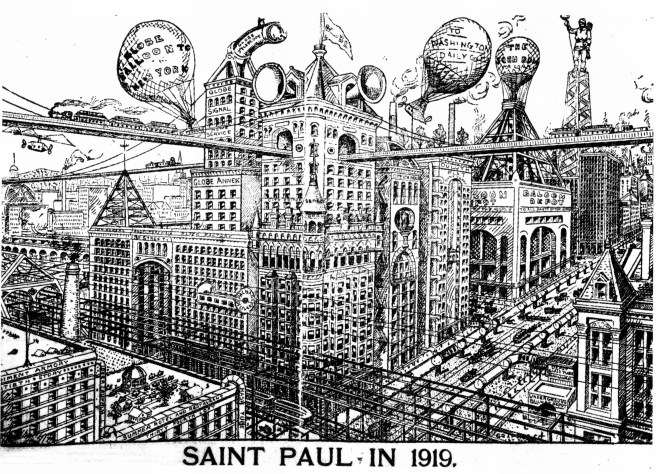
Cartoon published in St. Paul Globe, December 25, 1886. Mix’s Globe Building is directly in the center of the drawing. Note the 24-story stepback skyscraper annex in the center left and the elevated train supported solely by iron framing in the foreground, (Millet, Lost Twin Cities )

But the Twin Cities needed an architect with tall building expertise if it really was going to surpass Chicago’s architectural achievements.  This exact experience moved to Minneapolis in early 1886, in the form of former Milwaukee architect, E. Townsend Mix.  Mix, who had worked with Peter B. Wight in using his newly-patented terra cotta fireproofing systems for the first time in the Milwaukee Chamber of Commerce and Mitchell Buildings (see Vol. 3, Sec. 3.7), and who had taken second place in the New York Produce Exchange competition, had moved to Minneapolis apparently to take advantage of the building boom.  He brought the brick box with him, for compared to the great, rough-faced sandstone masses of Long & Kees, Mix employed the latest Chicago pressed brick techniques.  This is readily apparent in his first building in Minneapolis, the eight-story Temple Court Building designed in 1886. 

Above: E. Townsend Mix, Temple Court Building, Minneapolis, 1886. (Millet, Lost Twin Cities); Below: Burnham & Root, Burlington Building (left); Counselman Building (right).

In this building, one can easily see the influence of Root’s work.  Mix articulated the elevations into a two-story base, with three, two-story layers supported on top of it.  Each of these layers comprised of a two-story arcade of either single- or paired-windows that had the feel of those that Root used in the Burlington and Counselman Buildings.  The only difference in the detailing of the three layers was that the lower two employed segmental arches, while the top arcade incorporated semicircular arches, inset into a rectilinear framework.  This was capped by an open grid cornice that again, seemed to owe its inspiration to Root’s competition drawing for the Kansas City Board of Trade.

Ice Palace (140’ high) for the First St. Paul Winter Carnival, February 1886. (Online)

Surprisingly, all of these towering structures were built in flat, unlimited Minneapolis (“a ten-story building in a ten-acre lot requires explanation”).  St. Paul’s real estate market apparently wasn’t in need of the potential extra floor space created by the elevator prior to 1886.  However, one construction material that St. Paul did pioneer with that is less celebrated by architectural historians but nonetheless merits a brief mention, is ice.  The 140’ tall Ice Palace (the Insurance Exchange in Chicago was 140’ high) erected in February 1886 for the inaugural St. Paul Winter Carnival revealed the city’s yearning to build tall structures, even if they were ephemeral.  The following year, the Ice Palace was lit by electric lights.

Finally, in May 1886, Mix was commissioned by the St. Paul Daily Globe to design a ten-story skyscraper for St. Paul at the south corner of Fourth and Cedar Streets.  While the detailing of the two street facades of the Globe Building repeated much of that in the Temple Court Building, the building’s cornice sprouted corner turrets and a 40′ high lookout pavilion, that had been dictated by the building’s St. Paul owners as a direct response to Minneapolis’ ten-story Lumber Exchange.

E. Townsend Mix, St. Paul Daily Globe, St. Paul, 1887. (Millet, AIA Guide to the Twin Cities)

Mix wrapped the 85′ by 90′ site with a single-loaded corridor that left a meager 20′ by 20′ lightcourt running up the middle of the building.  When completed, it would be St. Paul’s first skyscraper, the tallest building in the city.

Mix, St. Paul Daily Globe. Atrium viewed from an upper floor. Note the glass tiles in the balconies’ floors. (Millet, Lost Twin Cities)

Nonetheless, the fact that Minneapolis had gained an early lead in building skyscrapers did not stop the local press from imagining that St. Paul would not only catch up with its local rival, but over time would eventually surpass it.  The Globe published on December 25. 1886, a cartoon that was a remarkable Jules Verne-like prophesy of what the city might look like thirty-three years into the future in 1919.  

Cartoon published in St. Paul Globe, December 25, 1886. Mix’s Globe Building is directly in the center of the drawing. Note the 24-story stepback skyscraper annex in the center left. (Millet, Lost Twin Cities)

In the middle of all of the new-fangled transportation systems, transcontinental balloons, elevated railroads, and pneumatic-tube like people movers, sat The Globe’s new ten-story building, then under construction, that sported a nine-story addition.  Immediately to its left rises The Globe’s new annex, a twenty-four story stepback skyscraper, one of the earliest manifestations of this type of skyscraper ever published (the tallest building at this time was the 258’ tall, 12-storied Washington Building in New York).  The stepback skyscrapers that were linked by skybridges have a direct resemblance to Henri-Jules Borie’s Aérodômes, first proposed twenty-years earlier in Paris.  

Henri-Jules Borie, Aérodômes, Paris, 1867 redesign of his original 1865 proposal. (Design Quarterly, 85, 1972)

No contemporary prophesy of tall buildings in either New York or Chicago has yet been uncovered to match this vision of the skyscraper future (this cartoon was six years earlier than Louis Sullivan’s own rendering of such a skyscraper that has often been referred to as “pioneering”).  Eight months after the bomb was thrown in Haymarket Square on May 4, 1886, and real estate speculation had fled the scene of class struggle in Chicago’s downtown looking for a safer climate for investment, St. Paul was looking forward to the erection of 24-story skyscrapers: ‘skyscrapermania’ had broken out in the Twin Cities during 1886. The year just ended had been a very good year in the Twin Cities, with 1887 even promising to be better.  The same could not be said for Chicago.

Louis H. Sullivan, “The High-Building Question,” the Graphic, Dec. 19, 1891. (Hoffmann, Frank Lloyd Wright, Louis Sullivan and the Skyscraper)

FURTHER READING:

Millett, Larry. AIA Guide to Twin Cities. St. Paul: Minnesota Historical Society, 2007.

Millett, Larry. Lost Twin Cities. St. Paul: Minnesota Historical Society Press, 1992.

(If you have any questions or suggestions, please feel free to eMail me at: thearchitectureprofessor@gmail.com)
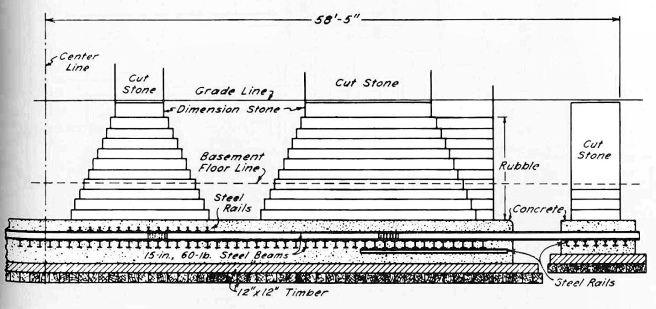
1.13. “MODERN AMERICAN:” THE FIRST IRON-FRAMED GLASS BOX?

Hodgson & Son, Bank of Minneapolis, Minneapolis, 1885. (Millet, Lost Twin Cities)

Another Minneapolis building designed in 1885 that exhibited an even clearer allegiance to Chicago’s contemporary buildings but went much further than anything constructed there in terms of its expression of its iron frame was the seven-story Bank of Minneapolis, located on the southwest corner of Third Street and Nicollet Avenue and designed by Hodgson & Son.  Their design is even more remarkable when compared to their Minnesota Loan and Trust, designed only a few months earlier in the same year.  It was reputed by some sources as having been completely iron-framed.  The Saturday Evening Spectator described its structure as “a complete iron and steel cage…from top to bottom”, that, if true, was more advanced than any building in Chicago at the time.  (I suspect that the two party walls were masonry loadbearing for fire protection and wind resistance.) Some sources, however, claim that the building also relied somewhat on masonry piers.  Nonetheless, what the architects had achieved was a design comprised of a repetitive rectilinear structure, veneered with a white Ohio sandstone, with large double windows (not the triple window of the Leiter Building that actually would block out more light) infilling each bay.  Particularly noteworthy were the single pane windows on the second floor, where the bank offices were located, that were ten-by-fourteen feet panes of glass, the largest single piece of glass that could be produced at the time.  These were so detailed that they could be tilted outward for summer ventilation. (I am not aware of any windows, let alone operable windows, of this size at this time in Chicago.)

Hodgson & Son, Bank of Minneapolis, Minneapolis, 1885. Detail showing how 10’ x 14’ windows in the second floor pivoted open at the top and bottom. (Millet, Lost Twin Cities)

While at first glance, the Bank of Minneapolis’ family tree can be traced back to Jenney’s First Leiter (including the pinnacles at the top of each pier) and then, to McLaughlin’s Shillito’s Store, it truth, the proportion of glass to structural frame has been so maximized that it no longer reads as a masonry grid of structure like its forbearers, but more as a true glass box, maybe the first of a line of new designs that were come in the near future.  This was best stated by the Evening Spectator’s review of the building at its opening, “The form and features of the walls are not in any of the so-called ‘styles,’ but may be termed a structure of the ‘Modern American’ model.”

FURTHER READING:

Millett, Larry. Lost Twin Cities. St. Paul: Minnesota Historical Society Press, 1992.

(If you have any questions or suggestions, please feel free to eMail me at: thearchitectureprofessor@gmail.com)