3.20. THE RETURN TO MASONRY BEARING WALLS: “BOXED” CONSTRUCTION
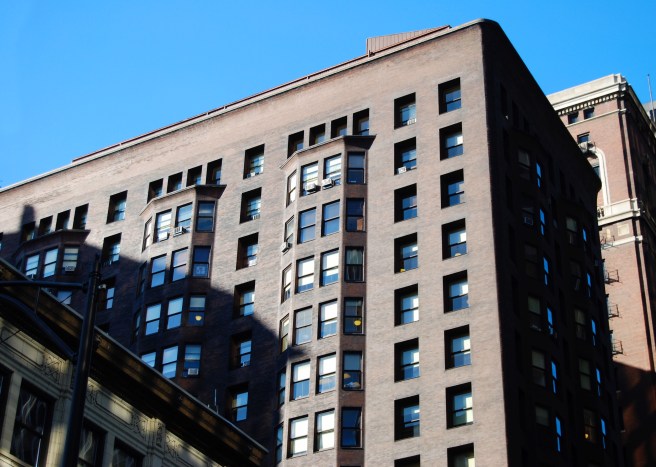
Burnham and Root, Monadnock Block, Chicago, southwest corner of Dearborn and Jackson, 1889. (Author’s collection)
But Wight’s system of fireproofing was applicable only to an iron skeleton frame in the interior of a building. This location was not exposed to the extreme temperature fluctuations that a building’s exterior experienced during the annual weather cycle in Chicago or New York (or Minneapolis!). In addition, before architects could start putting their exteriors on a similar diet, those heavy masonry exterior walls were still needed to resist wind loads as well as for fire protection. These masonry exterior walls would be replaced with fireproofed iron framing until the majority of a city’s building inventory was made fireproof with the new technology, and a technique of imparting lateral rigidity to the iron framing was developed. The actions by the National Board of Underwriters taken after the Chicago fire of July 14, 1874, in addition to forcing changes to be made in the manner in which the interiors of buildings were constructed, would also force architects during the second half of the 1870s to reconsider how to design and construct the exteriors of buildings. The new codes adopted by the insurance companies reflected the views of a growing number of experts that no matter what was done to the interior of a building that contained combustible materials, if the exterior was not designed properly, the building would still burn if exposed to the fire of an adjacent building. Therefore, the new codes required the use of solid exterior walls.
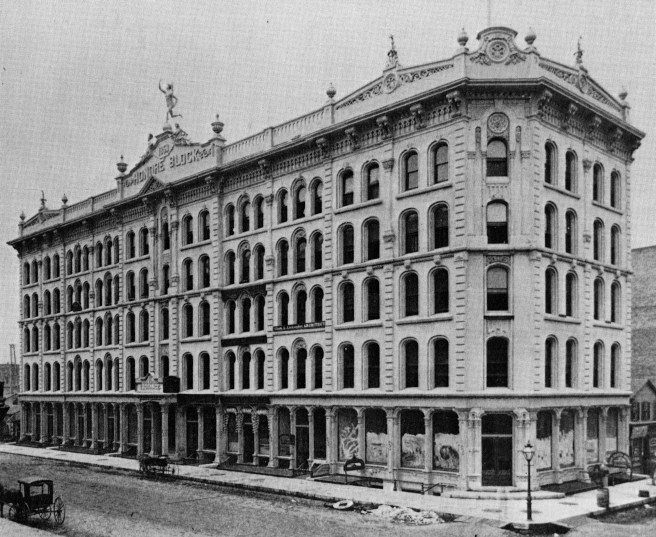
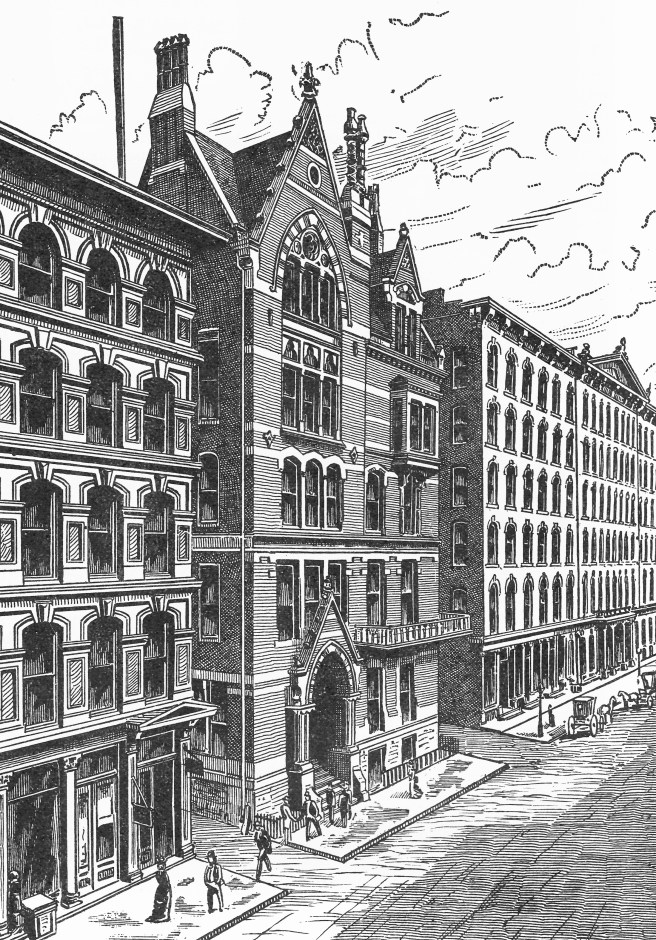
The bottomline following the successful test on November 15, 1881, was that architects would still be reliant on masonry exteriors for the immediate future. That meant that the early skyscrapers would comprise of “boxed” construction: a fireproofed iron skeleton frame erected within a masonry box. That box could be a solid brick wall with holes cut into it (Monadnock) or it could be comprised of brick piers and spandrels, such as Shillito’s store below.
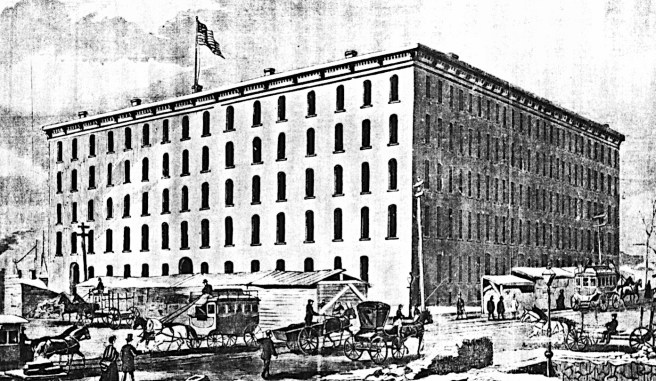
James McLaughlin, John Shillito and Co. Store, Cincinnati, 1877. (Cincinnati, The Queen City, 1901.)
In Section 1.11 I reviewed Jenney’s use of iron posts set at the interior face of the masonry piers (in compliance with the building code) in one of the two streetfronts in the First Leiter Building as the first timid step in the evolution of the skyscraper’s exterior from masonry wall to iron skeleton framing, but no one, including Jenney, followed up on this detail during the following five years. So just what were the limitations of the exterior masonry bearing wall that challenged architects in the design of the first skyscrapers?
Jenney, First Leiter Building. Construction Detail of Masonry Spandrel and Pier. (Author’s collection)
3.21. BRICK VS. STONE?
The emphasis upon the use of brick, to the exclusion of stone, was due to the observed poor behavior of stone veneers and walls in both the Chicago and Boston fires. This attitude was eventually codified by a series of experiments conducted in 1880 on the response that various building stones had exhibited when exposed to fire, by Dr. Cutting, the State Geologist of Vermont. The results, published later in American Architect, had substantiated Peter B. Wight’s earlier claim:
“He declares, in substance, that no known natural stone deserves the name fire-proof. Conglomerates and slates have “no capability” of standing heat; granite is injured beyond cheap or easy repair by even so mild a heat as that which melts lead; sandstones, including the variety called brownstone in this city, are better, and limestone and marbles are perhaps the best in this respect. But even they are injured by continuous heat of 900 degrees, and at 1,200 are changed into quicklime. Therefore it would seem that no stone buildings are fire-proof, and some of them, Dr. Cutting even says, are as much damaged by fire as wooden structures are. Brick, on the contrary, is usually uninjured, and is often rather improved by heat until it is melted. But as most brick buildings are trimmed with iron or stone, the damage is often considerable, even when the walls stand. . . The search for an ideal building material is not hopeless, but it must be prosecuted rather by the maker than by the quarrier of stone.”
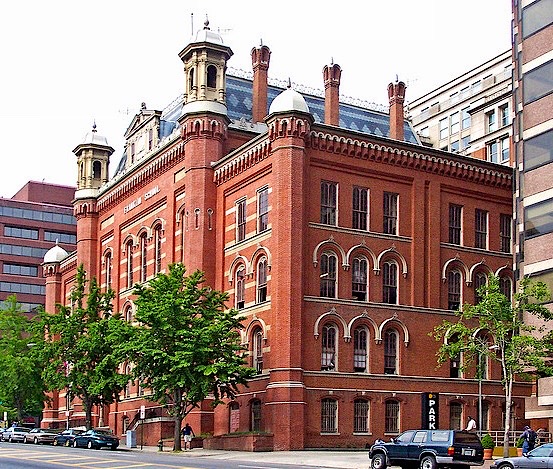
As stone had displaced cast iron in the 1860s, pressed brick and Loring’s terra cotta were beginning to be favored over stone in the 1870s as the material of choice for the exterior of a building. The acceptance of brick as an exterior material for commercial buildings was furthered by the stylistic abandonment, coming on the footsteps of the French defeat by the Prussians, of the Second Empire’s Neo-Baroque use of “Classical” elements in favor of either the more fashionable British Gothic revival, especially the Queen Anne, or the German revival of the Romanesque or rundbogenstil (round-arched style), both of which incorporated brick in a building’s exterior. However, a preference for brick exteriors that had even preceded these early essays had been the Quaker tradition of Philadelphia’s red brick commercial brick fronts of the 1850s (see Vol. 2, Chap. 5), and the numerous red brick buildings erected after the end of the Civil War in Washington D.C. designed by German-immigrant architect Adolf Cluss.
Adolf Cluss, Franklin School, Washington, D.C., 1867. (Online)
There can be little doubt that it was Atkinson’s pressure that encouraged the Boston Society of Architects to organize an exhibition of building materials, including the latest fireproofing techniques, at the 1881 Massachusetts Charitable Mechanics Association Fair. This set the stage for the final confrontation between Atkinson’s assertion that “there was no such thing as a fireproof building” and Wight’s work over the past seven years in refining just such a system. The American Architect in September reported:
“Perhaps of all the exhibits the one most to the purpose is that of the Wight Fire-Proofing Company, which is at once complete as showing the various applications of the process, instructive in its interesting features, and comprehensive and workman-like in the manner in which the exhibit is prepared. As one examines it one feels how other exhibitors have failed to comprehend the possibilities of the occasion and keenly regrets their inaptitude. The present absence of other exhibits of fire-proof material makes this display the more conspicuous. One cannot but believe that here is one of the nearest approaches to strictly fire-proof building that has been achieved. The tests which are to be made will show what ground there is for the belief that fire-proofing is possible and that the utmost that can be attained is not, as is believed by the Boston Manufacturers’ Mutual Insurance Company, a “slow-burning” construction.”
The test referred to in the above quote was sponsored by the Boston Society of Architects, specifically to ascertain whether Atkinson’s or Wight’s ideas about fireproofed buildings were the appropriate direction for future construction. On November 15, 1881, (ten years after the first Chicago fire), a small test building consisting of various fire-proofing materials, including Wight’s porous terra cotta columns and tiles for wood floors and Loring’s tiles for wood beams, was filled with fuel and burned for an hour and twenty minutes. Then the fire was extinguished with high-pressure hoses, simulating actual conditions as carefully as possible. After cooling, the building was inspected by a panel of judges who found no substantial damage to any of the wood or iron that was protected by porous terra cotta and reported:
“Buildings may be protected and partially fire-proofed, using posts, columns and girders of wood or iron, thoroughly encased in a fire-proof material,…we regard as essential qualities in a perfect material for general use in fire-proof building construction the power to successfully resist disintegration by the action of fire, water and frost. Loring’s Porous Terra-Cotta, as tested, has satisfied us that this material can be made to possess all these qualities… The terra-cotta submitted to these tests gave evidence in a remarkable degree of its ability to protect iron beams and columns from the action of fire and water, without fracture or disintegration, as well as to insure the complete security of wood from the action of the flames, so that not the least charring was observed where it was protected by Loring’s Porous Terra-Cotta.”
Poignantly, only three of the four appointed judges signed the final report. The fourth, Edward Atkinson, was not present at either the test or the later inspections. Therefore, he declined to sign the report that, in essence, recommended the new material, countering everything he had previously argued for the past two and a half years. This fact was not ignored by Loring, who must have savored having the last word:
“Mr. Atkinson’s absence and his inability to devote the time taken by his associates to investigate the results and test the material, was unfortunate, and the just sentiment which made it proper to draw attention to the fact that he declined to sign the report, will, perhaps, justify this attempt to call attention to the means, the time, and care taken by the other judges to fulfill their duty. The report, as the result of intelligent investigation by men whose experience and observation during many years of service, as the head of the Fire and Building Departments of Boston, entitles them and their report to attention. Very truly yours, S.E. LORING.”
Chicago’s efforts in developing a system of terra cotta fireproofing, mainly through the tireless efforts of Peter B. Wight and Sanford Loring, had succeeded in saving New York’s iron frame for the future erection of tall buildings. We might say that the date of the test, November 15,1881, marks the start of the consensus on the approved use of the iron skeleton frame in the United States, some seven years after the insurance companies had forced the issue following the second great Chicago fire of July 14, 1874.
A more conciliatory tone was initially taken by Wight in a talk that he gave to the New York State Association of Supervising and Adjusting Insurance Agents in Syracuse on May 20, 1879, only ten days after the publication of Atkinson’s letter. In responding to Atkinson’s arguments, Wight quietly defended his profession stating that although the architects were ready and willing to cooperate, the insurance companies stood “between the architect, who wants to do it right, and his client, who wants to do what is cheap.”
More importantly, however, Wight subtly attempted to quell the potential threat to his infant fireproofing company posed by the resurgence of interest in solid timber mill construction championed by Atkinson. Wight exploited this opportunity for promoting his ideas by describing in great detail all of the porous terra cotta fireproofing systems that he and Loring had developed and were presently marketing for combustible and incombustible materials. Yet during this very lengthy talk, he never once even intimated that he had any kind of a vested interest in these systems:
“Two systems may be followed. One is found in the use of heavy wood for all interior constructions…In such buildings all that is sought is the best facility for quenching a fire before it has had time to materially weaken the structure. Still, a fire in such a building, even if extinguished in its incipient stages, will cause so much damage that many of the heaviest constructional parts will have to be renewed in repairing damages. Such is the system of building sought to be enforced in factories by the Mutual Insurance Companies ofMassachusetts and Rhode Island. As the generality of buildings require an interior finish different from these, it is not always practicable to carry out such a system of construction in buildings other than factories.”
During the next two years while Wight refined his products and slowly expanded his company with a branch office opening in New York late in 1880, Atkinson undauntedly pursued a dual course of exposing the worst work done by architects while promoting the advantages of his “slow-burning” construction. During this period, Atkinson was the author or subject of more articles in American Architect than any architect. As such, he apparently commanded the attention of not only the national architectural community, but also the underwriters, fire fighters and owners as well. Through a series of some twenty articles and letters Atkinson attempted to clarify the fire issue and to reform both the problematic construction and insurance practices that were consistent in their themes:
1. It was useless to look to the underwriters for any help in the matter. This stemmed from the nature of insurance at the time. His company was successful in that it was a mutual company, meaning that the owners of the factories were also the owners of the company. Therefore, the company’s purpose was to reduce the risk to the owners while at the same time providing insurance. However, the bulk of the available fire insurance, and hence the problem, was with insurance stock companies. These were formed by speculative investors to sell insurance, gambling on the hope that the insured property would not burn. As these companies were licensed by the state, all were perceived to be equally reputable. Therefore, the competition for policies was fierce, which resulted in the readily availability of cheap policies. In essence, Atkinson agreed with the architects when they pointed their fingers at the insurance companies.
2. However, he reserved his most damning criticism for the architects who had no problem in diverting money that could have made the interiors safer, to the exterior for architectural effect. His arguments transcended the pragmatic basis of his architectural theory to join a growing body of opinion that rejected the prevalent eclecticism in favor of a regional vernacular appropriate for the United States.
“May it not be suggested that in most of the constructions of the professional architects, with a few conspicuous exceptions, the decorative art has been borrowed from styles and countries with which our necessary work and our climate have no analogy? Is there not a reason for the want of consideration exhibited by the mill-owner for the architect, in the fact that no truly national art or architecture has yet been developed in the profession that is in any way adapted to the necessity of our work, to our materials used in building, or to the changeful conditions of our climate?”
From an initial polite chiding, Atkinson progressed to more vituperative attacks on the profession.
“I know and count among my personal friends many men as thoroughly competent to build safe warehouses, safe churches, and safe school-houses, as any architects in the land, and what I shall say will not apply to them. I shall speak only of those who, having had a few lessons in the art of design, and being capable of copying from photographs, and of combining a few elements for outside architectural effect, in many cases entirely unfitted to the climate and conditions of this land, but incapable of considering this or the necessities of the business to which the buildings are to be devoted… The men who build these structures I don’t call architects…
So far as I can judge, all that the architects do is put up the most perfect specimens of combustible architecture, in order that you may have the satisfaction of putting out the fires which are sure to occur in them…There are a few conspicuous exceptions to the common rule, but the vast majority of those who assume the title of architect are masters only of the art of sham… Churches, school-houses, court-houses, college buildings and hospitals are usually planned by professional architects, and the method of construction is measurably under their control; eight hundred and eighty-one, burned in the last five years, are witnesses of their neglect…”
H.H. Richardson, Robert Gould Shaw Memorial, 1881. Bronze relief panel by Augustus Saint-Gaudens. (Online)
I should mention here that among the few architects whom Atkinson considered to be competent and whom he counted among his personal friends was H.H. Richardson, who also lived in Brookline, Atkinson’s hometown (the Brooks brothers also resided in Brookline). This fact may also help to explain Atkinson’s progressive architectural theory. Their relationship was best evidenced when only a few weeks after his New York talk, Atkinson, as chairman of the Robert Gould Shaw Memorial Committee, helped to secure the commission for Richardson who would collaborate with Augustus Saint-Gaudens who produced the bronze relief sculpted panel.
Boston Manufacturer’s Mutual Fire Insurance Co., 1879. (Top) Recommended construction for heavy timber roof. (Bottom) Potential design resulting from the company’s recommendations. (American Architect, August 9, 1879)
3. While casting aspersions on the integrity of architects as well as their construction techniques, Atkinson took great pains to disseminate information, drawings, details and specifications pertaining to his company’s “slow-burning” timber mill construction. (Among other devices that are taken for granted today that he deserves much credit for popularizing are interior sprinkler systems and firefighting standpipes.) Stating that “there is no such thing as a fireproof building,” he advocated sturdy brick walls and heavy timber beams and columns.
Boston Manufacturing Mutual Fire Insurance Co., 1879. Design of a mill using “slow-burning” principles. (American Architect, October 25, 1879)
4. He was at odds with the emerging trend in New York and Chicago of constructing taller buildings that he attributed to the introduction of elevators (and not to the invention of iron framing). In this he was finally joined by the National Board of Underwriters who in its 1880 annual report singled out the recurring problem of the ever-taller buildings outgrowing the maximum range of the existing fire pumpers.
Atkinson’s relentless offensive in 1880 slowly gained converts, and even his most biting criticism of architects went unchallenged by the American Architect. There must have been a solid basis to his remarks for the editor to be in sympathy:
“For ourselves, we honestly confess that we think these reproaches by no means undeserved. Mr. Atkinson’s opinion, that most architects are ignorant of the requirements of a fire-resisting construction, we are sure is erroneous; but that a large majority of the buildings erected under their control show, not an “utter want of consideration of the danger of fire,” but a very inadequate attention to the means of preventing it, cannot be denied… The community is rapidly awakening to the losses and danger which it suffers year by year from preventable conflagrations, and will soon look sharply to find some one to bear the blame of them, and we… cannot deny that architects, if they had not only uttered the warnings which their superior knowledge suggested, but had even, when full control was committed to them, been less careless or indifferent about practicing what they know, might have done much to promote a better state of affairs.”
George H. Young, Building for the Whiting Estate, Boston, 1880. The influence of Atkinson’s crusade for the adoption of heavy timber framing in commercial buildings is evident. (American Architect, October 1, 1881)
By November 1880 it was evident that Atkinson’s efforts were beginning to bear fruit. At the A.I.A. convention that year, architect Alfred Stone declared him to be the country’s leading expert on fireproof construction. Indeed, architects were paying attention, for the American Architect reported later that month that a number of mercantile buildings employing his suggestions had just been completed. Finally, in March 1881, even the American Architect had to admit that “it need not be said that more enlightened and convincing arguments than Mr. Atkinson can furnish [one] is never likely to hear.”
Otis Wheelock, Honoré Block, Chicago, 1873. Northwest corner of Dearborn and Madison. (Gilbert, Chicago)
Wight and Loring continued through 1877, 1878 and into 1879 using their reputations and connections to promote their products. At the 1877 A.I.A. National Convention both Wight and Loring gave major presentations. Wight delivered a paper, “The Fire Question,” in which he reviewed all of the latest methods of fireproofing. Prominent in the presentation was the Mitchell Building, which was then under construction in Milwaukee. The following day, Loring read a paper he had written that documented the progress made in terra cotta manufacture during the past four years.
By 1878 Wight had even achieved a modicum of European respect for his efforts and was invited to exhibit at the conference of Architects on Iron Construction at London’s Royal Academy in June. A few months later at the 1878 A.I.A. National Convention in New York, Loring, although he did not make a formal presentation, was very visible in his defense of terra cotta against attacks made on it by those who favored stone or carved brick, then very much still in vogue. The intense competition among the fledgling fireproofing companies was also apparent at the Convention in Leonard Beckwith’s open invitation to the convention for a tour through his Fire-Proof Building Company of New York’s facilities.
3.17. EDWARD ATKINSON AND THE BOSTON MANUFACTURERS’ MUTUAL INSURANCE COMPANY
The heating season of the winter of 1878-79 saw a marked increase in urban fires. The Honoré Block at the northwest corner of Dearborn and Madison was destroyed by fire in January 1879. This disaster was quickly followed by two major fires in New York which caused over five million dollars’ worth of damage. Curiously, even though the insurance companies have been shown to have been a leading force in what few improvements in construction had been made during the previous five years, they were held responsible in 1879 by the American Architect for the continuing problem of the lack of fireproof construction in buildings:
“At present the best hope of improvement next to the influence of architects, seems to be in the influence of underwriters. The burden of losses has been transferred to them, and it is this more than anything else, we suspect, which hinders safe building. If owners bore all the risks of fire, we may be sure that they would put more money into their buildings for the sake of avoiding it. When they can be secured against this risk for a moderate premium, the sense of danger which would be their chief stimulus to improvement being removed, they put the money where it will bring more profit. [my emphasis] They will spend lavishly for show, because show is one of the profitable elements in their business; but not for security because security has become the business of the insurance companies. It is evident that the prevalence of insurance has not been an unmixed benefit… The insurance companies themselves are rather reckless. Competition is sharp among them, and they take unsafe risks. Every great fire brings down some of them; but the profits of their lucky years are tempting and they swarm like bees.”
Evidently, even eight years after the great Chicago fire, the Honoré Block fire reaffirmed the fact that not much had been accomplished in remedying the original problems in Chicago’s construction:
“In the light of these fires we can see a glimmer of consolation for the probable loss of our forests which we have been lamenting in our last paragraph,–in the hope that at least the diminishing supply of lumber may at the end force us to build with more massive and less combustible material. The inadequacy of unprotected iron, our favorite substitute, to bear the fire, was freshly illustrated in the Chicago building, where the wooden floors of the store were carried on iron columns and girders. These, we are told, giving way under the heat, brought down the floors of the store which first burned and, pulling out the party-wall, let the fire through into the next… the more economical and more satisfactory way is already approved by experience,–to build structures that will not burn. To this, however, the people of Chicago do not seem disposed to turn their minds.” [Remember, this is 1879 not 1872!]
Apparently, this held true for people outside of Chicago in 1879 as well. With insurance companies willing to gamble with the attitude that “it was their business to pay for fires, and not to prevent them,” it was more profitable to build as cheaply as possible and protect the investment by transferring the potential loss to an underwriter. At the same time, the “insurance” business was so lucrative and competitive, that no distinction with respect to construction techniques was made in establishing rates. In fact, some owners were forced to build cheaply thanks to the unwillingness of some insurance companies to lower the rate for a planned building that was to employ fireproof construction.
The only exception to this state of affairs was a consortium of seventeen Eastern mutual fire insurance companies that had been formed by mill owners to insure their “uninsurable” factories. Early in 1879, the largest of these companies, the Boston Manufacturers’ Mutual Fire Insurance Company, located in Brookline, Massachusetts, issued a report on the then deplorable condition of American construction techniques and contrasted it with its own success, achieved by requiring heavy timber mill construction. The implied criticism directed towards American architects quickly elicited a response by the American Architect in April 1879:
“It would be difficult to find surroundings more deadening to the sensibilities, more uncongenial to art, than are to be found in any New England factory town…and its monotony of unsightly buildings; for somehow or other picturesqueness, or even grace, and utility are thought to be quite incompatible when it is a question of building a cotton or a woollen mill. To the architect more than to any one else such a building is an eyesore; to him it represents the minimum of result and almost the maximum of wasted opportunity…He can recall scores of engineering structures which are at once pleasing to the eye and useful, and he wonders how it happens that all owners of mills are affected by the same unappreciativeness of architectural effect. If he inquires diligently, he will find that the responsibility rests not wholly with the owners, but in a great measure with the underwriters who insure them against fire loss. They have formulated the conditions which a mill must fulfill before they will accept a risk on it, and having found them to be such as master-builders and engineers can fulfill to their satisfaction, they have discouraged intentionally or unintentionally, the employment of architects… In the East, at least, the responsibility for much of this bald work rests with a combination of seventeen mutual fire insurance companies, which make a specialty of insuring mills. Without reflecting on the propriety and wisdom of the regulations which these companies have established, we can express the wish that they may find it possible hereafter to make a more liberal view of the architectural needs of mill buildings.”
While decrying the lack of any aesthetic sensitivity, the article grudgingly had to acknowledge the success these regulations had achieved in severely reducing the fire losses in what was up to then the most dangerous of all building types. This vicious editorial that seemed to have come from out of nowhere, for the aesthetics of factories had never been an issue before, can be credited as the spark that finally ignited the fire issue into the national debate that eventually led to its resolution. Underwriter and architect would blame each other while supporters of slow-burning timber construction would once more challenge the integrity of “fireproofed” or incombustible building systems that employed iron. Peter Wight had finally run into a formidable adversary in his crusade to save iron construction from oblivion.
The one person who deserves the credit for singlehandedly initiating and focusing this debate (that was to reform both the insurance and the architecture professions) was Edward Atkinson, who, in 1878, had only recently become president and treasurer of the Boston Manufacturers’ Mutual Insurance Company. He quickly replied to the American Architect’s editorial, articulating not only the reasons behind much of the underwriters’ distrust of architects, but also a philosophy of architecture along rational lines (one of his Brookline neighbors and friend was H.H. Richardson) that was obviously in great contrast to that which was responsible for the bulk of the buildings being constructed at the time:
“These officers of insurance companies have no hostility to true architects whatever, but as underwriters they are compelled to take the position of hostility to the work of very many of the professional architects, for the following reasons…they have constructed buildings that were either unsafe to insure, not strong enough for the work to be done in them, or unfit in some important way… Furthermore the mutual underwriter distrusts the work of many of the professional architects because in most of the city buildings lately constructed under their control or supervision the method of construction is such as to assure the maximum of risk from the minimum of fire… In very many of them also the use of the interior has been subordinated to the architectural effect of the exterior; hence they are not only unsafe but in some measure unfit for their purpose… which is the true architect, he who subordinates architectural effect to the conditions of safety and fitness for intended use, or he who sacrifices either or both of the latter to the former?”
Seldom has the profession of architecture been subjected to such wholesale condemnation, yet there must have been some truth in it for the American Architect to print it. Response was quick and to the point. A Boston architect put the blame back on the availability of cheap insurance for owners who would reason:
“If I build it fireproof I shall need no insurance. With the ordinary construction the premium will be about one percent for five years, or $200 per year. To make it fire-proof will cost say $20,000 more. Interest on $20,000 at six per cent is $1200. I was then about to sacrifice a thousand dollars a year to a mere sentiment, or in order to gratify the whims of this architect.”
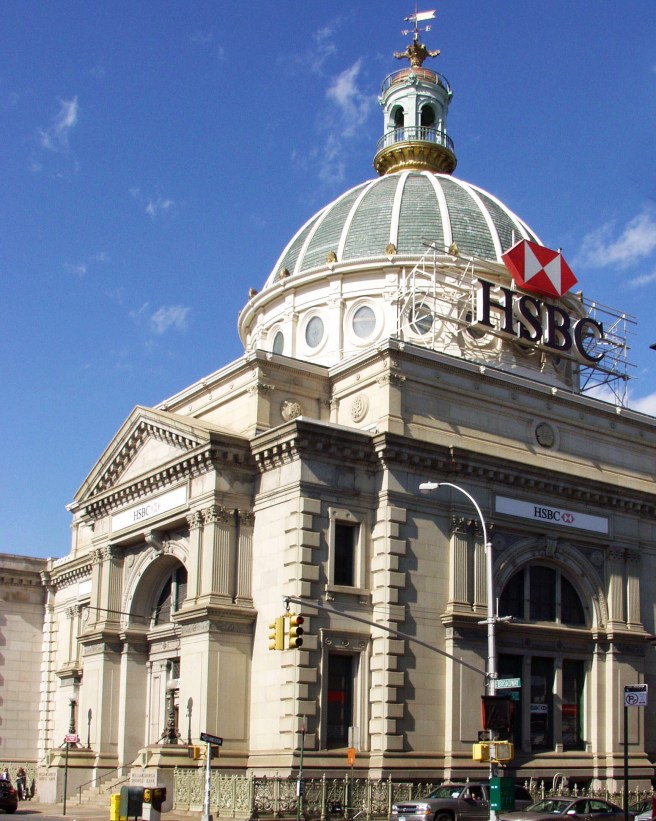
George Post, Williamsburgh Savings Bank, Brooklyn, 1870-5. Dome stenciling by Peter B. Wight. (Online photograph by Mitch Waxman)
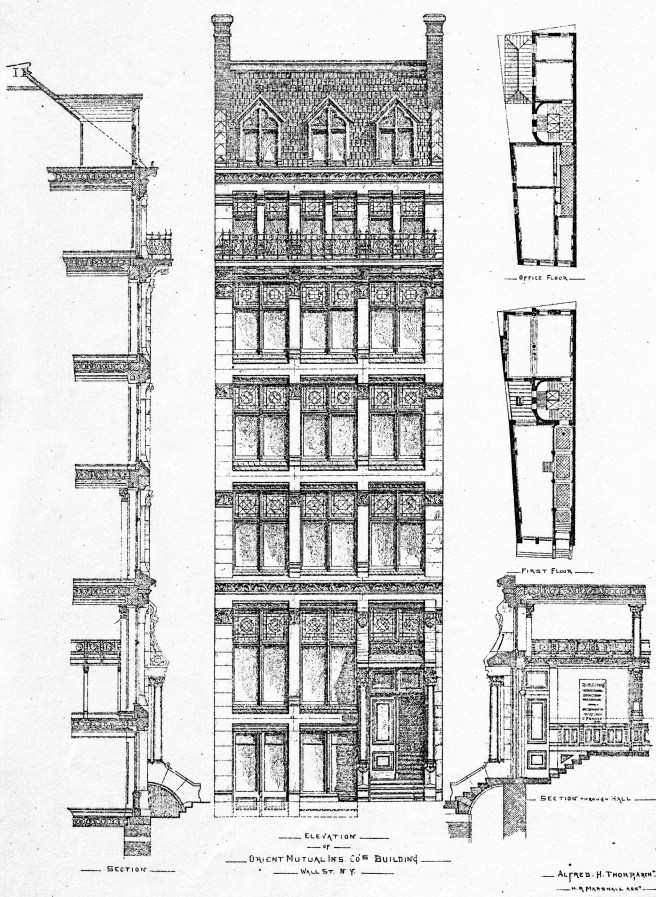
Wight continued to improve his system, patenting (#191,622) on June 5, 1877, an improved system for connecting the casings to the column. This was apparently first used in the Orient Mutual Insurance Building in New York, designed by Alfred H. Thorp in 1877. The building was said to have been completely fireproofed, using iron beams and Wight’s columns.
Alfred H. Thorp, Oriet Mutual Insurance Building, New York, 1877. (American Architect, March 2, 1878)
The building marked Wight’s penetration into the East Coast market and return to his former hometown as a fireproofing contractor. Here he would find not just competing products made by New York manufacturers, but also outright opposition to the use of all iron columns in building, including those “protected” by his clay tile casings. First, let’s review the development of fireproofing techniques for iron structures in the East.
3.15. THE STATE OF FIRECLAY TILE FIREPROOFING ON THE EAST COAST
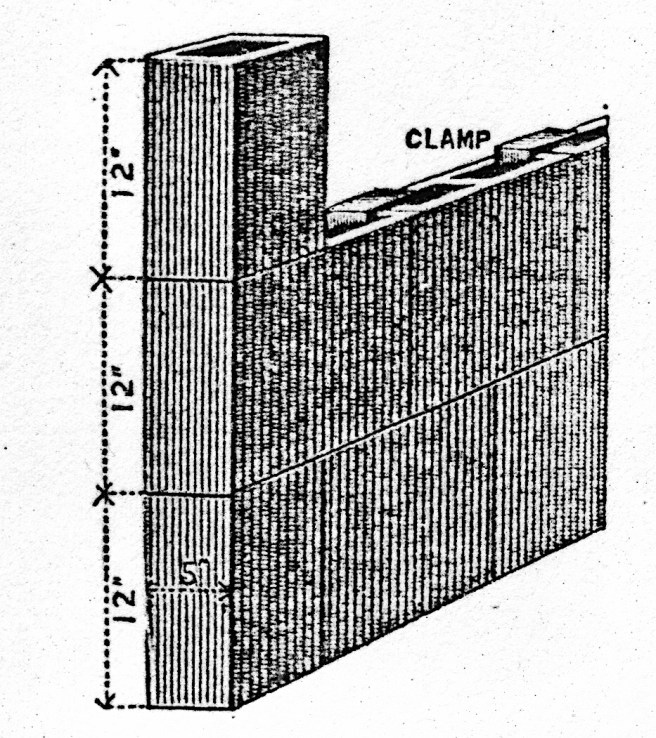
George H. Johnson, Patented Hollow Tile System for Grain Bins, 1869. Note the terracotta clamp tying two blocks together for added strength. These were covered over by the next course. (Brickbuilder, September 1897)
While Wight and Loring, inspired by the pioneering efforts of George Johnson, were refining their systems for fireproofing wood and iron structures in Chicago in the 1870s, Eastern manufacturers were on parallel courses towards the same ends. Therefore, it is appropriate to go back in time in New York to Johnson’s patent of a clay tile flooring system of March 21, 1871, and follow the parallel development of terra cotta fireproofing in New York. (As this is a blog rather than a paper book, I can repeat the needed images I have already used.) Johnson had already patented (#87,679) on March 7, 1869, a system of hollow fireclay tile blocks that was used to construct either round or square fireproof grain bins in the elevators.
Although Johnson held the patent, he needed expertise in the manufacturing of fireclay products. My research points to Johnson collaborating with New York’s leading fireclay producer, Balthasar Kreischer. Kreischer (1813-86) had been born in 1813 in Bavaria to a father who was a brickmaker. Following the 1835 New York fire, the twenty-two year old immigrated to the U.S. in hopes of finding work with his talents. Within ten years he had uncovered beds of clay needed to make fireclay for baker’s ovens and bricks to line fireplaces. There was no one more able in New York in 1869 to produce Johnson’s newly-patented clay tiles than Kreischer.
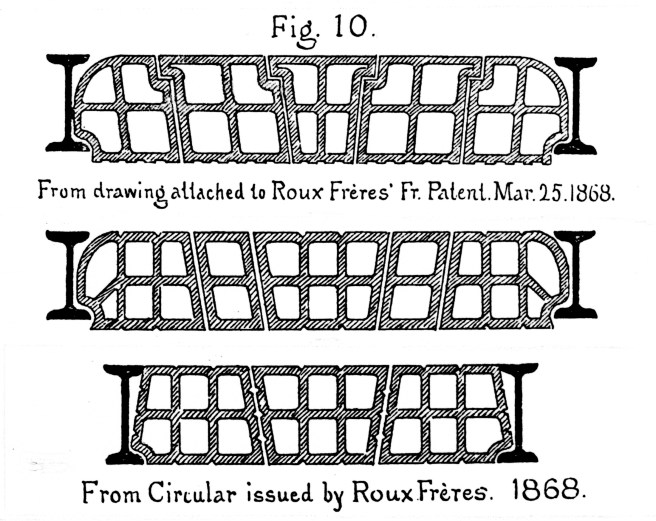
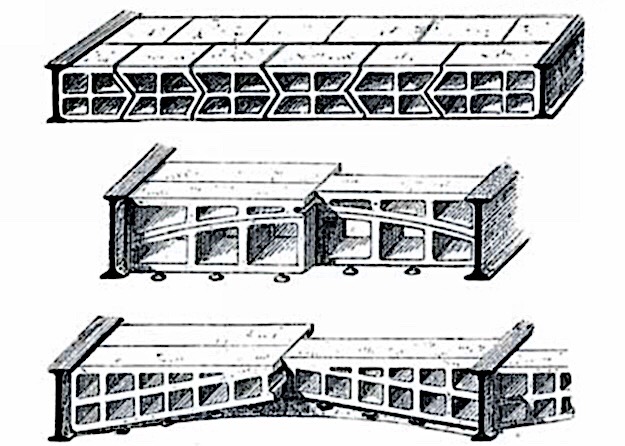
French Segmental Flat-arch Tile Floor Systems, 1868. (Brickbuilder, April 1897)
Stimulated by his interest in such systems, Johnson apparently had traveled to Paris in 1870, just prior to the start of hostilities with Prussia, to study the latest developments in fireproof floor construction. Johnson coupled this new information with Kreischer’s experience of clay manufacturing to address the problem of fireproofed floors. The two had patented (#112,926) a hollow tile floor system on March 21, 1871.
George H. Johnson and Balthazar Kreischer, Patented Hollow Floor Tile, New York, 1871. Note the piece rendered as wood dovetailed under the lower flanges. (Brickbuilder, April 1897)
Johnson and Kreischer’s system consisted of a monolithic terra cotta piece or pot that spanned between two beams. The monolithic nature of the design is curious in that the majority of patented French systems that Johnson would have seen during his trip, incorporated segmented arches and had been in existence at least five years prior to his trip. The story becomes then becomes suspicious as Kreischer returned to the Patent Office later that same day and patented (#112,930) without Johnson the same system, except that it incorporated a three-piece segmental arch.
Balthazar Kreischer, Patented Hollow Floor Tile, New York, 1871. The only difference with the Johnson/Kreischer patent of the same day is the segmental nature of the system. (Brickbuilder, April 1897)
We then followed Johnson who moved to Chicago either before or following the 1871 fire, where during the following year he had developed a segmental system of voussoir-shaped tiles similar to the French systems as well as Kreischer’s patented system. These were 9″ deep and formed with side angles of 18° and first used by Van Osdel in the post-fire Kendall Building, making the this the first use of segmented-arch floor tiles that I have be able to find in the U.S. As Van Osdel and Sanford Loring enjoyed a close personal relationship and that Chicago Terra-Cotta, because of its location had not been harmed by the fire, it is probable that Loring produced all of Johnson’s hollow tile units for the Kendall Building. Unfortunately, this system was viewed at the time in Chicago to be overly-expensive and never caught on. Then the 1873 Crash forced Johnson to return to his native New York City. Nonetheless, his influence on Wight and Loring’s later developments cannot be denied, and I wonder if Johnson was happy or not about their work going around his patents. A point we will return to later.
George H. Johnson, Hollow Floor Tiles for the Kendall Building, Chicago, 1872. In a 1897 article, Wight showed this Kreischer-patented system produced by HHC to be similar to those used in the Kendall Building. (Inland Architect, April 1892)
What did Johnson find when he returned to New York after his two years in Chicago? We are fortunate for the research of historian Sara Wermiel that has documented New York’s early history of this industry. Following Johnson’s move to Chicago, Kreischer, licensed his second patent in 1872 to two men experienced with iron construction: Wilson Haven who had worked for both Bogardus and Badger before taking a position with the Novelty Works in Brooklyn, where he met draftsman John Heuvelman. Novelty Works fell into bankruptcy and the two formed a new company, Heuvelman, Haven & Company (HHC) that Kreischer licenced to produce hollow tile segmental arched floors (see illustration above) based on his patent. These were first used in late 1873 in the new U.S. Post Office designed by the Department of the Treasury’s architect, A. B. Mullett.
French Segmental Flat-Arch Tile Floor Systems Exhibited at the 1867 Paris World’s Fair. (Wermiel, Beckwith)
The other pioneer New York company was the Fire-Proof Building Company (FBC), formed by two brothers, Leonard and Arthur Beckwith. Although born in the U.S., their father’s business had taken the family to France where the two brothers had graduated with engineering degrees from the École Central des Arts and Manufactures (the same school from which Jenney had graduated ten years earlier) in 1868. While they were enrolled, they attended the 1867 Paris’ Exposition Universelle, for which their father was the U.S. Commissioner General. They were able to study the Fair’s construction exhibits that showcased the latest French flooring systems that augmented their education about such systems they had received at the École.
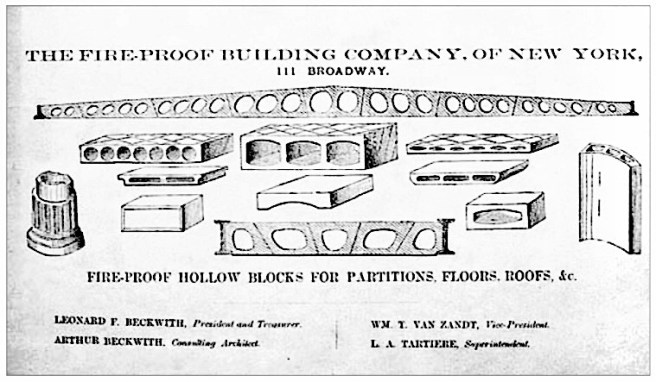
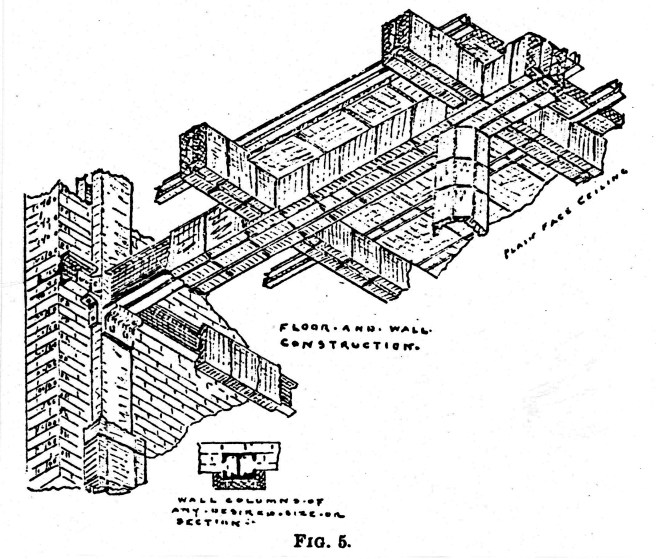
Fire-Proof Building Company, 1874 Advertisement Showing the Variety of Products Produced. (Wermiel, Beckwith)
Leonard had become an expert in the French concrete system of Françoise Coignet, therefore, their initial fireproofing products included both those made with fireclay and those made with concrete. Wermiel documented that this was not modern concrete made with Portland cement, but with hydraulic lime of Teil, that they imported from France. They began to contract to make these products in 1872 and formally incorporated the FBC in 1873. To promote their new products, they held a test fire of a house made with walls of their concrete blocks and with their ceiling tiles covering wood joists. (Note: this occurred a year before Wight had run a similar test of his wood gore column casings.) After being allowed to burn for an hour, the fire was extinguished to also test the blocks ability to resist the pressure of the water and the resulting temperature change (contraction). The house survived and the test received favorable publicity.
Richard Morris Hunt, New York Tribune Building as constructed, New York, 1873. (Online)
One architect who took note was Richard Morris Hunt, who at this time had the commission for the New YorkTribunebuilding. (Here is where we pick up the story of its interior construction from where we left it in Section 3.4.) Hunt, having been educated at Paris’ École des Beaux-Arts, would have appreciated the “French connection” of the Beckwiths. I noted the jarring contrast between the building’s gravity structure of solid masonry walls (5’ 2” thick) at the bottom) and the FRC’s latest technology of its lightweight fireclay block floors. I must assume that the floor tiles used looked like those shown in the center of this 1874 FBC pamphlet.
George Post, Williamsburgh Savings Bank, Brooklyn, 1870-5. (Online)
The fire demonstration must have gotten George Post’s attention as well as he specified FBC’s curved tiles to span between the curved beams in the Williamsburg Savings Bank in Brooklyn that he designed in 1873. This was the same building, in fact the same dome, for which Peter Wight designed the interior ornamentation that I described in Volume 2, Section 2.7.
Peter B. Wight, Decoration for Dome, Williamsburgh Savings Bank, Brooklyn, 1873. Pencil and gouache on paper. (Landau, P.B. Wight)
The competition, in which both Post and Wight were invited, for this building was held in 1869. This was two years before Wight moved to Chicago. With Wight’s brother-in-law sitting on the bank’s board, the two made a deal that whoever won would employ the other in completing the project. Post’s early Neo-Renaissance design was chosen the winner and, therefore, he contracted Wight to design the interior. This was in early 1870 when Wight was still in New York, but the project dragged on for three years until construction of the interior began in 1874. If you are anticipating my line-of-thought, 1874 was the year of the second Chicago fire, after which Wight patented his system of wood pieces to fireproof an iron column on September 8, 1874.
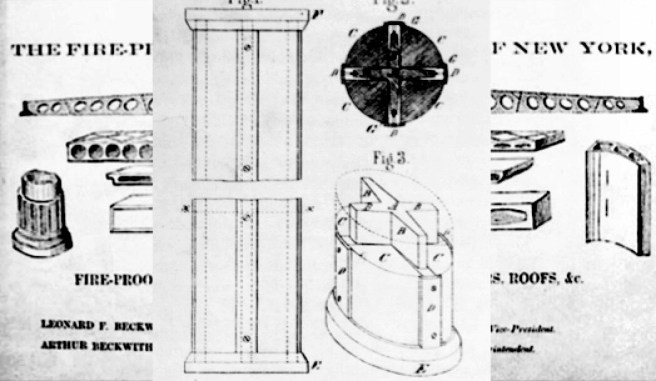
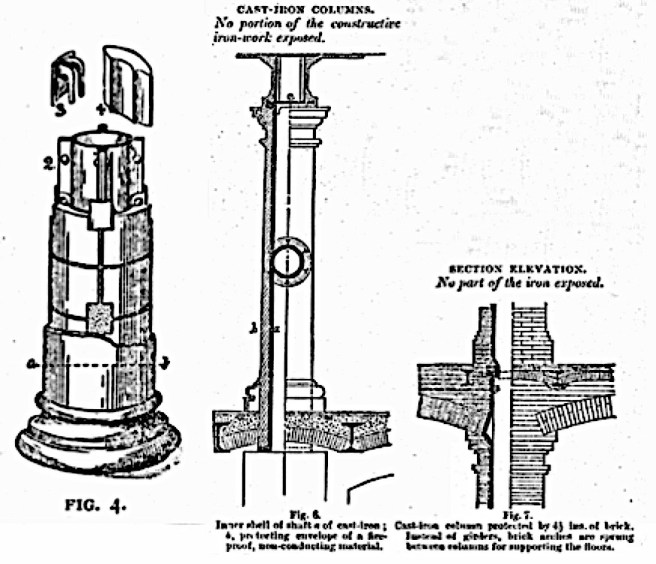
P. B. Wight’s 1874 Patent Drawing Overlaid (middle) on the FBC’s 1874 Poster. Compare his detailing vs. the two iron column fireproofing drawings at either side. (Landau, P.B. Wight; Wermiel, Beckwith)
By this date (Landau says Wight did the designs in 1873) he must have been working on the details for the inside of the bank’s dome that was to be constructed with FBC’s concrete blocks. This begs the question for some researcher in the future to answer: looking at FBC’s 1874 pamphlet, one sees a system of curved concrete blocks obviously designed to fireproof an cylindrical iron column. So which detail came first?
FURTHER READING:
Landau, Sarah B. George B. Post, Architect. New York: Monacelli Press, 1998.
Landau, Sarah Bradford. P.B.Wight: Architect, Contractor, and Critic: 1835-1925. Chicago: The Art Institute of Chicago, 1981.
Wermiel, Sara E. “Léonard & Arthur Beckwith: deux Centraliens dans l’Amérique du XIX siècle,” Centraliens no. 627 (Juillet 2013), pp. 53-60. (www.centraliens.net)
Wermiel, Sara E. The Fireproof Building: Technology and Public Safety in the Nineteenth-Century American City. Baltimore: John Hopkins University Press, 2000.
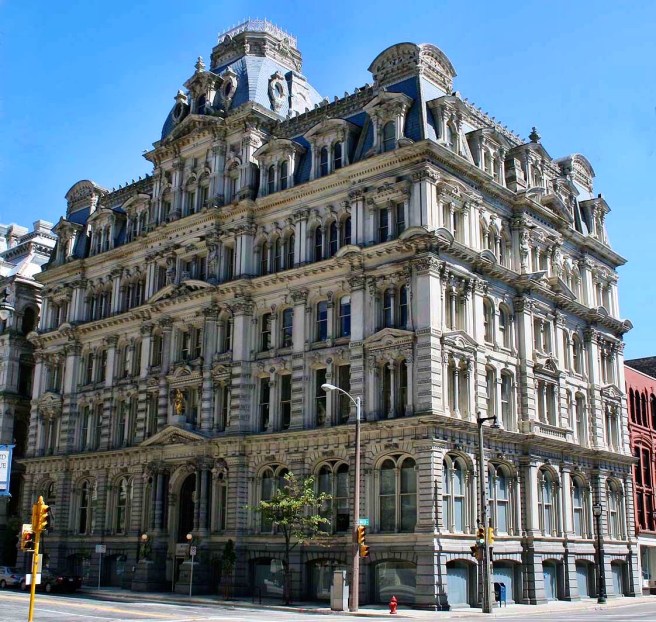
E. Townsend Mix with Peter B. Wight, Milwaukee Chamber of Commerce Building (the Mackey Building), Milwaukee, southwest corner of E. Michigan and N. Broadway Streets, 1879. Immediately to its right is the earlier Mitchell Building. (Online)
In the Spring of 1879, Milwaukee architect E. Townsend Mix and Wight produced a second totally fire-proofed building in Milwaukee for Alexander Mitchell, the Milwaukee of Commerce at the southwest corner of E. Michigan and N. Broadway, adjacent to the Mitchell Building. Mix reflected the mood of the period in wanting something other than the Second Empire with an eclectic design that included a central tower, á la what Post and Hunt had recently produced in New York, that seems to have taken much of its inspiration from the towers in Siena’s Palazzo Pubblico and Florence’s Palazzo Vecchio.
Mitchell’s Chicago, Milwaukee, & St. Paul had succeeded in making Milwaukee an early grain-trading center. A major activity of the Chamber of Commerce was the grain exchange that the new building was to house. Its three-story Exchange room contained an octagonal trading pit, so configured to give better access and vision to the traders.
E. Townsend Mix, Milwaukee Chamber of Commerce Building, Plan. (American Architect, Jan. 1, 1881)
The columns in the Chamber of Commerce were similar to those used two years earlier in the Mitchell Building, except that they either had six flanges or were five-flanged Phoenix columns.
Peter B. Wight, Fireproofed Iron Columns for Milwaukee Chamber of Commerce Building, Milwaukee, 1879. Left: A system similar to that used with four-sided Phoenix columns. (Brickbuilder, August 1897); Right: The system used in the Milwaukee Chamber of Commerce. (American Architect, July 6, 1878)
In addition to the columns and floors, Wight, also for the first time, encased the iron roof trusses in Loring’s porous terra cotta tiles.
Sanford E. Loring, Terra Cotta Tile Fireproofing, Chicago, 1874-79. This was similar to the tiles Wight used to protect the iron trusses in the MIlwaukee Chamber of Commerce. (Building, December 17, 1887)
E.S. Jennison, Post-fire Field & Leiter Store (Singer Building), Chicago, northeast corner State and Washington, 1872. Left: as designed. (Land Owner, 1873); Right: as built without mansard roof. (Online)
If having to replace the interior structure of its wholesale store wasn’t enough, Field & Leiter’s retail store on State Street caught fire on November 14, 1877. (See Sec. 1.6) The fire was a grim reminder that even six years after the 1871 fire not much had changed in Chicago’s construction for the better. The five-story Singer Building designed by E.S. Jennison in 1872 that housed its retail operations caught fire in its wooden double-roof. Jennison had designed a six-story Second Empire palace, including mansard roof, but at the last moment Field and Leiter cancelled the construction of the mansard (as was done in a number of post-fire buildings, such as the Kendall Block). The sixth floor structure had already been erected and it was decided to simply construct a sloping flat wood roof, covered with tin over the wood-planked sixth floor. The cavity between these two wooden surfaces varied in depth from 6′ to a few inches, a firefighter’s nightmare just waiting to happen.
Once again, the building had been typical for the post-fire period in that while it was well protected on the outside and roof, the interior structure consisted of cast iron columns and plaster-covered timber beams. The building, in fact, was better protected than most, with two iron water tanks under the roof that fed standpipes located throughout the building. Unfortunately, this happened to be one of the major problems in the fire, that apparently started in the space in between the roof and the cover sixth floor, because one of the tanks that was sitting on the timber beams, gave way and crushed through the wooden stairs to the basement, killing six firemen and injuring several more. The spread of the fire downward was facilitated by three open-shaft elevators within the building. From the historical record, it appears that Field & Leiter during its first ten years of business was not as lucky with its buildings as it was with its business. Similar to how they reacted to the 1871 fire, Field & Leiter had swiftly managed to find temporary space, this time in the Exposition Building on Michigan Avenue as its interim home, opening for business in two weeks’ time on November 27.
Characteristically, City Council showed little concern over the problem. Instead of addressing the danger of the continued use of wooden Mansard roofs, Council passed an ordinance that required:
“All buildings except such as are used for private residences exclusively, of four or more stories in height, shall be provided with one or more metallic ladders or metallic fire escapes extending from the sidewalk to the upper stories of such buildings and on the outer walls thereof.”
Once again, it was the Insurance Companies that made a positive attempt to improve construction. On January 16, 1878 Alfred Wright, the Secretary of the Chicago Board of Underwriters, issued the following:
“In view of the disasters which have resulted from the location of water-tanks in the upper stories of buildings where fires have occurred, and with the conviction that similar or still more calamitous consequences are likely to follow where such destructive agencies are permitted to exist, this board is forced to insist upon the observance of the following stipulations in their construction and arrangement: All water tanks, if constructed of wood, must be open at the top; if of metal or of other material than wood, they shall rest upon a foundation of brick, or some walls of solid masonry, or upon heavy iron girders, both ends of which shall rest upon solid brick or stone walls. On all buildings (with their contents) having water-tanks not constructed in conformity with above standard, a charge of not less than 10 cents per $100 will be added to the basic rate. This action shall take effect from this day; but on any building now provided with tanks not conforming to above requirements, if altered and constructed in compliance therewith before March 1, 1878, this charge of 10 cents will be rebated.”
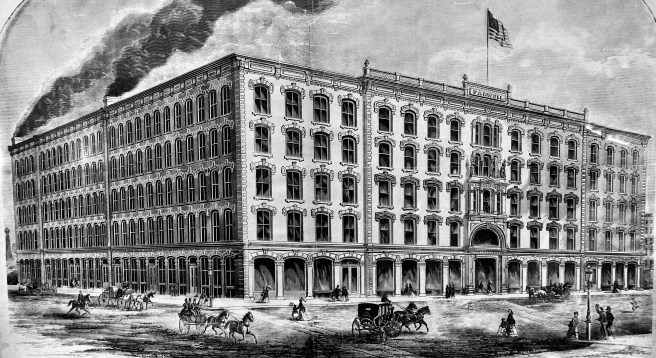
However, the Singer Building’s fire may have been a blessing in disguise. A post-fire investigation discovered that of the wooden members that had survived, most were dry-rotted almost to the point of collapse, not an unusual problem in this period, as was discussed in the previous post. It had been originally planned to repair the upper two floors gutted by the fire, but with the finding of dry-rot, the entire interior was demolished. Singer commissioned New York architect James Van Dyke to redesign the building using the surviving walls and requiring the addition of the mansarded sixth floor, ostensibly to make a building for Field & Leiter that would be as tall as Shillito’s new store in Cincinnati. The internal structure was completely framed in iron, fireproofed with non-combustible materials. One would assume that these were the products of Wight and Loring. The American Architect’s “Chicago Correspondent” was quick to report on the incorporation of a complete iron structure in the new Singer Building:
“The prospect of its (iron framing) extensive use in the future, coupled with the recent discovery of its weakness as a fire-resister, points with greater force than ever to the importance of adopting safe methods of constructing fire-resisting ceilings under the beams.”
James Van Dyke, rebuilt Field & Leiter Store, Chicago, 1878. (Wade and Meyer, Chicago)
View north up State Street showing the Field & Leiter Store taken sometimes during the 1880s (the Masonic Temple-1890 is not yet constructed on the adjacent block while the tower of the Central Music Hall-1879 is visible). (Online)
Field and Leiter had agreed amongst themselves that they would buy the building and the corner lot from Singer for $500,000, but Singer was asking $700,000. Field was in New York at a critical point in the negotiations when Singer broached the higher price to Leiter who, known for his quick temper, refused the offer. Singer immediately turned around and offered the building to their competitors, Carson, Pirie, Scott for an annual lease of $70,000 that they took on the spot. Singer had snookered them and they knew it. Not wanting to lose the prized corner on State Street, the two partners belatedly bought the building for the original $700,000 with their personal funds and leased it back to the company. They also had to throw in an extra $100,000 to compensate Carson’s for cancelling its lease. Marshall Field had a long memory…
FURTHER READING:
Twyman, Robert W. History of Marshall Field & Co. 1852-1906. Philadelphia: University of Pennsylvania Press, 1954.
I’d like to thank Brian Kelly of “brianbrands.com” for offering his knowledge of the Field/Leiter relationship.
The “Chicago Correspondent” continued to champion the search for better fireproofed-iron construction. Only a month later he wrote:
“As in 1872, with the experience of a great disaster before us, the thoughts of many were turned towards providing against the contingency of its recurrence, so now, with the news coming in from every quarter, of death-dealing and property-destroying conflagrations, the subject is being agitated in Chicago and the west with renewed vigor….But beyond the erection of thick walls but few improvements calculated to guard against fire have been adopted until recently. Several buildings with iron floor-beams, which were supposed to be fire-proof, were erected after the great fire; but none of them show any advances upon heretofore well-known methods which are now known to be anything but fire-proof, for the particular reason that the necessity for protecting the constructive iron-work has not been recognized.”
As the 1874 fire had motivated Wight to investigate the protection of iron columns and correspondingly invent his system of wood and later terra cotta encased columns, so it seems that the Singer Building fire had moved Wight to solve the problem of fireproofing wooden floors. While he was writing the last two articles, Wight was busy at work perfecting a system of terra cotta ceiling tiles for fireproofing either wood or iron floor structures. What seems odd to me, however, is that by this date nowhere is there any evidence that prior to 1880 that Wight had any interest in using the flat segmental tile arch system for floors patented by Johnson back in 1871. In essence, the “Chicago Correspondent” was creating an awareness of the problem and a corresponding need for Wight’s new system of ceiling tiles that was patented on April 16, 1878, only three weeks after the publication of the second article. (Note that in 1878, seven years after the 1871 fire, Chicago was still building commercial buildings with wood floor joists!)
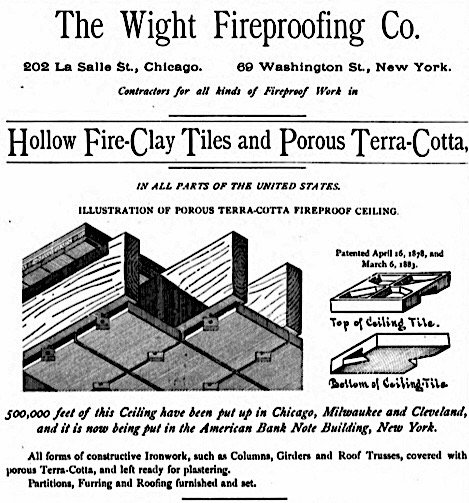
Peter B. Wight, Porous Terra-Cotta Tile System for Fireproofing Wood Floors. (Inland Architect, February 1885)
Field and Leiter Wholesale Store, Chicago, northeast corner of Madison and Market (N. Wacker), 1872. (The Land Owner, February 1872)
If we recall the hurried rush in which Chicago’s buildings were rebuilt after the 1871 fire, incorporating green lumber brought into the city straight from the forests in Michigan and Wisconsin, that was in many buildings made “fireproof” with a coating of plaster, we should then expect a corresponding onset of dry-rot in this wood within a few years. The timing of the development of Drake and Wight’s column could not have been more propitious, for the summer of 1876 marked just such a crisis in Chicago of considerable proportions. While the use of green lumber by itself posed no direct problem, however, when one hermetically seals such wood with paint, varnish, or plaster, fungi within the wood that can chemically deteriorate the wood cells, are allowed to multiply and attack the wood because of the moisture within the wood’s cells that the fungi needs to survive, is not allowed to naturally escape the piece of wood, thereby setting off the necessary chemical reaction. The cheapest way in which to fireproof wood immediately after the fire was to encase the wood members in a thick coat of lath and plaster. But this assumed the wood had been at least air-dried. This construction had been somewhat promoted at a nationwide level, beginning with the 1871 A.I.A. National Convention following the Chicago fire. Only four years after the fire, however, a problem began to manifest itself in the mysterious failures of all types of post-fire buildings. This was not caused by what some historians have labeled “post-fire flimsy construction,” but by the formation of dry rot in the hermetically sealed wood. The plaster-encased wood had been an attempt to build not only a better building than had existed before the fire, but also one that was fireproofed. While the technique was less expensive than Johnson’s system of terra cotta floor tiles, it still required more capital than pre-fire construction and therefore, cannot be construed as either inferior or “flimsy.” This was not just limited to Chicago, but because of the greater number of buildings constructed there after the fire, was a problem of greater magnitude there than in other U.S. cities.
In the summer of 1876, two of Chicago’s larger, post-fire buildings were in the process of having their entire interior structures replaced because of dry-rot. Field and Leiter’s huge new five-story wholesale store at the northeast corner of Madison and Market (N. Wacker) had been considered a miracle when it was completed, for it took only 100 days to construct it. Green timber posts had been used throughout the six floors, including the basement. These were then finished with varnish and several layers of paint, hermetically sealing the new wood and assuring the onset of dry-rot. During 1876 the company was forced to replace the rotted members as quickly as they were discovered, but wooden posts continued to be used.
John M. Van Osdel, Farwell Block, Chicago, northern half block bounded by Market (S. Wacker), Monroe, and Franklin, 1872. (The Land Owner, May 1872)
Field and Leiter’s major competitor, J.V. Farwell and Co. suffered no less in the newest section of their large post-fire building at the northeast corner of Monroe and Market (S. Wacker). Here the wooden columns and girders had been encased in plaster as an attempt to fireproof the structure. The girders had so quickly decayed within three years that the posts, which were not continuous but beared instead upon the tops of the girders, were able to crush through the rotted girders, causing isolated failures among the floors, sometimes without warning. The entire interior wood structure of the new addition was replaced in 1876 with continuous iron columns that supported timber girders.
Throughout 1877, buildings across the country, especially in Chicago, were collapsing without warning, causing much concern among owners as well as the general public. An editorial in The American Architect decried the situation:
“In the propositions for casing wooden beams in stucco and the like, we have not much faith. If the wood is embedded in them we invite dry-rot, and our floors are likely to come down some day as did certain warehouse floors in New York lately, without warning. Whether imbedded or not we know of but one available material to cover them, –terra-cotta– which is not friable under heat, and which might not be expected to shatter and fall away if exposed to a fire hot enough and long-continued enough to endanger an iron beam; and we doubt if even terra-cotta could be made secure under such circumstances. All such materials make floors extremely heavy, and so are likely to increase the cost of them to the degree that it seems better to go farther in search of a less equivocal security.”
The editorial also suggested a major shift in the prevalent fireproofing strategy:
“It is not so easy, it is true, to make our houses impregnable against such fires as swept Boston and Chicago; but if our city laws insisted on the fire-proof building that can be done, such fires would never occur. Where no building burns from within, we may be sure that none will take fire from without.”
In the face of the emphasis on strong exterior masonry walls and solid roofs, this shift of emphasis once again to the interior is extremely significant. Before the heavy fireproof masonry walls and window shutters could be stripped from a highrise building and replaced with a light-weight curtain wall of terra cotta and glass, a city building’s stock would have had to have been made relatively incombustible, making the extensive exterior protection unnecessary. This was to be accomplished only by the total elimination of wood structures, which in Chicago was still eight long years beyond the editorial.
Undoubtedly, the dry rot problem had thrust Drake and Wight’s fireproofed iron column into the limelight, as wood columns were no longer viewed as more acceptable than iron columns since the cheap coating of plaster as fireproofing was no longer viable. The “Chicago Correspondent” of The American Architect was quick to report on the problem:
“It may be of interest to note, with reference to the prevalence of dry-rot in a building only five years old, that the internal construction of the old building was of iron columns and double girders…This system of floor construction in wide stores has been extensively practised in this city, and has failed in many instances through the prevalence of dry-rot…The extent of decay in timber has doubtless been aggravated by the extensive use of green timber during the days of hurried building. Altogether it is a strong argument in favor of the use of iron, which is now cheaper than ever before, and within the reach of many who could not have employed it a few years ago.”
(Note that the lengthy depression of 1873-9 had begun to affect the price of materials, especially iron which made it even more competitive with wood.)
E. Townsend Mix with Peter B. Wight, Mitchell Building, Milwaukee, southeast corner of E. Michigan and N. Water Streets, 1875. (Online)
The first building that employed both Wight’s fireproof columns as well as Loring’s porous terra cotta hollow tile floor arches, therefore being the first building in the U.S. that was totally fireproofed with porous terra cotta was not in Chicago, but in Milwaukee. Milwaukee architect E. Townsend Mix was born in New Haven, CT, and had worked for a brief period with Richard Upjohn in New York. In 1855 he moved to Chicago where he partnered with W.W. Boyington. He was supervising a firm’s project in Milwaukee in 1856 when he had decided to set up his own practice there. Mix, who had previously worked with Wight in 1873 on the Immanuel Presbyterian Church in Milwaukee, invited Wight in 1875 to work with him on an office building he was designing in Milwaukee for Alexander Mitchell to house the two companies that Mitchell was president of: the Wisconsin Marine and Fire Insurance Company Bank and the Chicago, Milwaukee and St. Paul Railroad.
3.8. ALEXANDER MITCHELL: MILWAUKEE’S WILLIAM OGDEN
For all practical purposes, Alexander Mitchell was the William B. Ogden of Milwaukee. I have so far kept Milwaukee’s competition with Chicago for the economic hegemony in the region in the background, but, obviously, can no longer do so. Geography had blessed Milwaukee with a harbor and river that was better than Chicago’s, but unfortunately for Milwaukee, its river ran north, and not west to the Mississippi, as did Chicago’s. Once the railroad had evened out any geographic natural advantages, however, Milwaukee could ship the grain of the NorthWest cheaper than could Chicago, simply because it was closer to the area of production, and it was also 100 miles farther north along the cost of Lake Michigan (shorter ship transit to the Atlantic). As early as 1847, then Milwaukee Mayor Bryon Kilbourn had understood this and had chartered the Milwaukee & Waukesha Railroad (whose name was changed in 1850 to reflect its ultimate goal, the Milwaukee & Mississippi), at the same time and for ostensibly the same purpose that Ogden had taken control over the bankrupt Galena & Chicago Union. Businessmen in both cities understood the stakes involved with this race.
Born in Scotland, Mitchell had been brought to Milwaukee in 1839 by the NorthWest’s pioneer financier, fellow Scotsman George Smith to assist in managing his investments, eventually inheriting the control of the vast bulk of these when Smith had decided to return to Britain in 1857. Smith had placed Mitchell in the presidency of his Wisconsin Marine and Fire Insurance Company in 1839, a position he would hold for the next 48 years, on his way to becoming Wisconsin’s richest man. (Mitchell’s grandson, Gen. Billy Mitchell, for whom the B-25 bomber was named, is thought by many historians to have been the father of the U.S. Air Force.) As had Ogden, Mitchell understood the potential of the railroad to enhance his personal wealth along with that of his hometown, especially by connecting it with the fertile areas in the NorthWest. In 1864, he became the president of the Milwaukee and St. Paul Railroad (that terminated at La Crosse), one of two Wisconsin routes that ran between Milwaukee and the Mississippi River. So while Ogden was busy building his Chicago & NorthWestern out of Chicago to Omaha, and going out his way to isolate Milwaukee in building his other line to St. Paul, Mitchell was essentially building Ogden’s main competition, except that Mitchell was building to Chicago, from Milwaukee, and had relied upon the good will and the tracks of the independent Chicago & Milwaukee for access into and out of Chicago. Once Ogden had sprung his hostile takeover of the Northwestern in 1864, (see Vol. 1) he wasted little time in also trying to shut-down any competition from Mitchell, by acquiring the Chicago & Milwaukee in 1866, thereby cutting Mitchell’s access to Chicago and forcing Mitchell to build his own line directly into Chicago. Mitchell, being every bit as clever and resourceful as Ogden, chartered the Chicago, Milwaukee, & St. Paul (what would eventually be known as “The Milwaukee Line”) in Illinois in 1872, probably taking advantage of the chaos caused by the fire, and proceeded to build his own tracks into Chicago, finding a permanent home in Union Station. Simply stated, over time, there would be no love lost between the NorthWestern and the Milwaukee Lines, as they moved their cars back and forth between Chicago and southern Wisconsin.
3.9. THE MITCHELL BUILDING
By 1876, in the depths of the depression, Mitchell had put his railroad on solid financial ground so that he could afford to erect a new, monumental building to house the company’s headquarters. Mix designed the Mitchell Building at the southeast corner of E. Michigan and N. Water Streets as a straightforward Second Empire palace, in the waning months of the style’s fashionability, complete with the requisite mansard roof and corner pavilions. He collaborated with Wight in fireproofing its ironwork by covering it with terra cotta, that Wight described in an 1878 article in American Architect:
“The dormers and chimneys, which are heavy, and rather crowded, are of stone; but all the ribs and crowning members of the roof which are of elaborate design and good detail, are of hard terra-cotta from Chicago Terra-Cotta Works. The entire roof is covered with porous tiles set between T-iron rafters, the slates and metal covering being secured directly by nails to the porous terra-cotta. All the iron columns throughout the interior are of the radiating web pattern, and made fire-proof by Wight’s process. The girders are enclosed with porous terra-cotta; and the spaces between the iron beams are filled by a system of brick arches and hollow tiles, which fully protects the beams, and affords a very light construction, said to not exceed 40 pounds per foot. This is the invention of Sanford E. Loring of the Chicago Terra-Cotta Works. It is of such nature, however as to require diagrams for a proper description. This is the first building in which it has been employed. All the small partitions are of hollow bricks.”
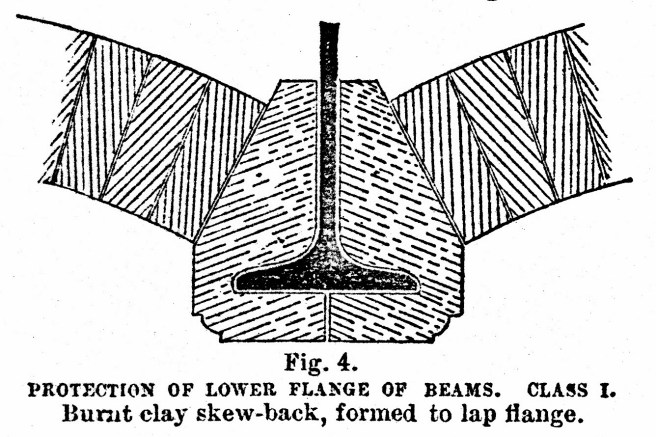
Sanford E. Loring, Porous Terra Cotta Encased Iron Beams, similar to those used in the Mictchell Building, Milwaukee, 1875. (Amercan Architect, June 29, 1878)
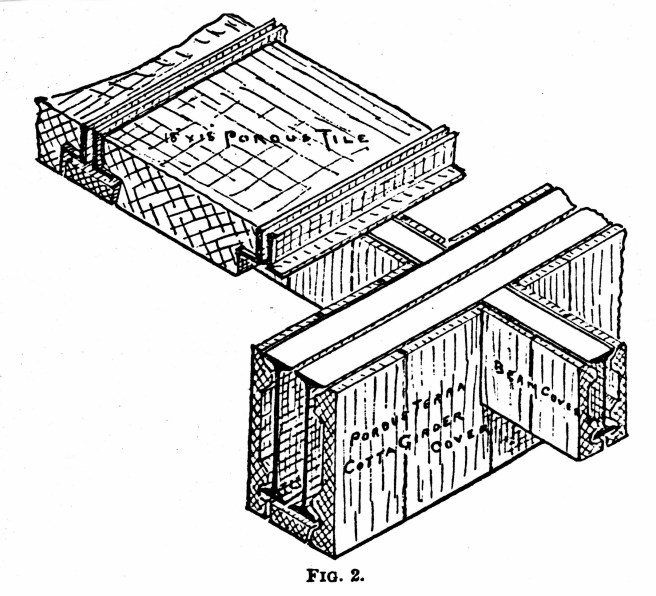
The beams were encased by two pieces of porous terra cotta that sat on the bottom flange of the beam, joined on the bottom of the flange by mortar. These formed skewbacks from which solid brick arches sprung at a spacing of two and a half feet. The void between the arches and the top flanges was covered with two, 2″ thick, cellular terra cotta panels that were two feet long and one foot wide. In this way Loring utilized his patented system of tiles, while avoiding infringing on Johnson’s patent. The girders posed a different problem than the beams in that their sides were not protected by the floor arch as the beams were. Therefore, Loring used three pieces of porous terra cotta to cover the girders. Two side pieces with straight exterior faces were molded to fit into the girder and bear upon the bottom flange. The bottom of the girder was protected by a piece that was bedded up against the iron and held in place by the side pieces with a dove-tall connection. The entire assembly was held in place with mortar. Wight, the “Chicago Correspondent” proudly stated that the building, which was occupied on February 1, 1878, was “The most costly private building erected in the West for many years, and is a monument to its owner.”
Sanford E. Loring, Porous Terra Cotta Encased Iron Girders, similar to those used in the Mitchell Building, (Building, December 17, 1887)
Treat and Foltz, Chicago Club House, Chicago, 1875. (Andreas, Chicago)
(You will find an Index of and links to earlier posts in the menu above. To read as a continuous narrative, use the links at the bottom of each post to continue to the next post. If you would like to receive an eMail or text when I have just posted a new segment, please click the Follow button at the right if on a computer or at the bottom of the Index page (above) if on a phone and enter your info.)
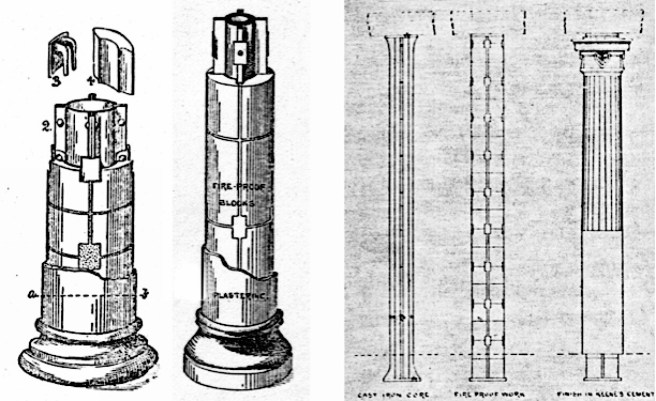
I can now pick up the story, where we left of in Volume 2, Section 4.7, of Peter Wight and his development of terra cotta fireproofing for iron columns, following the July 14, 1874, fire in Chicago and the corresponding subsequent cancellation of fire insurance policies in the business district. After his first successful test of the timber-encased iron columns on October 8, 1874, he had worked with Sanford Loring’s Chicago Terra-Cotta Company to revise the system from employing timber pieces to ones made of Loring’s porous terra cotta. Wight’s first terra cotta-encased columns were incorporated late in 1875 in the six-story Chicago Club Building at 12 E. Monroe Street, across the street from the Palmer House, designed by Treat & Foltz as Chicago’s first genteel retreat for the likes of Potter Palmer and Marshall Field. Four cast iron columns with the cruciform section were encased in one-foot long sections of porous terra cotta, which projected 1″ beyond the flanges and were covered with a smooth coat of Portland cement.
Peter B. Wight, Terra Cotta Fireproofed Iron Columns, Chicago, 1878. This was similar to the columns used in the Chicago Club House and the Mitchell Building (see next post), both built in 1875-76. The difference was the cross-section of the column, which was a cruciform rather than a cylinder with projecting flanges. (Brickbuilder, August 1897; Inland Architect, July 1892)
Wight did not rely on the mortar to bind the tiles to the column, for he was concerned that the tiles, when exposed to the heat of a fire, could break away from the column due to differential expansion lengthwise. Therefore, he mechanically attached the tiles to the columns with 2-1/2″ square wrought iron plates that were located in recesses cast in the tiles that were then screwed into the ends of the column flanges. The column capitals were made by Loring’s Chicago Terra-Cotta. These were first carved by its artist, James Legge, cut into two pieces, fired and finally set into place with Portland cement. The shafts of the column were finished with a skim coat of plaster, completing the assembly. The Chicago Club Building revealed the wide range of products that Loring was manufacturing in 1875. In addition to the column capitals, Legge also sculpted the ornamental statuary contained in the front facade. The gables of the portico and the roof were inlaid with highly sculpted majolica tiles. The walls of red Baltimore pressed brick were accented with black enameled bricks. The chimneys were constructed with molded terra cotta. All of these were the products of Chicago Terra-Cotta.
3.6. WIGHT USES THE NEW AMERICAN ARCHITECT TO PROMOTE HIS PRODUCTS.
During the completion of the Chicago Club Building, a new architectural magazine, The American Architect and Building News, had begun publication in Boston in January 1876. Essentially, much of its initial support was from the A.I.A. as a means for publishing the Institute’s business and the papers that were delivered at its Conventions. Due to Wight’s position within the Institute, he was the author of many articles in the first years of the weekly journal. Wight’s articles were either signed, as an expert on fireproof construction, or anonymous, as the magazine’s Chicago correspondent. Wight’s connection with the national magazine certainly enhanced Loring’s and Wight’s abilities to promote their products to the profession on a nationwide basis. This was quickly exploited in an article by the “Chicago Correspondent” on the new Chicago Club House:
“The inventors [of the columns, Drake and Wight] have been so well satisfied with the results as seen in these, that they are recommending the use of fire-clay and Portland cement for exterior coating in preference to wood.”
The American Architect and Building News, First Cover Page, January 1, 1876. (Online)
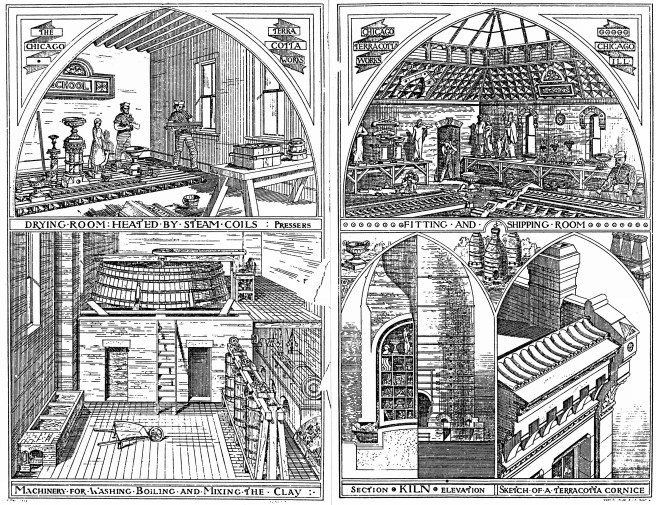
The national preeminence of the Chicago Terra-Cotta Works at this time was assured by an atypically lengthy two-page article, “The Manufacture of Terra-Cotta in Chicago,” published in the December 30, 1876, issue. It was probably written by Wight, Loring, and James Taylor, the company’s foreman. A complete description of the manufacturing process and facilities was accompanied by two pages of engravings that illustrated the various stages of the process. The article stated that the company had, since its founding, already produced over half a million dollars of work, located “from Salt Lake to Boston, and from Minnesota to Texas.” It also confirmed the fact that the company had transcended architectural ornamental terra cotta, and was producing “porous tiles for deafening or for ceilings and side-walls, porous blocks for fire-proof columns, and porous hollow bricks and flues.”
Illustrations of Chicago Terra-Cotta Works. (American Architect, December 30, 1876)















 The Architecture Professor